Categories
Previews

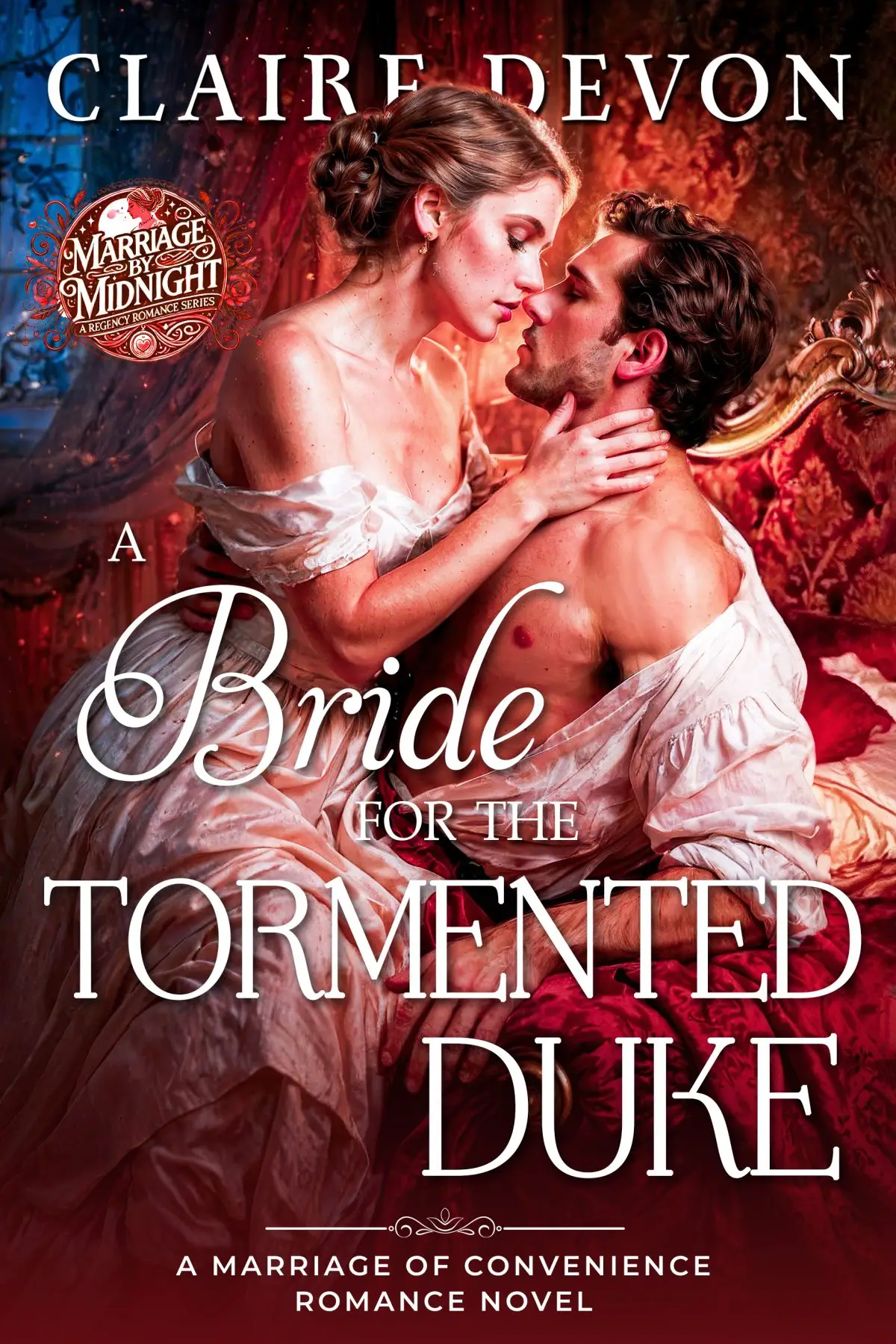
A Bride for the Tormented Duke Preview

Please Enjoy a Snippet of my Upcoming Novel!

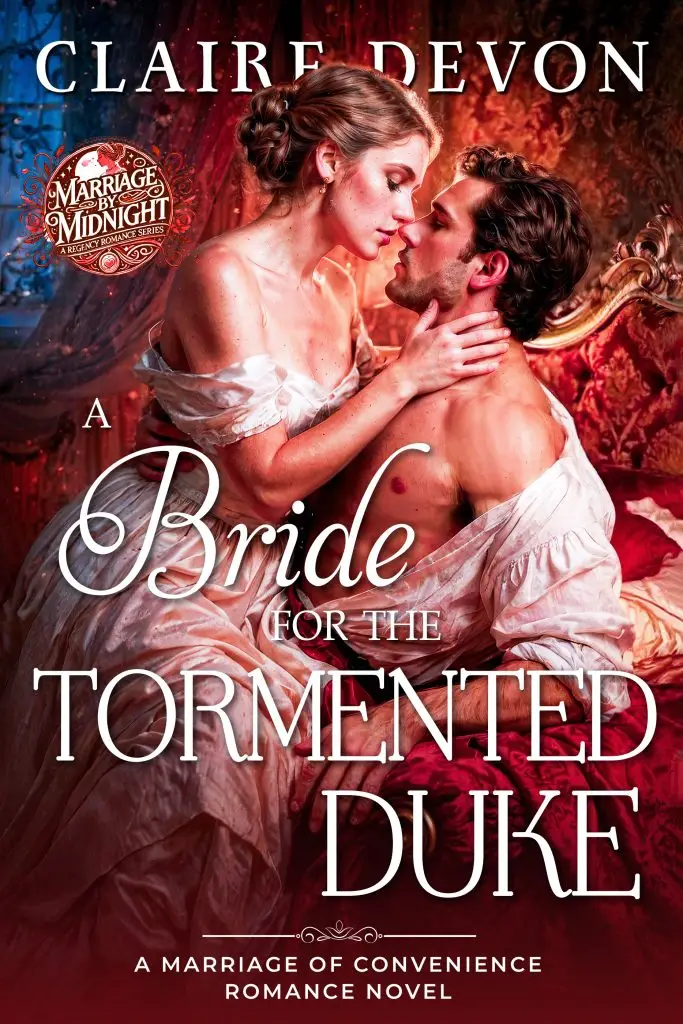
A Bride for the Tormented Duke

“Are you trying to tempt me into madness, little mouse?”


Miss Aurelia is desperate. Disgraced, dismissed, and nearly ruined, she has no prospects—until a strange old man makes a shocking proposal: marry the infamous, reclusive Duke Sebastian…


Duke Sebastian lives in isolation by a windswept lighthouse, haunted by tragedy and branded a murderer. No woman dares approach him—until Aurelia appears, desperate enough to accept his cold-blooded terms: marriage until she gives him an heir. Then, they part…

He doesn’t believe in love—he buried that with his late wife.

But his new wife is far from diplomatic as each stolen kiss breaks a new rule. And soon, the broken Duke must choose: let her go… or risk everything to keep her.

Chapter One

1814

London, Grosvenor Square

Aurelia hurried through the grand rooms of the house until she reached the duchess’s sitting room, a space that in ordinary cases might have been a peaceful area.

The duchess had never known peace. In another life, she might have been a general, standing stiff-backed before her army. In this household, she ruled with a rod of iron, and when Aurelia came upon her, she sat before the fire with her cane in one hand, her narrowed eyes fixed on the door.

Aurelia almost stumbled at the sight. She jumped to a halt and dipped into a curtsy. Her hands shook, and she buried them in her skirts.

“You summoned me, ma’am,” she managed in a shaking voice.

The duchess clacked her cane against the ground. “I did. Can you tell me what you have done to incur my wrath?”

“No, ma’am.”

Insolent!” The duchess rose, her eyes flashing fire. “Think again. What took place when my nephew visited?”

Aurelia’s stomach dropped into her shoes. Lord Redwood, the duchess’s nephew and the apple of her aging eye, had thought himself at liberty to grope and paw at her as though she were not his aunt’s companion but a lady of the night.

Aurelia had resisted, and evidently, he had run to his aunt with stories of how unobliging she was.

Hateful man.

She couldn’t say that, of course, so she merely cast her gaze at the floor. “I don’t understand what Your Grace is meaning.”

“Is that so?” The duchess clicked her tongue. “I’m disappointed in you, Miss Dufort. I had thought, after taking you in when your mother died, that you would treat my household with more respect.”

I—”

“Instead, you attempted to seduce Lord Redwood in my own home. Imagine my shock when he informed me of your betrayal. Attempting to ruin yourself in the hopes of his marrying you, no doubt. As though a man of my blood—and an earl, at that—would ever commit himself to a shameless hussy like you!”

A carriage clock ticked obnoxiously loudly on the mantelpiece, and Aurelia squeezed her jaw shut so tightly, it ached. If she called Lord Redwood out for his lies now, the duchess would never believe her.

So much for her home and mode of employment. She knew where this was going.

“But, Your Grace,” she tried, measuring each word, “I—”

“I will not hear your excuses!” She bashed her cane against the floor again, and Aurelia recoiled physically. The hard metal end had never been used on her, but there was always a first time. “If you cannot admit to it, then say nothing at all!”

All the indignities Aurelia had endured, all to secure a place in a prestigious household that would pay her a small amount and offer food and board. All this, and for the most basic securities. Aurelia wished she could throw it back in the duchess’s face—but if she did that, where would she go?

She had nowhere to go. No family to receive her, no home to retreat to.

And so, she cast her dignity to the wind as she fell to her knees and clasped her hands together. “I would never disrespect you in your own home, ma’am. Please believe me. I—”

“Stand up, girl.” The duchess huffed, her grip tightening on her cane. “You ought to have known better, given your position. If you had merely done what I asked of you and kept your head down, I would have allowed you to stay. But I will not countenance this.” She tapped her cane against the carpet. “You have an hour to collect your things and get out.”

Aurelia’s fingers trembled. “Please—”

Leave.”

Aurelia’s amenity to humiliating herself came to an abrupt end, and she rose, dusting off her skirts. No amount of begging would restore her position, so she gave up on the attempt.

“Yes, ma’am,” she said flatly. Then, because the duchess would never give her a good reference regardless, she added, “Your nephew is a boorish pig, and he has no right to attempt to seduce the help, then complain about her licentiousness when it fails miserably.” She bobbed an ironic curtsy and left the room, ignoring the duchess’s spluttering fury. Without looking back, she strode along the hallway, anger and determination alive in her chest.

She would find something else. When her mother and uncle had died, she had not despaired; she would not despair now.

A gentleman stepped in her way. Lord Redwood, leering down at her from his position of privilege. His hand snaked out to grip her elbow. “Scared, little mouse?”

Aurelia wrenched her arm free. Now that she had been dismissed, what did a little incivility hurt?

“Do not touch me,” she snapped, loudly enough for a passing footman to raise his head. If Lord Redwood were to force her, the footman would do nothing, but the servants would talk. Servants always did. “If you do, I’ll scratch your eyes, you see if I don’t.”

“Now then, Miss—”

Without waiting for him to say another word, she strode through a servants’ door and down through the servants’ quarters. To her relief, he didn’t follow, and she was left to gather what little remained of her dignity, along with the rest of her possessions, and leave.

***

A carpet bag under one arm, Aurelia made her way out of the servants’ door in the side of the house. The first thing she ought to do, with what little she had, was to place an advertisement in the paper. For a lady’s companion, perhaps. Or a governess. Perhaps there might already be a placement she could apply to—so long as the duchess didn’t poison the well against her.

That theory seemed hopeless.

As she made it to the main street, where the façade of the grand house stared down at her, a carriage came to a halt beside the front door. She spared it half a glance, noting the well-sprung, plain black carriage, bare of any coat of arms.

She would have paid as little attention to the older gentleman stepping out, too, had he not seen her and done a double take.

“Excuse me,” he called after her, glancing from her face to the grand house. “Are you by any chance Miss Dufort?”

Pausing, Aurelia took in his appearance. He was perhaps in his fifties, gray playing through his hair and a pair of spectacles perched firmly on his nose. Although he dressed well, it was obvious he was not of nobility.

She could not relax. What would any man want to do with her?

She hugged her carpet bag to her chest. “Who inquires?”

Immediately, he snapped to attention. He inclined his head, giving her a kindly, fatherly smile. “My name is Mr. Arnold, the solicitor to the Duke of Ravenhall. I came here to bid Her Grace to give me an interview with you, but I see I am fortunate enough to find you independently.”

“I no longer live in Her Grace’s household.” As of an hour ago, if that. Still, it was her reality. “Why do you care to speak with me? I have never met the Duke of Ravenhall.”

“No, indeed. Ah—” Mr. Arnold leaned into the carriage and retrieved a letter sealed with red wax and the unmistakable Ravenhall crest. “Would you be so polite as to accompany me?”

One glance at the seal dispelled any lingering suspicion. Although Aurelia had spent little time in fashionable London, through her time in the Duchess of Fenwick’s household, she had come to be aware of many members of the nobility.

The Duke of Ravenhall, she had never met personally, but she had seen correspondence bearing his seal. As a member of one of the oldest and most influential families of the ton, Aurelia knew the duchess had been trying to ingratiate herself with him some more.

“I assure you I mean you no harm,” Mr. Arnold coaxed when she still hesitated, staring at the letter as though it would bite her. “In fact, my proposition would change your fortune exceedingly.”

She raised her gaze to his face. “And what is your proposition?”

He smiled reassuringly at her, as though his smile alone could banish any fears she might have. And perhaps they might have done—the duke had chosen his solicitor well. The man was charming in a very understated, non-threatening way, and he exuded a sense of calm control. In a world where everything felt increasingly out of her control, Aurelia found herself wanting to believe he could fix all her problems with a magical wave of his wand.

Then he said the most ridiculous thing she had ever heard in her entire life.

“The duke proposes that you accept his hand in marriage and become his wife.”


Chapter Two

Aurelia gawked at Mr. Arnold in confusion and no little alarm.

Marry the Duke of Ravenhall?

She could almost have believed in an offer of being his mistress; after all, Lord Redwood had done his best to put his hands on her, and if news of that had gotten around, perhaps other lords might have thought her worthy of their grand attentions.

But marriage?

Er—I see you are shocked,” Mr. Arnold said gently, his offered hand faltering only just a little. “Come with me, and I will take you to my office where we can discuss the matter in greater detail. I also have correspondence from the duke confirming his wishes.”

“He wishes to marry me?” Her voice ended in a squeak.

“He does.”

“But—why?”

“He has his own reasons. Suffice to say, he is in need of a wife, and one for whom courting Society’s notice has no particular allure.”

“But why—”

“If you feel as though you could become his wife and provide him with an heir, then I can make the arrangements for a wedding to take place. In the meantime, of course, the duke would provide for your accommodation and everything else you require.”

Aurelia’s jaw hung wide.

It was as though an angel had fallen from the heavens and handed her everything she ever could have wanted, but she didn’t know how to trust in her mysterious benefactor.

He wanted her to be a duchess? The idea made no sense when there were plenty of other, far more eligible ladies in London.

Aurelia wavered only a heartbeat before finally accepting Mr. Arnold’s offered hand. Whatever this was, running from it would hardly improve matters.

He helped her into the carriage with brisk, professional ease, and the moment she settled onto the seat, they lurched forward. London blurred past the window, and with each turn of the wheels, she felt the odd, breathless sense that her life had stepped onto a path she had never planned—and couldn’t quite step off again.

“Ah,” Mr. Arnold piped suddenly. “Here we are.” The carriage came to a stop beside a smart building, a sign hanging from it. “If you come with me, Miss Dufort, then we can get everything sorted in a jiffy. That is, assuming you agree to the proposal and the conditions attached.”

“Conditions?” Aurelia shivered as she stepped into the cool spring air. Although the days had warmed with the sun, the nights were still cold, and evening fell quickly. Already, the sky was becoming obscured with thick, navy clouds. “And what happens to me if I refuse?”

“Why, nothing.” The solicitor gave her a kindly smile as he opened the door, ushering her inside. The entryway was narrow, but it opened out into what appeared to be a small saloon and an office affixed with a brass plaque titled Arnold. “In here, my dear. I know this must have come as quite a shock.”

Aurelia clutched her carpet bag to her side as she sat upon the seat offered and looked around. Mr. Arnold’s study looked like any other, with a bookshelf filled with large tomes and a collection of folders. His walnut desk dominated the space, and he sat on the other side of it, gesturing to the letter she still held in one hand.

“For your peace of mind, I recommend opening that,” he pointed out. “As you can see, it is a letter from the gentleman himself, outlining his intentions and verifying that his interest in this arrangement is legitimate. If, after reading that, you wish to proceed, there are a few things I would like to clarify and establish before the wedding takes place.”

It was a good thing Aurelia was sitting down, or her legs might have given way underneath her. With shaking fingers, she broke the seal and spread the paper.

Miss Dufort, the note ran.

I have been made aware that your circumstances may benefit from an advancement, which I would be pleased to offer in the form of my hand in marriage. If you are amenable, I would be eager to bring about this union as soon as possible. Mr. Arnold holds the details; I hope you will give this offer some consideration.

With regards,

Sebastian Hale, His Grace the Duke of Ravenhall

Aurelia blinked slowly. The letter came in and out of focus. With the duke’s own seal and words behind the offer, she could hardly dismiss it out of hand as being erroneous—yet what was he doing applying for her hand in marriage in this way?

What was he doing applying for her hand in marriage at all, in fact?

“He knows my circumstances are… less than ideal?” she asked numbly.

“Of course! He could not have known you were dismissed—I discovered that fact by chance today when I came to speak with you. But he knows in general of your situation. You see, I made him aware. It is my job and duty to know what occurs in London, and I take my duty seriously.”

“I—” She didn’t know what to say. “So you knew that I was the Duchess of Fenwick’s companion?”

“I did.”

“And, knowing that, you proposed the match to the duke?”

“I did.” He beamed with a ceremonious sort of pride and reached across the table to pat her hand. “The duke has his requirements, and I believe you will suit them well enough. And, if I may say so, I believe that your situation means you will be amenable to the match, even under these unusual circumstances.”

In other words, he knew she was desperate.

And that was the crux of the matter, wasn’t it? As bizarre as this situation was, she had no choice. If she didn’t agree, this same smiling man would gladly turn her out on the streets for another candidate, and she would be left to find her own way.

It was that or become the Duchess of Ravenhall.

How was that, really, a choice?

“If I accept…” she began slowly, “what would happen next?”

“Next, I would arrange for you to stay at a hotel with a maid. Grillon’s, perhaps, as would be befitting a duchess. You would have wedding clothes made up, a new wardrobe commissioned—all at the duke’s expense, of course—and the wedding would take place in a few days.”

Days?”

“With your consent, there is nothing to do but make the necessary arrangements.”

“Of course,” she murmured. What else was there to delay for? “And the… duke is amenable to marrying me, without ever having met me?”

“If he were not, he would not have agreed to this arrangement at all.” Mr. Arnold shuffled his papers and drew out a single sheet. There, printed neatly, was a contract. “You will sign this, agreeing to remain at the hotel and proceed with the marriage, and to tell no one about the unconventional method of your meeting and arrangement.” He tapped a space at the bottom for her signature. “You will not gossip. You will not betray his trust in any manner.”

Aurelia barely hesitated before signing the agreement. She would have a place to stay that she had not paid for. And what did it matter if the duke was, most likely, old with crooked teeth and bad breath? When a lady was out of options, she accepted even those that seemed unpalatable.

Her husband might be a tyrant, but he would offer her safety and security, two things that had been lacking since her uncle had died.

“There,” she said, putting down the pen with an oddly final clack. “I have agreed.”

Mr. Arnold smiled once more. “Then we may begin.”

***

Sebastian Hale, the Duke of Ravenhall, stood with his hands clasped behind his back as he stared out of his study window at the gale twisting the trees below. In the distance, the angry sea lashed at the cliffs. The weather reflected his mood, although what little reflected of his face in the glass did not show it.

He was not a man given to freely expressing his emotions.

A knock came behind him. He half turned. “Come in.”

“A letter, Your Grace,” Fellows, the butler announced, holding out a letter in an immaculate white glove. “It arrived express.”

With a grunt, Sebastian accepted the letter and ripped it open to reveal its contents. Three words, signed by his solicitor’s hand.

It is done.

Well then. She had agreed, and his life would change. No doubt for the worse, but he required an heir, and a wife would provide one. After…

Well, after she had done her duty, he could ship her off to one of his other small estates, and they could live separate lives. This Miss Dufort cared little for London Society, Mr. Arnold had assured him; she would be, therefore, content to live out her days far from the capital, and far from him.

“Prepare the bedroom adjoining mine,” he instructed, returning to gazing at the sea. “It will shortly have a visitor.”

Fellows inclined his head. “Will they be staying long, Your Grace?”

Sebastian gave the matter little thought. “No. No, she will not.”

Chapter Three

The wedding took place with dizzying speed. One moment, Aurelia was accompanied to Grillon’s Hotel by a maid and Mr. Arnold himself, who assured her she would be accepted no matter her appearance. And although Aurelia was certain the servants gossiped about her, everyone had treated her with the utmost respect.

A dressmaker had come, muttering under her breath about the depths to which she was obliged to sink, but measured and pinned every aspect of Aurelia’s body, promising a wedding gown for the following day, and a full wardrobe to be delivered to the duke’s address.

Aurelia had merely nodded.

Her maid had ventured out to purchase all the other necessary wedding garments—stockings and nightgowns and silky chemises that, in private, Aurelia rubbed her cheek against and wondered at. She had never worn anything so fine.

Then the wedding had taken place.

Aurelia’s gown was a soft rose pink, embroidered with tiny flowers, and gathered below her bust. The silk glimmered whenever she moved, and she thought it was the finest gown she had ever seen.

When she reached the church, however, a fresh wave of alarm washed over her. Instead of the duke, she found Mr. Arnold standing in the duke’s place before the priest.

“I—” Aurelia started when she saw him.

He smiled kindly at her. “I know, this must be a shock. I don’t blame you for your surprise.”

“But His Grace—”

“I will be attending the wedding as his proxy. Fear not; you will not be legally married to me.”

Aurelia attempted to draw herself up. A few ladies and gentlemen sat in the pews, watching them and whispering behind their hands. Although most of their words were lost in the acoustics of the church, she caught a few:

How very like the duke to have done this.

Do you suppose he’s too ashamed to show his face in London?

Poor mite, she looks terrified. I would be too, in her place.

Aurelia squared her shoulders. Over her years, she’d had more than enough time being whispered and pointed at to know both how easily people latched onto perceived differences, and how cruel and hurtful it could be.

She would not let their vile whispers get to her.

Even if a small part of her wondered what reason the duke had for being ashamed. What could his reputation be? The Duchess of Fenwick had courted his interest still, so surely it couldn’t be that terrible.

Or perhaps—could the duchess have been searching for gossip? The woman did enjoy gossiping, as little as Aurelia liked it.

She stood opposite Mr. Arnold as required, nerves squirming in her stomach as the priest ran through the barest bones of the ceremony. Fortunately, Aurelia had not expected romance, for she found none in this declaration of marriage. They were to be united as husband and wife, but her husband was absent, and they certainly did not care for one another.

The instant the ceremony ended, Aurelia was officially the duke’s wife in the eyes of the law and God. Mr. Arnold took her arm and led her back down the aisle.

“I had your belongings packed,” he said matter-of-factly as they emerged back into the sunshine. Perhaps the passers by would think him her husband; truly, she felt as though she knew this strange man more than any shadows her husband left behind him. “This carriage will take you to the duke’s estate.”

“There will be no wedding breakfast?” she asked timidly.

“I’m sure the duke will offer you a hearty dinner when you arrive,” Mr. Arnold assured, just as amicably as ever, but Aurelia had the distinct impression his kindness was now tinged with pity. “Your maid, Jane, will accompany you.”

“Thank you,” Aurelia managed, gripping his hand for a moment. The tiniest part of her waited, hoping perhaps he would tell her this was a terrible dream—a lie cast into being out of desperation and hallucinations. But he merely extracted himself from her and bowed formally.

“Your servant, Your Grace.”

Oh Lord, that was her now. She was a duchess. Numbly, Aurelia climbed into the carriage, finding her maid sitting opposite her.

“I hope you don’t mind me darning these stockings,” Jane said cheerfully as the carriage lurched into motion. “They’re mine, see, so the quality of the stitching don’t matter, and I may as well have something to do before we get there.”

“Do you know how long the journey will take?”

“A few hours, if I recall the coachman correctly. The duke lives by the sea.” Jane’s eyes gleamed with honest excitement. “I’ve never seen the sea before. Lawks, this is so exciting. My ma will never believe I’ve gone and seen the ocean, and as a lady’s maid at that.”

Aurelia attempted the thinnest of smiles—though it didn’t feel right on her lips. If the servants knew she had been one of them—or near enough—they would never respect her, but she wanted nothing more than to confide in a friendly face.

I can’t do this, she wanted to scream. I will never be able to do this.

Instead, she murmured, “I’ve never seen the sea either.”

“I’ve no doubt the sea air will do you good, ma’am.”

“No doubt.”

Until she saw her husband and knew what manner of man she was to call her husband.

***

The journey took four hours, with a brief stop to change the horses and partake of a light luncheon. By the time they arrived at the duke’s estate, the sun was beginning its inevitable slide toward the horizon, and the distant sea gleamed. All around, evidence of rain lingered in the damp beads of water on fresh leaves and dark, dampened earth, but the sun shone to greet her at the estate.

Although… perhaps she ought to call it more of a castle. The great house rose from atop a small hill, ramparts built above a luxurious expanse of glittering windows. From there, they would have a direct view of the sea.

Lawks,” Jane breathed again, peering from the window.

“Quite,” Aurelia replied.  

Of this house, she would be mistress.

She had never felt so unequal to a task before. Her mother had run the small home she had lived in with her uncle, and when they had died and she had become the duchess’s companion, she became more of a servant than a lady, in charge of nothing but seeing to the duchess’s whims.

Now she would be at liberty to have whims of her own. And she would have servants to obey her every command.

As the carriage came to a stop on the gravel front, the door opened, and two servants emerged. The butler and the housekeeper, Aurelia surmised from their uniforms. Neither looked particularly pleased to see her. If anything, as she stepped out of the carriage and onto the gravel, the housekeeper’s mouth pressed together in an unusual display of displeasure.

Your Grace,” the butler declared, endeavoring to imbue the word with copious quantities of disdain. “I am Mr. Fellows, and this is Mrs. Hodge, and we are the butler and housekeeper. Welcome to Ravenhall Manor.”

It may once have been a manor, but the house now had far outgrown that, expanding into a vast display of wealth and grandeur.

Aurelia shivered, in part due to the cool sea breeze.

“Is His Grace inside?” she chattered.

“He is.” Mr. Fellows made no further attempt to clarify his answer and instead gestured at the door. “Your luggage, such as it is, will be brought through shortly.”

“You are to have the Duchess’s suite,” Mrs. Hodge explained as she followed Aurelia with the sharp clack of keys. Aurelia had always gotten along with housekeepers at her previous places of work and employment, but this was entirely different.

She was now mistress, and the housekeeper would answer to her.

It was obvious from the coldness of Mrs. Hodge’s demeanor that the elder woman disliked the notion greatly.

Well, Aurelia could hardly blame her. She would hardly have chosen herself as a duke’s wife; when Mr. Arnold had found her, she had been summarily dismissed, though she doubted Mrs. Hodge knew that.

Whatever the housekeeper did know, it was enough to ensure Aurelia could not make a favorable impression. After all, she wore the wedding clothes that had been made up especially for the wedding—the wedding the duke had not arrived at.

“I gather His Grace must be very busy,” she said, hurrying after Mrs. Hodge.

The housekeeper sent a brief, derisive glance back. “He has his things to be getting along with, ma’am. Now, you’ll find this is the Red Parlor. We use this for guests if we do not want to invite them further into the house.” By her tone, Aurelia could only imply she would have been one of those guests if she had not been married to the duke.

Married.

There was a gold band on the third finger of her left hand. It felt like a chain, tying her to a gentleman she had never met and felt nothing for. And whom, she could only presume, felt nothing for her in turn.

Mrs. Hodge took her on a tour of the house, all the rooms bleeding into one another and blurring into a confusing mass of grand spaces. The drawing room had a high, Stucco ceiling and a fireplace larger than Aurelia’s former bed.

The library had more books than Aurelia could ever have dreamed of reading, and the chamber centered around a fireplace in the center. Comfortable sofas framed with tables lined that spot, and Aurelia presumed that was where one chose to read, if one read.

There were other rooms, of course. A music room, a room that had once been used as a nursery for the current duke; a schoolroom used for the same purpose.

As they made their way upstairs, Aurelia happened to glance down the corridor—purely by chance, of course—and saw a man emerging from a room. He closed the door behind him and walked away with long, assured strides.

She stared after him, her thoughts skidding to a halt. That could not be her husband. Her husband was supposed to be elderly, stooped, possibly asleep in a chair at all hours. Not… that.

Tall. Capable-looking. Broad enough through the shoulders to make a doorway consider its life choices. And from the brief angle she caught, his face seemed precisely the sort a sculptor would chip into marble when he wished to ruin other sculptors’ confidence.

Aurelia blinked hard.

What color were his eyes? She didn’t know, and yet she felt absurdly determined to find out. Gadz, she hadn’t even seen the man’s face fully, and already her stomach was performing a small, mortifying flutter.

Would he look at her kindly? Or at all? And if he did, would he see a bride—or a girl who’d been polished up for the occasion and was trying very hard not to gape at him like a country cousin in a London sweet shop?

Would he find her as pretty as she found him… handsome? She doubted it, though if ever there were a time for him to find her pretty, it would be in her wedding gown, her hair made up as though she were a lady.

Because she was a lady now, she reminded herself. A duchess, no less. She should not forget it.

But this sighting—the man could be no one else except the elusive duke—proved beyond doubt that he was here. If he was avoiding her, presumably it could not last forever. He had not sent a proxy in his stead because he was too senile to leave his bed or out of the country on urgent business; merely that he did not care to.

That realization stung more than it ought, given the circumstances.

“There are certain rules you must abide by,” Mrs. Hodge announced suddenly, interrupting Aurelia’s gaping. Her lips pressed tight with more of that lemon-tinged disapproval. “You may venture where you will, except for the east wing, which is the duke’s suite. He is a busy man, and you may not interfere with his schedule in any way. When he is in his study, he is not to be disturbed. If you wish to address him, you may let me or Mr. Fellows know, and we will apprise the duke of your intentions. He may then seek you out at his leisure. Do you understand?”

Aurelia frowned, her heart in her mouth. “I… I thought I was also a duchess? And this is my house too?”

“This is His Grace’s house,” Mrs. Hodge corrected. “You are his wife, admittedly, but nothing more, and he did not invite you to live here so you could upend his life.”

Then why? she wanted to demand. Why had he invited her here if he wanted nothing to do with her?

“His Grace has—” Mrs. Hodge continued as she led Aurelia through the second-floor rooms, “—done you a great favor by taking you out of your situation and bringing you here. You ought to be grateful.”

“Oh,” Aurelia replied hastily, “I am very grateful. And I have no intention of being a problem for His Grace in any manner. I—I merely wished to speak with him and express my gratitude in person. We have yet to meet.”

“You will meet when the duke wills it,” the housekeeper said dismissively.

“What can you tell me about him?” Aurelia asked. “Is he well-liked by the servants?”

“Of course!”e

“Can you tell me anything more? His personality, his likes and dislikes?”

“When you meet him, you will see all this for yourself.” Mrs. Hodge’s eyes narrowed a fraction. “And whatever opinion you come to, I advise you keep it to yourself. The duke does not care for sentimentality.”

So, Aurelia surmised, even if she were to dislike the duke on sight, even if he were to be cruel, she would have no recourse. No one would hear her out. No one would so much as care, it sounded like.

What else had she expected? He had come from nowhere with an offer of marriage, having never met her. Had she expected that he would be a young, charming man with no dark habits and nothing in his past to warrant such an unusual course of action? The young ladies had whispered about his reputation, and now seemed the perfect time to ask.

But the housekeeper was leading her back down the stairs, past a small wooden chamber organ, and seemed disinclined to answer any further questions. Aurelia picked up her skirts, resigning herself to knowing nothing until she finally met this enigmatic duke in person.

Keep an eye out for the full release on the 21st of December

Categories
Previews

The Duke of Mayhem Preview

Enjoy an Excerpt of my Upcoming Novel...

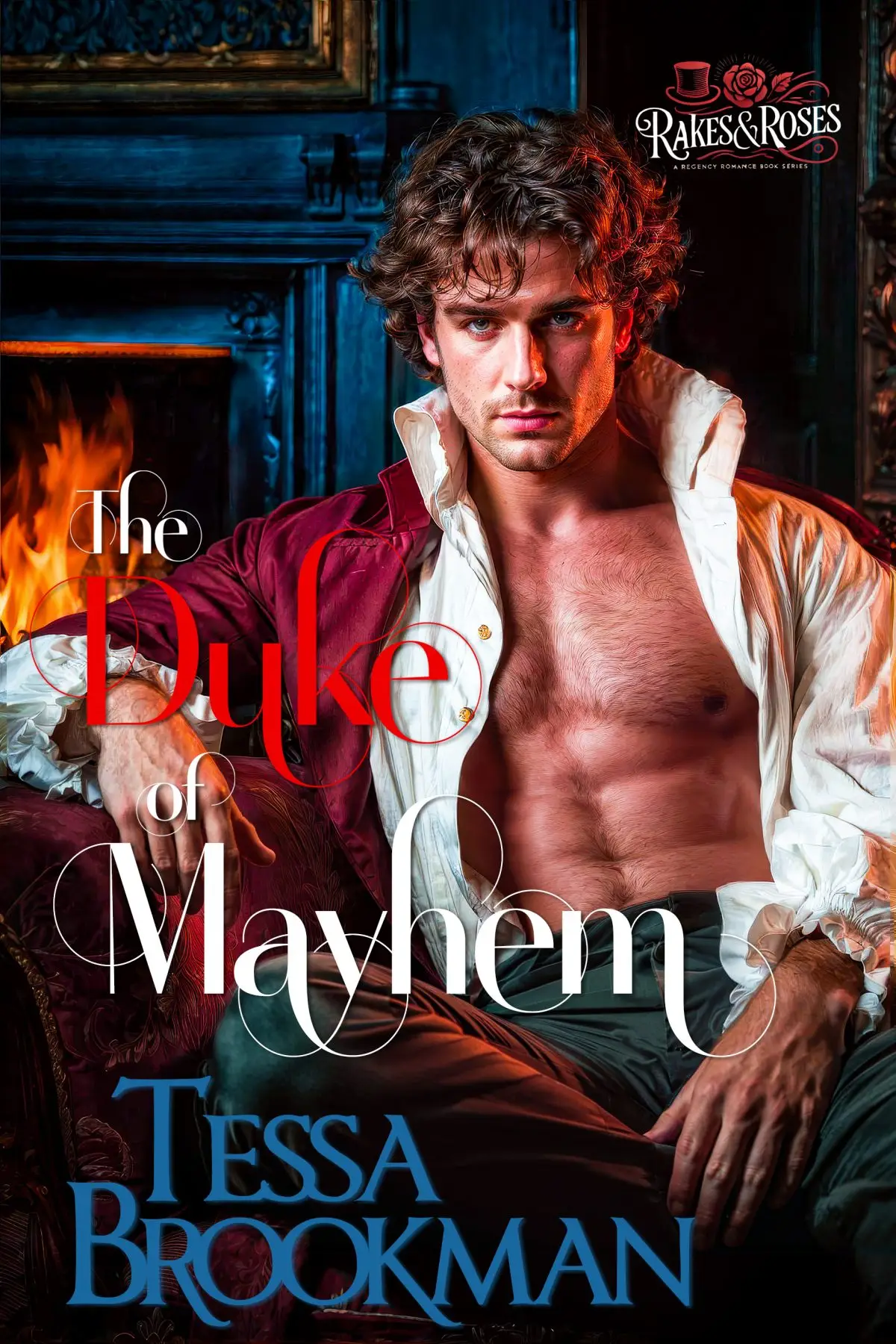
The Duke of Mayhem

The only sounds I desire to hear from your mouth are gasps of pleasure.”

Lady Cecilia, fed up with her stalled betrothal, hatches a scandalous plan to trap her fiancé into marriage. But she never expected to accidentally kiss her greatest rival: the notorious Duke Cassian…


Duke Cassian has vowed against love, after being abandoned one too many times. He plans to leave his life in England behind forever. Until, the day before his departure, an infuriatingly irresistible wallflower traps him into marriage, throwing his plans in disarray…

So, they make a deal: marry for 60 days and then annul the marriage. Cassian can leave and Cecilia can choose anyone but the man she despises most. Resisting is necessary.

But being alone with one another makes resisting impossible… 


Chapter One

Mayfair, London, 1809

Dowager Countess Lydia Montrose’s Estate

“Here you go, my dear.”

With pleasure, Cecilia took the glass of champagne from her husband-to-be and took a sip. “Thank you.”

As she looked around the ballroom, she caught the faces of various ladies giving her the eye. Blithely, she ignored them.

It was to be expected when she was to marry one of the most eligible bachelors of the Ton.

At eight and twenty, Gabriel Whitmore, Duke Rutherford, was tall and breathtakingly elegant, a study in elegance from the top of his head to the champagne shine of his boots. There was not one blemish to his name; the man treated every lady with respect, he had no affairs, and donated to charity every year.

He was perfect.

They had just finished a spirited Vienna waltz, and while they rested for the next dance, Cecilia used her thumb to nervously twirl the ring on her finger.

“Gabriel, how far are we on the wedding?” she asked quietly. “We haven’t spoken about this in over a month.”

His jaw tightened a bit, but when he spoke, his voice was calm, nonchalant even. “There is no rush, my dear. People have been engaged for longer than we have.”

It’s been nearly two years, and with how we started on so strongly, people are starting to talk.

“Would you like to take a turn through Hyde Park later this week?” She pressed. “We have not had an outing in over a month, too.”

“I’ll arrange something,” Gabriel murmured, his tone dismissive. What irked her, too, was that while he spoke with her, his gaze was trained on something—possibly someone—over her head.

Was it that hard to pay an ounce of attention to her?

“Gabriel, please—”

“I am terribly sorry, dear, but please excuse me.” His voice was flippant and even held a hint of contempt. It felt like he could not wait to get away from her. “I need to speak with someone.” He took her hand, swiftly kissing the back of it before he walked off.

Cecilia gave herself a minute to look at the broad span of the gold of his waistcoat, fashioned to mimic Alexander the Great’s golden breastplate.

It was fitting for the lady’s masquerade party, but there was nothing noble about his dismissive treatment of her. Glumly, she retreated to the seating area and joined her friends.

“That is not an expression I’d expect to see from a lady who just had a romantic dance with the love of her life,” Miss Rosalind Winston, or Rosie for those close to her, Cecilia’s bosom friend, said.

“I—” she sighed. “I do not know what to do. When I speak, it seems like it is going through one of his ears and out the other: It’s as if he’s just… absent.

“A far cry from the man who would send me a bouquet of flowers every day and would call twice a week when we were first engaged,” Cecilia groused. “He hasn’t called in the last month and—”

“A month!” Emma gasped in horror. “Why didn’t you tell us?”

“I…” she blew out a breath. “I did not think too much of it, you know. Dukes are men with constant business after all. But when he had not sent any flowers or cards, no invitations to take a drive, or to the opera. Not even luncheon, I felt confused and ashamed.”

“Don’t fret,” Rosie cautioned. “We can find a way to solve this. Surely, one of the many novels we’ve read has an answer to this.”

Gabriel’s bright golden hair was a beacon, and Cecilia followed it as he went to speak with some of his gentlemen friends. Friends, she belatedly realized he had never introduced her to.

Looking at the ring on her finger, a magnificent diamond, she wanted to smile—but it fell flat.

It was hard not to feel snubbed, and little by little, her hopes of one day becoming Lady Cecilia Whitmore were extinguishing. 

The whole of the ton had been in agreement that the match between her and Gabriel was the love story of the season. Those present on the night of her debut swore that the moment their eyes had met across the room, every guest there had fallen silent as though sensing that the epic meeting of two perfect souls had just occurred.

It does not seem so now, does it…

All her life, she had done everything right—excelled in school, had no missteps, no scandals, not even whispers, and when Gabriel had offered her marriage, she’d been elated—so why is she still waiting for her marriage two years in?

“Cecilia?”

“Hm?”

 “Could there be a way for you to force him to pay attention to you?”

“Like what?” Cecilia asked dourly. “I doubt I’d get his attention if I suddenly rode into the dancefloor on an elephant’s back while juggling apples while balancing a teacup and saucer on my nose.”

“Oh! I know,” Emma practically bounced in her seat. “We can send a note to him, by a footman, to ask him to meet you in the library upstairs.”

Cecilia listened with half an ear.

“Now, he’s dancing with Ophelia Hawthorne,” Cecilia nodded. “This year’s diamond-of-the-first-water. I—I wish I could understand the male mind.”

“Good lord, not tonight,” Rosie muttered. “I wish the good lady would not invite such riff-raff to such genteel events.”

“What do you mean—” Following her friend’s line of sight, Cecilia muttered, “Oh.”

Instantly, her heart walloped in her chest, moments before ire sparked in her veins. There was one secret Cecilia held dear to her heart, one that would never leave her lips.

Two years and three months earlier, the very night of her debut, before she had met Gabriel, she ran—quite literally—into Cassian Fitzroy.

“Easy there,” he’d said, steadying her from toppling. “Where is the fire?”

He’d looked so lean and powerful in somber grey; mesmerized by the intensity of his slate grey eyes, she’d whispered, “Thank you… um, who are you?”

His slow, self-deprecating smile devastated her senses. “My manners aren’t usually this shoddy. Forgive me, Cassian Fitzroy, newly minted Duke of Tressingham, at your service.”

A silly little infatuation had birthed in her naïve chest that night, and even when she’d learned that he was one of the worst rakehells in London—it still happened.

Emma whispered, “His Grace is here.”

“You mean his scapegrace,” Cecilia said sourly.

Reaching over, Rosie patted Cecilia’s free hand, “Dearest, it is about time you let that incident go.”

She dropped her bread on a platter and wiped her hands. “Let it go? The man humiliated me and then jabbed salt into the open wound.”

“Yes, dear, we know,” Rosie monotoned. “We were there.”

Pushing the horrible memory to the back of her mind, she tried to train her thoughts back to the issue with Gabriel. She did not know what to do as there was no way she could force Gabriel down the aisle, but even worse, this new dismissive attitude from Gabriel rubbed her wrong.

Is this my fault? Have I done something wrong?

“Duke Tressingham is handsome,” Rosie sighed, while flapping her fan. “It is such a shame he is a rakehell.”

While refreshing her cup, Cecilia had to—silently—agree. Despite his erroneous character, the lord was Narcissus reincarnated.

With a lean face, the hollows of which highlighted his sculpted cheekbones and granite jaw, he always wore his inky black hair a bit long, brushing his shoulders instead of cropped like a true man of the ton wore theirs. His eyes, though… his eyes were spellbinding, like ethereal smoke caught in a glass.

Cassian Fitzroy was the god of wine personified, his hair wild and tousled, as if he had just rolled out of bed. Knowing his reputation, he quite possibly had. He was holding a comically large goblet in his hand while the wreath of grape leaves tilted on his head as he laughed.

Between a rakehell I cannot stand and my fiancé who seems to not want to stand with me… I don’t know what to do. I feel stifled.

“If you’ll excuse me, I need a breath of fresh air,” she said to her friends while she stood and brushed her skirts down. The bodice, constructed of white and silver satin, had a wide V-neck gown that almost left her shoulders bare.

The gown fitted tightly to her torso, then cascaded into full skirts covered in shimmering white feathers that, when she moved, made her look the most gracious swan.

Fixing her mask, a creation of lacework and seed pearl, Cecilia took a passing look in the mirror. Her blonde hair was pinned away; the carefully plucked tendrils cascaded down her temples, while her dress was the ace of perfection.

As she circuited a path around the dance floor, she thought—not for the first time—that the night’s endeavor was rather pointless.

The night air was cool, and this far in the countryside carried the smell of forestry and the nearby river. So far from the clustered houses in Mayfair or Grosvenor Square, she was able to breathe freely, which calmed her inner restlessness.

A few minutes of respite before she opened the glass door once more and heard the roar of a ball ahead of her. Maybe she should try to talk with Gabriel once more and get him to understand her anxiety.

“If he does not give me a fitting answer, I’ll count this night as a loss and go home,” she squared her shoulders and stepped back into the ballroom.

Spying Gabriel, she headed there only to get intercepted by a passing Duke Tressingham, who stepped directly into her path.  

Lifting his goblet to her, he asked, “What, my dear Lady Disdain! Are you yet living?”

Her heart beat a rapid staccato at Cassian’s voice, but she kept her eyes on Gabriel. By rule of habit, she turned and curtsied to him but kept her voice sharp.

“Disdain shall not die while there is much food to feed it, Signor Nuisance, oh pardon me, I mean, Your Grace.”

He slapped a hand over his heart; his hurt expression was comical. “Oh, such a dagger to my soul. How ever shall I recover?”

“Jump out of another paramour’s window,” she slid an eye to him. “Breaking a bone might divert the pain.”

His lips flickered. “I have no idea what you are referring to.”

“Of course you don’t,” she said dryly. “And the Sahara desert is full of flavored ices.”

He tapped a finger on his chin. “You know, that might be the destination for my next travel. Shall I send you some strawberries?”

“No, thank you. It is probably laced with belladonna,” she muttered. “Now, please excuse me, I need to speak with my husband-to-be.”

He looked over his shoulder, “It seems he is occupied—” Cassian returned to her, his brows lowered over his mesmerizing eyes. “In the interim, would you like to dance with me?”

She gaped at him, “Are you mad?”

He cocked his head, “Possibly. I do not think there is a word for my condition.”

“I have many,” Cecilia put in. “Reckless, wild, madcap, rakehell, wanton, licentious, self-absorbed, brazen, lush, aimless, vagrant—”

His left brow lifted. “Do you think of me that much, my dear?”

“I am not your dear,” she spat.

Cassian looked to Gabriel once more as he bowed over Molly Attenborough’s hand. “From where I stand, it does not seem as if you are his either. Otherwise, you would be there and not here.”

That stung.

“Goodbye, Lord Jester,” she snapped.

“How long has it been?” his words stopped her. “Two years now since he proposed?”

“Sixteen months… and two and a half weeks,” she said stiffly while refraining from twisting the engagement ring on her finger. “Not that it is any of your business anyhow. And no, I will not dance with you. Not now, not ever.”

He turned his head to view the dancefloor, and Cecilia absently marked the cut of his jaw over the knot of his toga. “You do know that night was simply a jest.”

“You said I had stepped on your foot and pranced around with a limp all night.” The heat of that shame ran through her again.  “You even wore crutches to the next ball!” she accused him.

He raked a hand through his hair. “I thought it was funny.”

She stiffened, “It was not to me.”

“I’ve apologized countless times.”

“The ton called me Club Foot Cecilia for months,” she hissed.

“Do you want me to write my apology in the sky?” Cassian asked.

Yes,” she said firmly while dipping out another curtsy and moving off. “And fetch me a hunk of cheese from the moon to go with my supper, too.”

As she walked away, she felt his hot gaze shiver over the back of her neck, his gaze as piercing as a scalpel. Bereft, she went to join Emma and Rosie at the sidelines and sank to a chair with a huff. She was on the verge of crying.

She dimly reacted when Rosie gestured for a footman to come to them and startled when he handed her a glass of champagne. “Your Grace,” he bowed.

That cut even deeper.

“I’m not a duchess,” she snapped.

“My apologies, my lady,” the footman bowed lower.

Emma piped up again. “What do you think about my suggestion, to send His Grace the note to meet you?”

Rubbing her eyes, Cecilia nodded, “We can do that. At this point, I do not see what else can go wrong.”

Chapter Two

“Cecilia, sweetheart…” Rosie dropped her voice, “You might want to leave off the sherry. You are looking quite piqued, and people are watching.”

The disparaging glances, raised brows, and secret smirks behind the champagne flutes and snickers behind fans were like pointed arrows, ready to fly.

They were not going to make their mark as she deflected them with stony composure. Years of experience had taught her that her best defense in such situations was to look past them as if they were nothing and smile. Nothing could get under one’s skin if one did not let it.

All through supper and the dancing afterward, she’d kept a brave face, never letting her smile slip even in the face of subtle—and not so subtle— snubs.

“Nonsense, I am fine,” she waved her friend away.

“He’s dancing with Molly Attenborough again,” Cecilia noted dully.

“Ah, yes, the American dollar princess with new industrial money,” Rosie bit. “She just arrived from Virginia and has taken all her flirty American mannerisms with her.”

“And monopolized the attention of all the lords around us,” Emma grumbled. “Who knew building railroads and dealing in steelworks was such a profitable industry?”

That is it!

Calling a footman to her side, Cecilia asked, “Can you ask her ladyship to assist me with a card and a pen? I have an urgent message to send to someone.”

The man bowed, “At once, my lady.”

With both Rosie and Emma soon twirling on the dance floor, she was all alone. Quickly, but carefully, she wrote out the note on the tray, then stood—and staggered a little.

“Maybe Rosie was right about the sherry,” she mumbled as she skirted the floor.

Sighting Gabriel in a trio of lords, she gestured vaguely in his direction, “Please give this note to His Grace when the set breaks.”

Heading to the stairs, she held on to make sure she did not slip, then headed upstairs. From there, it did not take her long to get to the display room she knew the Dowager Countess had under construction and found a chair to wait.

“I need to tell him…” she whispered. While blinking at the doubling walnut cases away from her sight, she mumbled the words she wanted to tell Gabriel the moment he walked through the door.

“Why are we not married yet!” She practiced, then huffed. “That sounds like a shrew or a fishwife. No, I need to be calmer—” Dropping her tone, she tried for calm. “Dear Gabriel, please may I inquire as to why we are not yet married?”

“That’s better,” she nodded to herself.

Tapping a finger to her chin, she pondered. “But what can I do to make sure he knows I mean business. He is a bit unflappable.”

As she deliberated the dilemma, she noticed the heavy velvet drapes to the left of the seating area. The curtains hung from ceiling to floor, and it looked like there were voluminous layers of drapery behind them.

She shook her head, “No, no, I need to find a way to certify my marriage…”

What would make Gabriel jolt out of his disinterest….

***

“This came for you, my lord.” A footman bowed and handed Cassian a note.

Brow furrowing, he broke the vanilla seal and unfolded the heavy stationery.

“What’s that?” Benjamin Hadleigh, solicitor by profession and Earl of Somerton by birthright, craned his head to look over Cassian’s shoulder.

 He was one of Cassian’s firm friends as far back as from Eton, Cambridge, and various other discreet organizations.

“I humbly ask your presence in the display room upstairs…” he skipped over the directions to the most important part. “I hope neither of us will leave disappointed. Signed X.”

“An invitation for a rendezvous and a parting salvo, even though this lady does not know it.” Cassian spun the card over. “It is anonymous too.”

 As far as I can recall, none of my old paramours are in attendance tonight.

“Are you going to take it on? Who do you think it is?” Ben asked, swirling his glass of whisky. “You are slated to go off to Greece on the morrow,” his friend added.

“Not a clue,” Cassian murmured curiously. “I cannot recognize the hand either.”

“A frisky debutante or newly minted widow,” Ben deduced, while flicking a lock of his auburn hair from a green eye. “And what room is on the third floor, second corridor, four doors on the left? Why ten o’clock on the dot as well.”

“No idea,” Cassian replied. “I do not know this house—” he slid an eye to his friend. “—appalling, I know. A rake like me should have already known the layout of every building, every hiding spot, and how dare the shadows move without my permission.”

“I am surprised you’re not simply doing a tour of the continent again,” Ben said. “You took a shine to Italy, didn’t you? The lovely city of Messina.”

Cassian’s mind flickered a certain slender, dark-haired lady with shimmering brown eyes, always clad in a dark, silk robe, and shook his head.

“I did,” Cassian smirked, “But I aim for something more permanent this time. You know very well that I aim to leave England forever. Besides, there is an entanglement in Messina that I am keen on avoiding.”

Ben’s eyes sharpened. “Please tell me you did not leave an encumbered woman behind, because in twenty years, you will be making my life hellish.”

“There is no child,” Cassian assuaged. “I simply could not give a lady what she wanted from me.”

“I… see,” Ben nodded. “You left a relationship behind while I aim to start one.” He nodded to a lady sitting near Cecilia’s friend, Miss Rosalind, and Cassian choked back a laugh.

“Lady Emma Montrose? The Dreamer? Are you mad? Her friends will scratch your eyes out before you get within a foot of her. You cannot be serious.”

“I am,” Ben replied somberly. “Have you heard her play the pianoforte? The girl is Mozart reincarnated.”

“A rake and a romantic dreamer,” Cassian laughed. “Tell me how that works out. In the meantime—” he pulled out a pocket watch and checked the time. “—I have twenty-three minutes to idle away.”

A waltz began, and while two lords claimed Cecilia’s friends, he wondered where she was.

“Speaking of the lady’s friends, is anyone ever going to tell Lady Cecilia?” Ben asked. “Surely no one can allow that farce to go on. Everyone knows except her.”

“She will not believe that her Gabriel Whitmore, the Faultless, has a wandering eye and is only ever interested in the lady who has all the attention in the room. Every single one for the past five years has gained his eye, but he has only proposed marriage to one.” Cassian sighed while sticking a hand in his pocket.

“At least, with rakes, women know not to expect too much,” he said dryly. “With men like him, bounders who dangle the promise of marriage and faithfulness on the line while never lowering the hook. That rock on her finger is nothing more than a pretty bauble.”

“Poor girl,” Ben shook his head.

Even with their differences, Cassian felt some guilt for Cecilia; she hated him, but he did not want Whitmore to take advantage of her by trapping her in a loveless marriage.

No one should let such youth, beauty, and rapier wit fade into obscurity and hollowness. And, hell’s teeth, Cecilia was beautiful, he thought in bemused wonder.

He pondered how she might look if he pulled her hair from those pins and let her tresses cascade around her neck. How would those thick ringlets feel pouring through his fingers?

Her mouth, those lovely bow lips, and the divot in the bottom, were always pressed tight in an arresting thin line. Her pale blue gown had exposed the length of her neck, the slim clavicle, and the rounded swell of her breasts.

“Has she ever taken your apology for that night?” Ben asked.

“No,” Cassian shook his head absently. “And it might take divine intervention for it to take hold.”

Finally, he checked his watch again, fully intending to go to this room and meet this mysterious paramour. “Ten minutes now.”

***

Even with the door closed, Cecilia heard the deep chime of the grandfather clock. She lifted her head from her arm and grimaced at how light her head felt.

“I should have let off on the sherry…” she murmured.

Training her eyes on the door, she brushed her skirts down while waiting for Gabriel to enter. Surely, he had gotten the note, and no doubt she had appealed to his sense of curiosity.

“If he starts arguing… I’ll—I’ll do what I need to do to convince him,” she muttered as the door began to creak open.

Straightening, she hoped there was enough light in the room—she had lit a sole lamp to stave off the darkness. The door inched in a little, and soon, a shadowy figure stepped inside.

She rose, and her head spun something fierce. When Gabriel looked around, she made to speak—but decided actions were louder than words. He was not listening to them anyway.

Dash it all!

She flung herself to him, grabbed Gabriel’s shoulders, and pulled him down for a kiss—her first.

Her technique was sloppy, but it managed to get Gabriel to respond. This was madness! Utter madness… She’d never thought her first kiss would be this way, in desperation. Yet here she was.

The touch of his lips; it was like a lit match to oil.

Gabriel took command, and when he licked the seam of her lips, she gave a start of surprise, clutching onto his lapels for balance. A sound tore from his chest, and the kiss grew even more torrid. He penetrated her mouth with a stabbing force that made heat ricochet through every limb and nerve.

She clung desperately to him, and his kiss grew even more potent—he kissed her as if he owned her. The unrepentant, masculine possession of her sent a strange, singing sweetness through her blood.

How was it that Gabriel kissed like this? It was unlike anything she could have ever imagined… Hot promise rushed through her flesh.

In her drunken flurry, she hadn’t realized the force she’d thrown herself towards him had forced him to stagger out of the open door. Gabriel managed to steady them, but in the middle of the corridor.

It was fine, wasn’t it? Gabriel was her husband-to-be, after all.

It was a bit scandalous, yes, but surely anyone would understand. She sought his lips again. Who would have thought such a standoffish man like him could kiss this seductively? What other talents had he been hiding from her?

“Lady Cecilia? W-what are you doing?” The Dowager’s tone was aghast—but why was she horrified?

It was only when firm hands pushed her off and her eyes peeled apart did she realize three things in heartbreaking, blood-curdling succession.

The man she was kissing was not Gabriel…

It was Cassian Fitzroy.

They had an audience.

Four people in the corridor with them—one of whom was in fact Gabriel—were staring at her in abject horror. The frank truth of the moment slammed into her like a phaeton out of control.

I am ruined.

Her knees went out from under her as the shock and the drunkenness made her head spin even more. Ophelia Hawthorne’s eyes went alight with sadistic delight, and she snapped her fan out to hide her smirk. The second lady, Henrietta Ashbrook, openly gaped at the two. Soon their shock turned to palpable excitement, and Cecilia felt the weight of her ruination crashing down.

Darkness swept over her in waves, her body flashing cold.

Cassian grabbed at her to stop her from falling, but it mattered not. The damage was already done. If he pitched her over the balustrade and into the champagne fountain below, she could not be any less broken.

Her vision grew blurry.

“Cecilia,” Gabriel stepped forward. “What is going on here?”

“I-I—” she felt faint.

“The good lady is drunk,” Cassian said calmly. “Can’t you see that?”

Gabriel straightened, his gaze imperious. “And she so happened to be kissing you to grow sober, is it? What were you doing with her at all?”

“I came here to have a quiet moment away from the hubbub downstairs,” Cassian answered. “And she flew out of the doors.”

Cecilia shook her head and grabbed at her temple as the room spun. “Gabriel, I sent a note for you to come and see me. Why—why weren’t you there?” She pushed away from Cassian to totter to him. “I thought it was you. Not—not him.”

Gabriel stepped away from her. The cut was not subtle at all. “I had received no such note.”

“I am sure, I sent it to you,” she pulled away and pressed her hand to her chest. “Gabriel—”

“You should return to Duke Tressingham, my lady,” Gabriel said with a condescending smile. “It seems he is your new fiancé. I should have known with how seductive you’ve been for these past few weeks.”

Weeks?” She blinked. “You have never seen me once in a month.”

“Matters not,” he said, stepping aside. “You may have the breeding, but I was sorely mistaken about your class.”

His words had all the effect of a punch to her face.

“Wait a moment, Whitmore,” Cassian interjected. “Is this how much of a bounder you are? To reject your fiancée when she is clearly ill?”

“Ill or not, you took advantage of her,” Gabriel replied pompously.

Cecilia pressed a hand to her temple as small black spots began to pepper her vision.

“I am not surprised,” Cassian snapped coldly. “You never had the intent to marry her, did you? You’re a social vulture, Whitmore, and everyone knows it. Well, perhaps everyone but poor Cecilia here.”

Turning to Cassian, she blinked the double vision away. “What—what do you mean?”

The argument had drawn more people, but they stood silent in the periphery.

“Your fiancé has no interest in you anymore because you do not carry the swing of the attention in the Season,” Cassian said frankly. “Whitmore is a social buzzard flying to the scene of the freshest kill because he craves attention like a plumed peacock. He is only keeping you on the emotional tenterhooks while he roams.

“Surely you have noticed it. Ophelia Hawthorne tonight, and last year, was it Letitia Corrington? Both of them were Diamonds after you. Do you not wonder why they have the loaf of his attention while he gives you the crumbs?”

Horrified gasps swept through the room while Gabriel looked apoplectic.

“It does not detract from the issue that you were kissing her!” Gabriel spat.

“I—” Cecilia swayed as her stomach felt swoopy and her heart hammered irrationally.

“The good lady is drunk, and this is a massive misunderstanding,” Cassian repeated calmly.

“A massive misunderstanding that ended with the two of you kissing,” Gabriel’s sneer was cutting. “I think it’s by design. You are a rake after all, and Cecilia’s been growing infinitely desperate these past few months.”

Cecilia felt her stomach falling to her feet. Blindly, she reached out, grabbing for anything she could hold onto. That thing was Cassian’s jacket. “I do not feel well.”

Cassian turned from her, his brows furrowing, “My lady, are you—”

The black spots peppering her vision surged into a sheet of black, and the last thing she saw before the darkness took her was one man looking at her with disgust… and another with frenetic worry and tender care.

Chapter Three

It is the Scandal of all Scandals.

It is fair to say that every guest of Dowager Countess Montrose’s ball was aghast with horror to see Lady Cecilia locking lips with London’s most notorious rakehell, Duke Tressingham, Cassian Fitzroy—while her poor husband-to-be watched on in utter shock.

“You could see the pain in his eyes”—remarked Lady M. “Who would have thought she would do something as scandalous as that?”

“I always thought she had a defective streak in her”—Added Miss O. “I knew her from the schoolroom you know, and she always had that look in her eye. Always so proper, but it was a façade, you know. She was never a decent sort.”

“The lady was heartbroken and drunk”—said Lord J. “It’s the loudest secret in the ton. Whitmore has the attention of a gnat. He had no intention of marrying the poor girl.”

No one knows what to make of these sudden turn of events yet. Some are optimistic that the good lady can change the lord’s mind, others not so much…

That was as far as Cecilia got with that morning’s version of the London Gazette. Huddled into her room, with the shades down and a fort of pillows around her, she did not know what she wanted to do first. Scream or cry.

Possibly both.

She was ruined—the carefully crafted reputation she had forged over the years was now in tatters. She doubted she would ever show her face in Town again.

“Cecilia, dear,” her mother, Margaret, swept into the room, her face a mask of disappointment and censure. “Come on, you must get up and stop this wallowing.”

She sat up and considered her words. “Mother, what would you do if you were in my position? My reputation is in shreds, the whole town is mocking me, some are happy that I have fallen from grace, and now, I must marry the worst rake in London. Possibly, the continent!”

Margaret stopped at the end of her bed, her lips pursed. “I would find a way to make the best of it.”

A long silence rested between them. “I never intended this, Mother. You must believe me.”

Her mother’s rich golden hair shimmered in the small light from the fluttering curtains. “I believe you. But that still did not give you a reason to drink to excess. Ladies do not get drunk, Cecilia, it is—”

Uncouth,” she said hollowly, “I know. Did you know Gabriel had no intention of marrying me? That once the attention of being the glorified Diamond of the First Water was off me, so was my appeal to him.”

Margaret’s thin brows met in the middle, “And how do you know that?”

“I learned it from Tressingham,” she whispered. “Apparently, all the lords have their own sort of conclave separate from that of the ton. They all knew he was only dangling me on, and that made it even worse.”

She let out a puff of disgust. “And to think no one would have told me the truth. A lot of seditious scoundrels they are.”

“You cannot blame yourself, Cecilia,” her mother warned her.

“No, no,” she shook her head, “I should have seen this coming. As I sit here, I try to think of what I saw in him—” that cowardly fop “—and all I can think is what I presumed to be excellence.

“He was handsome, titled, successful with nary a streak to his name,” she said. “Even father approved of him, and you know father is not one to be placated easily.”

“I do,” her mother nodded. Her slim shoulders slumped. “Cecilia, the best thing for you now is to stay out of the spotlight and keep your head down. Like every other scandal that has wreaked havoc in Town, this too shall pass.”

Cecilia wanted to believe her, but she did not see how it was possible that any of this would ever go away. Even ten years from then, she could see the snide looks and polite sneers. She would never live this down, much less stomach the prospect of living in a loveless marriage.

“Do you really believe so, mother?” she asked absently.

Margaret did not look so comforted herself. “It is the best we can hope for now.” She strode over to the window and swept the curtains open, flooding the room with light. “Your friends are coming by in under an hour, and you are going to meet them.” Turning away from the window, she added, “I’ll have your bathwater sent up.”

When her mother closed the door behind her, she sat up and rubbed her face.

Horror and shame collided inside her. There was no doubt that she had made a bungle of things, given the whole of Town another scandal to eat. She did not know how she could explain her scandalous behavior.

She was never a person to let herself drink to excess or follow her impulses—but she had allowed both four nights ago, and now she had to pay for her choices.

And now I will be forced to marry Tressingham.

Shifting from her bed, she donned her robe and went to splash water over her face. “Can anything good come out of this? How will I ever live this down…” She almost set herself to tears once more.

“My lady,” a maid interjected from the doorway. “We will be filling the tub now.”

Cecilia scrubbed at her red eyes, “Go ahead.”

***

An hour later, seated in the blue drawing room, and paging through a book she was barely reading, Emma and Rosie swept in, worry painted on both faces.

“Oh god, Cecilia,” Rosie shook her head. “I cannot tell you how worried I am. How worried we are.”

At Emma’s emphatic nod, Cecilia closed her book, “How bad is it out there?”

“You’d rather not know,” Rosie told her, her face falling in sorrow.

Shaking her head brokenly, Cecilia murmured, “I already know. Half of the ton ladies are celebrating my fall from grace, and the others are using me as a teaching moment to their girls. I am now a proverb.”

“That is… the gist of it,” Emma said as a footman came in with a tea tray. “They are crowing over your ruination. Before this, I never realized how cruel some of the ton women can be.”

“I would not expect any less of them,” Cecilia sighed. “People love to see others fall. Somehow it soothes their empty souls.”

“Have you spoken with or seen Duke Tressingham since that night?” Rosie asked. “At all? Anything?”

“No,” Cecilia murmured. “But I suppose he will contact me soon. He promised Papa to get the Special License, and it takes a few days, even for a Duke.”

While fixing her tea, Emma said, “Do you suppose something good can come from this? His Grace is a rakehell. Maybe matrimony can help him see not only the error of his ways, but perhaps even change him to an honorable man.”

Cecilia let out a short laugh. “That is a fairytale. A leopard never changes its spots, and neither does a rake.” She set her tea down and wrapped her shawl tighter around her.

“Tressingham…” she sighed. “—well, he is my betrothed, so I suppose it’s best to call him Cassian, or Fitzroy…” her nose scrunched, “None of those seem right.”

“You can still call him your eternal enemy,” Rosie suggested.

“Or the thorn in your side,” Emma added.

She pursed her lip, “I suppose I’ll just call him His Grace. It is not anything too personal, nor does it make me get closer to him. His Grace told me that Gabriel was worse than a rake. With rakes, you know what you’re getting. No commitment, no pledges of love.

“Gabriel, on the other hand, held onto me like a fish on the line, feeding me crumbs of his affection while keeping the loaf for others. He said Whitmore would never marry me, and I am thinking he was right.”

She huffed. “I cannot believe I was so blinded by his good looks and impeccable reputation that I’d fooled myself into thinking he was a good man. When he’d asked me to marry him, I’d thought it would be a month or two before we’d walk down the aisle.

“The month or two turned into nearly two years with me still not only wearing the wool over my eyes but voluntarily pulling it further down,” Cecilia ranted on. “I do not know what I saw in that fob!”

“Maybe you should tell that to his face,” Emma nodded archly. “If he is only with you for the attention you bring to him, he is shallower than a dry pond in summer.”

Her eyes shifted between both Emma and Rosie. “Do you think that is a good thing to do?”

Tucking her feet to the side, Rosie said, “You are not a wallflower, Cecilia. Do you remember what the headmistress at Madame Rosenberry said about you?”

“That I am spirited, opinionated, and held a cutting wit sharper than a double-edged sword,” Cecilia smiled deprecatingly. “All the synonyms for a hoyden. Frankly, it would have been more straightforward if she had just said it.”

“You’ve muffled yourself for years, Cecilia,” Rosie put in. “For the sake of being a duke’s daughter and under the many propriety lessons you were forced to abide by. I think it’s time you shrug that blanket off and be the person you know you are.”

“And you’re being married off to Tressingham,” Emma encouraged. “A married woman has more freedom than a debutante.”

“So does a widow,” Cecilia muttered instantly. Her eyes clenched tightly in dismay. “I see what you mean.”

Chuckling softly, Emma said, “I think it’s best that you do go and see Whitmore. Ask him, to his face, if he truly had no intention of marrying you, and I trust you have enough intuition to see through his lies.”

Sitting up, Cecilia thought the suggestion over. It would give her closure to know the truth coming from the source itself.

“What time is it?” She asked.

“One in the afternoon,” Emma replied.

“It’s time I sought out Gabriel once and for all,” Cecilia said hotly, getting up. “Help me find a dress.”

***

Cutting through the heated liquid of his bathhouse, Cassian reveled in the fiery temperature of the swimming water. The exercise calmed him, focused his erratic thoughts into a sensible line.

He’d already petitioned the Archbishop for the Special License, but that was as far as he’d gotten.

The bathhouse he’d had remodeled like an ancient Roman bath, decorated with replicas of Roman columns at each corner of the large rectangular pool.

His engineers were miracle workers too, making sure to fashion the pool with grates where heated coal could be placed under the furnishing to warm it. There was ingenious plumbing that took fresh water in and a valve that let the used water out into the pond beyond the house.

He got to one end of the pool and, with a quick flip, swam off to the other end. In the fleeting moment when he resurfaced for air, he heard the bathhouse door open and feet padding to him. Only when he got to the end of the pool did he hold onto the edge and shake the water from his head.

“What can I do for you, Somerton?” he asked.

Benjamin’s patent leather boots shone in the dim light. “Nothing much,” he grunted. “I just thought you’d like a friend to talk with.”

Hauling himself out of the pool, Cassian reached for the towel he had sat nearby. After drying off, he pulled on his robe. “The weather’s been lovely, hasn’t it?”

Ben rolled his eyes. “That is not what I am talking about.”

“Why not?” Cassian said blithely. “We could go to the countryside and have a hunting party?”

“With your new bride in tow?” Ben asked dryly. “I have heard a lot of stories about Lady Cecilia of late, but I am sure her being a sharpshooter is not one of them. Surely you know that everyone is talking about you and the good lady.”

“I’d be disappointed if they were not,” Cassian shrugged. “Bunch of civilized savages. Half of them are most likely spinning lies about us having an affair behind Whitmore’s back and that the kiss was the outcome of our liaisons.”

“I have not heard that one yet, but I will keep an ear out for it,” Ben replied. “Look, I know you were heading away from London for a while—”

England,” Cassian corrected. “And not for a while. I had everything lined up to leave forever, and now all this…” he gazed at the plaster molding around the room. “Now I have a wife.”

“Scared?”

“Not exactly,” Cassian murmured while cocking his head to the left. “What I feel is… an unfathomable, sickening sense of dread that has carved a crater of inevitable doom and despair inside my gut.”

“And here I thought you were not the poetic sort,” Ben teased, “That almost rhymed.”

Har, har.” Cassian mocked. Moving to a chair near the other side of the room, he sat.

Leaning on the wall near him, Ben asked, “It can’t be all that bad, can it? You are about to marry one of the most sought-after ladies in the ton. Surely you cannot despise that.”

“It is not who I am marrying that is the issue,” Cassian rolled his neck. “’Tis the fact that I am marrying at all that unsettles me. I am sure you know that a lot of gents have been bitten by the matrimonial infection, but I am impervious to the poisonous fangs.”

“Putting the marriage part to the side,” Ben pressed. “I know you and Lady Cecilia have a connection—”

“She despises the very air I breathe,” Cassian snorted. “That will make the best of marriages.”

“The only reason she hates you is because you gave her a reason to,” Ben added sagely. “You were like a mischievous boy tugging her pigtails, only magnified by ten. I can bet you she took so deeply it stayed with her for all these years.”

“And I’ll have a lifetime of apologizing and she’ll never forgive me,” Cassian said, his lips twisting, “For the taunt that night and for trapping her in a marriage she does not want. Which proper lady wants to be leg-shackled to a rakehell until she goes gray?”

“That’s the very thing,” Ben pressed on. “The church allows you to be married and have the marriage annulled in sixty days after the ink is dried. As long as it is not—”

“—Consummated,” Cassian finished, giving him a fleeting look. “I know the law as well as you do. I am a man of voracious appetites, Ben. Two months of celibacy will kill me before the damned period ends.”

“Eh, I don’t know about that…” Ben gave a sidelong glance. “What happened when you took that trip to Italy? You were gone for five months.”

“I had… friends in Italy,” Cassian said.

“Friends…” Ben’s eyes narrowed. “Or a paramour.”

Cassian’s shoulders slumped as he stood. “What difference does it make? I won’t be going that way again.”

“…She asked for a commitment,” Ben threw at his back. “Didn’t she? And you told her you could not give her one.”

“I told you,” Cassian looked over his shoulder. “We rakes have a natural immunity to such things. Now, will you join me for a coffee while we straighten out this marriage agreement?

Keep an eye out for the full release on 11th December!

Categories
Previews

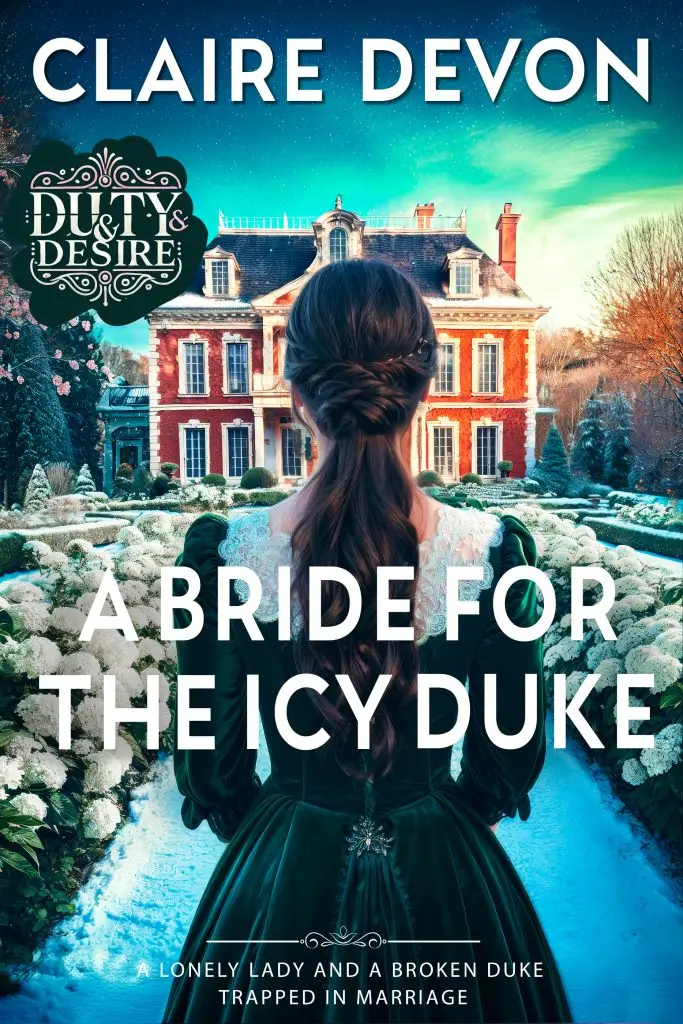
A Bride for the Icy Duke Preview

Please Enjoy a Snippet of my Upcoming Novel!

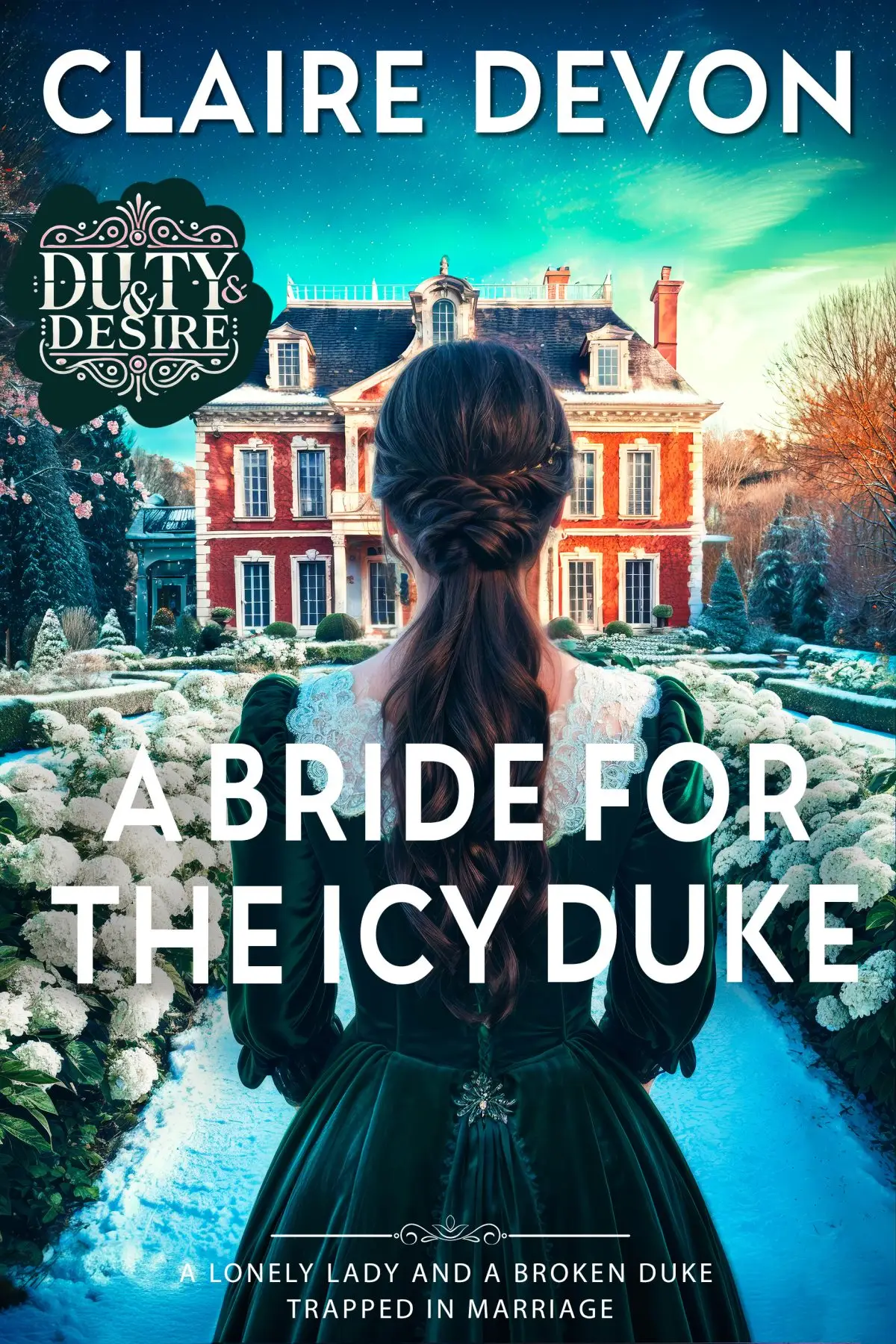
A Bride for the Icy Duke

I’m going to taste every inch of you until you beg me to stop.” What if… what if I never want you to stop?


Miss Lydia Swinton has nothing left but her pride. Orphaned, penniless, and unwanted, she is forced into a marriage with a cold-hearted duke who offers her comfort—but never love…


Duke Alexander has vowed never to love after the death of his childhood sweetheart. But a deathbed vow compels him to wed the girl he wronged. One year of living apart, followed by a quiet annulment…

But when he returns, his forgotten wife is no longer the heartbroken girl. She is confident, irresistible—and determined to make him stay. Trapped together by a storm, their marriage sparks into something far more dangerous.

Especially when something about her feels achingly familiar…


Prologue

1804

North Riding of Yorkshire

“Lydia, darling! Get back here!”

Clawed branches ripped at Lydia Swinton’s clothing as she lurched through the woodland. Dusk had fallen, the final embers of day settling low in the sky. Tears streamed down her cheeks, and she let out a choked sob.

Leaving York. Leaving for London. Lydia had never visited London before, but she knew of it—knew it was busy, noisy, overwhelming. And she also knew that her best friends would not be leaving with her. She would be alone.

Another harsh sound—too raw to be a sob—broke free. She swiped ahead of her blindly with her arms. Her father’s calls behind her melted into the encroaching darkness.

Good. If he was going to travel to London, he could do it on his own.

When her mother had died, he had awkwardly held her, her head on his shoulder, his arms curving around her back with the stiffness of a man not given to physical affection. “We shall contrive together,” he had told her. “Just the two of us. You’ll see.”

But for all she knew he was trying, she was a young girl—thirteen now, leaving girlhood behind in favor of adulthood—and he was a man. They had nothing in common. If it were not for her friends, Eliza and Marie Radcliffe, she would be lonely indeed.

Yet her father insisted she must leave them behind.

First she lost her mother, and now she would lose her home. Her friends. Everything that had made her life feel bright. All that was left was her father, who had never recovered from the loss of his wife a few months earlier.

Well, neither had she. And leaving the last place that had memories of her would be a blow too far. Too much. Her chest hurt, and she rubbed at it with the heel of her hand as though she could scrub away the pain. More tears blurred her vision, spilling down her cheeks, their paths cool in the night air.

She stumbled through some bush and came face to face with a pond. Here, her father’s voice had faded into the night breeze. Finally, truly, she was alone.

The water almost seemed to mock her. There was little light left, but what there was, the surface of the pond reflected back to her. Moving more out of instinct than conscious thought, she moved closer. Her chest rose and fell with each breath, and she wanted to turn, to run, to demand her father listen to her for once in his life.

But desperation had her slipping her shoes and stockings off. The frozen moss burned her bare feet with its chill, but she ignored the discomfort as she stared down into the dark, endless surface of the pond.

Logically, she knew the water must have an end—and probably not a deep one. But as she stared into its depths, she could trick herself into believing that there would be no floor, nothing to support her if she stepped in.

She sucked in a ragged breath as she took the first step. Then the next. The water was so cold it almost burned, and although it was barely night, already patches of brittle ice lined the surface. So cold. Her teeth chattered. Yet she kept moving, welcoming the pain, letting it distract her from the overwhelming hurt in her chest. Before her mother’s death, she had not known a heart could hold so much pain. Although she knew it could not be true, she felt as though the organ itself was splitting apart. Her mother had been the only person in the world who had understood her, and now she was gone.

All this time, Lydia had been living in the memory of her mother, burying her face in her mother’s perfumed shawl and reading her mother’s favorite books. She would wander the hallways and recall conversations they’d had. In the library, she would curl up in her mother’s favorite armchair and pretend the cushions were her mother sitting underneath her, preparing to read her a story.

All this would be gone in London.

Her breath grew harsher as the water reached her thighs. She was no longer crying, but she didn’t know if that was due to shock. Her chest felt tight, as though breathing itself was a challenge she could not overcome. She no longer felt her feet, but the water felt like icy knives in her legs.

Laughter reached her, the sound so incongruous that she stopped, blinking and looking up. Shadows wrapped around the tree trunks. The laughter sounded male, but it was not her father—the timbre of the sound was different. Rougher, sprightly, perhaps. That of a young man rather than an older one. If anything, he sounded a little like the stable boy they employed, the one who was a mere couple of years older than she.

But surely it could not be the stable boy.

Confusion and indecision had her pause, her feet sinking into the mulch and the water slicing her into ribbons. She shuddered, arms wrapping around herself, as the shadows parted to reveal a man.

No, a boy.

No, older than a boy. He was taller than her, although not quite as tall as her father. His shoulders, too, were not as wide. But as he approached, she saw he had grown out of the awkward, lanky phase that boys so often went through. Definitely not the stable boy.

The laughter stopped as suddenly as it arrived. He stared at her, soaked in the water of the pond and drenched in the last remaining light from the sky above. When next he stepped forward, the movements were jerky.

“Miss?” he ventured, extending a hand, although he could not quite reach her without entering the water himself. He stopped right by its edge. “What are you doing, miss?”

Lydia tightened her hands into fists by her chest. What was she doing? What did she hope to achieve here? She was so cold she could hardly think straight. All she knew was that there was kindness in his voice, and she had felt as though she had been empty for months, and now, finally, someone had come along to fill that forgotten place inside her.

She let out a ragged sob. One, then another. Messy, raw sounds that racked through her and threatened to send her tumbling headfirst into the dark water.

“Miss!” After a second, she heard a splash, and then hands were on her arms, hauling her backwards into a warm body. The boy cursed, using words Lydia had never heard before, and set an arm around her waist as he hauled her back to the shore. Disoriented, she made no objection, merely crying harder when he stood her upright again.

“That’s bloody cold,” he shuddered, almost to himself, then brushed his fingers over her arm. “What happened, miss?” he managed, gentling his tone.

She shook her head, unsure whether the tremors racking her body were from the chill of the water or the shock at having been dragged from it by a strange boy. Or if it was just leftover from the news that they were leaving York.

Perhaps all three combined.

“I—” he started, looking around as though searching for something. When nothing appeared, he dragged a damp hand through his hair. Dusk had well and truly fallen, disguising its color, but Lydia suspected it was light. A sandy brown, perhaps. Soft blonde. She caught only glimpses of him when she glanced up, but it was enough to tell her that this boy was handsome.

At the realization, she cringed and put her hands over her face. Now her disgrace was complete—not only must she endure the worst thing to have ever happened to her, but this handsome boy bore witness to her every weakness.

“Now then,” he said, the hand on her arm traveling to her shoulder. “Don’t cry, miss.”

If anything, that made her cry harder.

He exhaled gustily, and drew her against his body in an embrace. She froze, mid-sob, shocked at the unexpected warmth of his chest. Though he wore a waistcoat and coat, the heat of his body blazed into her, feeling like a warm bath after being so, so very cold. She shuddered, and he drew a hand up and down her spine.

“You shouldn’t go in the water at this time of year,” he said, both soothing and gently chiding. “You’ll freeze.”

“I-I-I—” Lydia’s teeth were chattering too hard to get any words out. Unlike her father, whom she knew loved her but at a distance, this boy felt as though he was accustomed to handing out embraces left, right, and center. His breath gusted by her ear.

Lydia closed her eyes. Her heart, so bruised and bloodied from her mother’s death, gave a little leap. He felt so warm, so right, so solid and reassuring in front of her. She had read about these moments in novels, an illicit embrace between a man and a woman, and the entire sensation was so very nice, so very welcome, that she forgot to cry. All she could do was stand within the circle of his arms and feel.

“Alexander?” a girl’s voice called, and suddenly, Lydia was pulled out of her relief. Someone else was here. The boy’s arms loosened, and she turned to find a girl stepping out from the same set of bushes that he had emerged from.

“I found her in the water, Hel,” he replied. “She’s frozen.”

“Oh, poor dear.” The girl came closer, revealing herself to be a few years older than Lydia. Perhaps sixteen, her figure soft and womanly. Her features, though Lydia could see little of what she looked like, were pretty, ringlets of indeterminate hair color framing her round face. She, too, seemed kind, but there was a way that she looked at the boy—who held her rather more loosely now—that made ice from in Lydia’s chest.

These were not merely two playmates. They shared a history, a past, and some kind of affection Lydia could not even hope to access or guess at. All she knew was that the boy who had made her feel so warm and safe belonged to this girl, not her.

“Don’t you worry,” the girl soothed, feeling around on the ground until she located Lydia’s shoes and stockings. “Rub her hands, Alex, before she catches a chill.”

“What do you think I’m doing, Hel?” he rolled his eyes, though he obediently took Lydia’s hands and rubbed warmth into them. “There,” he coaxed. “Are you feeling better now? What happened?”

Mutely, Lydia shook her head. Explaining her troubles to this boy and girl felt incomprehensible. Although they had been nothing but kind, nothing but determined to save her, she felt certain the illusion would shatter once they understood she had knowingly run away from her father. That she had walked into the pond with no clear idea of what would happen after the event.

The girl fell to her knees and squeezed Lydia’s dress onto the grass. “Here,” she said, easing Lydia’s feet into her shoes, abandoning the stockings altogether. Some part of Lydia felt as though she ought to be scandalized, but she didn’t have the energy. “We must get you back home. What’s your name?”

“L-Lydia,” she stuttered. “Lydia Swinton.”

“Lord Blackmoor’s daughter?” the girl asked.

“Yes.”

“Oh.” She exchanged a long look with the boy. Alexander. “Well. My name is Helena Perry. This is… Alexander Rayment.” The pause suggested she was going to say something else before changing her mind, but Lydia did not have the energy to examine what that might have been. Instead, she looked up into the face of her savior, just able to make out a handful of features. She had never met him before, but she memorized what little of his expression she could, determined that if they were to meet again, she would recognize him.

Helena rose, putting her arm around Lydia’s waist. “Come now,” she said, and Lydia could have sworn her hand brushed Alexander’s behind her back. “Tell me what the problem is. Are you running away from home?”

Lydia shook her head jerkily, though had she been running away from home? She had certainly been running—and she knew there was no home for her to return to.

“My father wishes us to move,” she whispered through chattering teeth. “To London.”

“I see,” Helena said. “And you don’t want to?”

“He wants to dispose of the last memories of my mother.” This time, the crack in Lydia’s voice sounded as though the earth under her feet had split entirely. “But how can I?”

Helena held her a little tighter. “Oh, poor child. Your mother died?”

“A few months back.”

“I’m so sorry, dearest,” Helena cooed, so gently it made Lydia cry all over again. “That must have been so terrible. But, you know, memories don’t leave us just because we’re no longer in the place that birthed them.”

“London is a place of possibility,” Alex nodded.

“My friends are here.”

“Do you think it impossible to make new friends?” Helena asked, brushing tears from Lydia’s cheeks. “Because I can assure you now, that is not the case.”

“Let us take you home,” Alex urged. “Things won’t seem so bad in the morning.”

Lydia looked up at him, needing the reassurance he was offering. “Do you promise?”

He nodded, steady and certain. “I promise.”

Chapter One

1813

London

The winter air stroked cool fingers across Lydia’s face as she strolled along the street. Her friend, Lady Penelope Marshall, frowned at the sudden burst of pale sunlight.

“I should have brought my parasol,” the blonde lady shuddered.

“For this? Dearest, it’s winter.” To demonstrate her point, she tilted her face back to the sky.

“You know you’ll get freckles regardless.” Penelope tugged at her arm in false exasperation. “Your complexion is too pale.”

Lydia cast a laughing glance at her friend. At two-and-twenty, she knew precisely what would happen if she spent too long in the sun. Her red hair and pale skin ensured her skin was frequently painted with freckles across the summer months. Not the handsomest feature, but they always faded in winter, and she barely had any at present.

“I hardly think a single walk will do me any danger,” she remarked, biting back her amusement. “Besides, no one will care. Lord Scunthorpe began courting me last summer when I had a multitude of freckles.”

Penelope gusted a sigh at the sound of Lord Scunthorpe’s name. Unlike Lydia, who had seen three London Seasons now—the slightly younger girl hadn’t quite abandoned her romantic leanings. She still dreamed of a hero sweeping in on a white steed to rescue her.

Lydia had no such misconceptions.

There was no such thing as heroes. At least, none on whom she could rely to stay in her life.

“Lord Scunthorpe is such a bore,” Penelope groused.

“Don’t be cruel. He’s…” Lydia paused, trying to find a way to describe the baron in a flattering light. Perhaps he was not the most dashing or young of men, but he was perfectly kind, and she knew he would provide for her. “He is very devoted to me.”

“Is he now?” Penelope asked, arching a brow. “And what of his other wives?”

“To be sure, he has had bad luck in the past, but I hardly think you can blame him for the death of his wives.”

Her friend wrinkled her nose. “I think he wants someone to be the mother of his children.”

“Well, is that not also reasonable?”

“And you are the daughter of a viscount,” Penelope pointed out. “Imagine if you were not. Would he have the same interest in you then?”

“Well, I can’t say for certain, but he knows I won’t inherit any of Papa’s property regardless,” Lydia shrugged. “It’s all entailed away, and Papa made that very clear at a dinner earlier this year. And Lord Scunthorpe hasn’t retracted his suit. So whatever his motivations, it is not because he thinks, as my husband, he will be my father’s heir.”

Penelope pursed her lips. “But your father is a powerful man,” she reminded. “A union would benefit Scunthorpe far more than you. He is a baron. Twice married.”

“He is rich,” Lydia pointed out.

“Not so rich that he wouldn’t benefit from your dowry.”

Lydia said nothing.

The move to London nine years ago had been a difficult one, just as she had known it would be. She had made few friends, and in her three years on the marriage mart, she had received interest from only one eligible gentleman.

She would be a fool to turn that down. And really, he had come along at the perfect time, when she had despaired of making a match. The estate being entailed away was likely one reason; the other she expected was her unfashionably red hair, and her difficulty making casual conversation with the few gentlemen who spoke to her.

Even so, her situation now was far superior to any she could have imagined when she was picturing the move. Her father had promised to try, had promised they would find happiness, and they had. She had. Together, they had carved out a quiet, contented life for themselves.

Different from the childish joy she had known when her mother was still alive, where grief had yet to touch her, but happiness nevertheless.

 She still, on occasion, missed York.

She never stopped thinking about the boy by the lake, though she knew how improbable it was she would ever see him again, and she always missed her mother. Still, she found other things to enjoy, such as her new friendships. And Lord Scunthorpe. Not the daring man from her dreams, but a man who would offer her a home and security. Provided, of course, he would offer for her.

“I am certain we would do well together,” she finally said with conviction. “All I need is for him to offer. He is a little shy.”

“Odd for a man over twenty years your senior to be shy,” Penelope said slyly. “And only a baron! Just think how much better you could have done.”

“If I could have done better, Pen, I would have done so before now, don’t you think?”

“You are not on the shelf!”

“No, but I may be if Lord Scunthorpe doesn’t muster the courage to offer for me soon.” Lydia sighed, but commotion further down the street disrupted her contemplation. Several servants stumbled down to the street, and a page boy dashed down the road past them, his face a mask of such concentration, he didn’t so much as recognize her.

Lydia recognized him, however. He belonged to her household.

Dread trickled down her spine. People only looked like that when something terrible had occurred. Immediately, instinctively, she thought of the day her mother had died. Lydia hadn’t been sitting by her mother’s side then, but she had felt the ripple move through the house. The immediate distress of the servants. Panic, moving through walls like a ghost.

She had known.

And now, too, she had the same feeling sitting in her chest.

Penelope glanced at her nervously. “Is that—”

“Hurry!” Lydia dragged Penelope faster down the street, her heart in her mouth. As they approached, it became abundantly clear that this truly was her house. A stable boy had dashed off down the road, and several coachmen lingered by an unfamiliar carriage on the cobbles outside. There was a crest emblazoned on the side that made Penelope gasp, but that Lydia didn’t recognize.

“Wait here,” she told her friend, ensuring her maid was still beside them before she freed her hand and hurried up the steps to where the door was ajar. Inside, footmen rushed about in an atmosphere of panic.

“Branfield,” she called, searching for the butler in the chaos. “What is going on?”

When she didn’t immediately see him, and when no one stopped her, she swept upstairs to where the source of the commotion appeared to be coming from. The dread sitting on her heart froze, the way water crystallized on blades of grass when the frost came. Just as she reached the doors to her father’s chambers, the door swung open and a gentleman stepped out.

He was tall and broad, a coat clinging to his wide shoulders and his cravat neatly pressed. At a glance, she could tell this was a man of fashion, his clothes of high quality, although the colors were sober: a black coat overtop a navy waistcoat. Even the buttons were small, mother-of-pearl, but with a muted shimmer.

His face, however, was what caught her attention the most. Blonde hair in carefully tumbled curls, stern blue eyes that seemed to her incredibly cold and distant, like plunging into freezing water. She had experienced that once before, and seeing this man now brought back all those memories. The chill of the water, and the kindness of the boy who had once rescued her…

That boy had possessed this man’s features, but nine years had given them a sharper edge.

“You…” she gasped, but he seemed not to hear her.

“Miss Swinton?” he asked, standing so utterly in the doorway she couldn’t see past him.

“Yes. What is going on? Why are you here?”

“Please, Miss Swinton, allow me to guide you to a seat.” Holding out a large hand, he ushered her to one of the benches lining the corridor. They were wooden and uncomfortable, polished carvings digging into her back that her father had not yet come around to replacing.

“What is happening?” she managed through her tight throat.

“It’s your father.” The man—Alexander, she remembered—gazed at her with those cool blue eyes, so distant, as though he was watching someone else deliver this terrible news. “I am afraid there has been an accident.”

Lydia lurched to her feet. “What accident? Let me see him!”

The man blocked her way, another large hand hovering just above her arm, as though he was loath to touch her, but would if necessity dictated. “That would not be wise. Please resume your seat, Miss Swinton.”

Do you not recognize me? She wanted to scream. Her stomach twisted so violently, she wondered if she would empty her accounts all over the man’s polished Hessians. The tassels along the side almost seemed to mock her.

What was he doing in her house?

“Please…” she breathed, looking into his face once, searching for the kindness she had once found in him. “Tell me what happened? Will he be all right?”

Finally, his gaze flickered, the stoic expression there faltering for just a second. “Miss Swinton,” he repeated, and this time, his hand did land on her elbow, supporting her as he said, “I’m afraid your father has passed.”

Lydia didn’t recall her legs buckling, but she did recall the way the man supported her, leading her back to the bench so she might sit without fear of tumbling headlong to the ground. But awareness of this faded under the awful, sickening ringing in her head.

Passed.

That was one of those ridiculous words people used when they didn’t want to admit to the reality of things.

Dead. That was the word he meant.

Her father was dead. Her stomach lurched again, her chest tightening until she thought she might pass out. Her fists tightened, knuckles whitening, and she attempted to focus on the stranger’s face as he knelt before her.

“Dead,” she said, her voice too flat, not sounding at all like her.

He hesitated, searching her face, before he nodded. “I’m so sorry, Miss Swinton.”

The ice around her heart cracked. The numbness fled, leaving her with that feeling she had experienced before, the one where it felt as though that precious organ in her chest was being crushed. A physical, damning pain. If she could have dug her fingers through her skin and ripped it out, she would have done.

Dead. The last member of her family, gone forever.

A ragged breath left her lips, and her face crumpled. She gave one hoarse sob and leaned in to the man, silently asking for comfort. All around them, chaos still reigned, but all she wanted was for someone to hold her, make her jagged, twisted world make sense once again.

But Alexander hesitated, the hand on her elbow moving to her shoulder to stop her from sinking into his arms. This time, there would be no embrace. Humiliation flashed through her, and she placed both hands over her face, tears wet against her fingers.

This was not the man she remembered, so cold and unwelcoming. What happened to the boy who had drawn her into his arms without a second’s thought?

“He was all I had left,” she sobbed. “What am I supposed to do now?”

Baron Scunthorpe, she thought distantly.

Perhaps he would be prevailed upon to offer for her sooner rather than later—but without her father, she didn’t know if he could be persuaded to take that final step. After all, her father was an influential man. He held a position in the House of Lords and had a vast fortune to his name. Would that fall to her? She suspected not; all she had to her name was her dowry.

In one moment, she had lost her home, her world, everything she had come to hold dear. Where would she go next? Who would take her in? As far as she knew, she had no immediate family. Her father had been the last person in the world to care for her…

Another shuddering sob racked its way through her.

“As for what will happen to you,” Alexander said gruffly, “I was with your father until the end, and his last words were to make provisions for you.”

His words barely penetrated. She attempted to listen, but nothing made any sense.

“You may not know this, but I am the Duke of Halston, and your father requested I marry you so you are provided for.”

Lydia lifted her head, blinking through the tears to bring his face back in focus. He was looking at her with perfect seriousness, which suggested this was not some kind of cruel jest. But the things he was suggesting—marrying her when he barely knew her, all for the sake of providing for her now her father had died—seemed utterly ridiculous.

She sniffed, fishing for her handkerchief. “You wish to marry me?”

If anything, his eyes grew colder. “I feel a certain… responsibility toward you,” he clarified, which explained nothing. Why would he have any responsibility toward her when he clearly didn’t even recognize her as the girl he had rescued all those years ago? “The marriage will be a temporary arrangement, lasting a single year. After that, we shall annul it, but you will be forever after protected as my wife, and with a portion of my fortune placed on you. I will also gift you a property of mine.”

She mouthed a property, trying to wrap her head around what he was saying. “You wish to marry me for a year…?”

“Precisely.”

“And then… annul said marriage?”

He nodded curtly. “I believe that would be the best course of action.”

Lydia pressed her fingers against her lids, watching as light bloomed in red flowers, wishing she could just wake up and escape this awful nightmare. Over the years, after she had last met Alexander, she had dreamed about him coming into her life and sweeping her off her feet. But since then, nine years had passed. And, in her daydreams, she had imagined that he’d fallen madly in love with her.

Instead, she had this. A man who refused to hug her even at the worst moment of her life, and a father lying dead in the next room. Not even at her mother’s passing had she felt so alone. Abandoned in a world that seemed to be doing its best to impress upon her its cruelty…

“I made this arrangement with your father,” Alexander said now, still kneeling at her feet, though he seemed too large, too present, for the gesture to be a supplication. “Do you accept?”

“Do I accept… your hand in marriage?” she croaked.

“I can marry us this afternoon. Let the world think it happened just beforehand.”

Lydia hadn’t precisely dreamed of romance for a long time—she was currently being courted by a gentleman almost twice her age who had been married twice before. But she had always hoped for something better than this. A quick marriage for the pure purpose of security when all she wanted to do was collapse on the floor and grieve her father.

After coming to London, he had tried. She had known, even if he couldn’t always articulate it, that he loved her. Adored her. She meant more to him than anything else in the world.

And that, finally, was what pushed her into making her decision. If he had requested this, arranged it for her sake, she could not deny him. This was his final wish.

“I accept.”

***

The wedding passed in fragments. Cold stone beneath her feet. The rector’s impatient fingers drumming against his prayer book. Alexander’s profile, carved from ice, as he spoke vows that sounded like terms of business.

I, Alexander, take thee, Lydia…

The words meant nothing. Everything meant nothing. Her father was dead, and she was marrying a stranger who had once been kind to her, and now looked at her as though she were a burden he’d agreed to shoulder out of obligation.

He did not kiss her.

“There,” he muttered as they emerged into pale winter sunlight. “It’s done.”

Done. As though their marriage were a distasteful task to be checked off a list.

The funeral blurred past, black crepe and hollow condolences, and her father’s coffin disappearing into the earth. Then the will, read in clipped tones by a solicitor who kept glancing nervously at the duke. Everything entailed away. Everything gone.

And then the journey.

Two days in the carriage with a husband who barely acknowledged her existence. Two days of watching the landscape shift from London’s soot-stained buildings to rolling countryside, the silence between them so complete she could hear every creak of the springs, every breath he took.

She wanted to speak. Wanted to ask him something—anything—that might crack the shell of ice surrounding him. But what could she say? Do you remember me? Do you remember that night?

The questions died on her tongue.

By the second evening, as dusk painted the sky in shades of violet and grey, they finally turned down a tree-lined drive. Through the window, she caught her first glimpse of Halston Manor. Stone ramparts softened by large windows, golden light spilling onto frost-covered grounds.

“We are here.”

Lydia jumped at the sound of Alexander’s voice. She turned to find him watching her, and something flickered in those winter-blue eyes. It vanished before she could name it.

The carriage came to a halt. Alexander descended without waiting for assistance and held out his hand. She took it, feeling the warmth of his palm through her glove, and let herself hope—just for a heartbeat—that perhaps inside, things would be different. Perhaps he would show her the chambers he’d mentioned, perhaps they would dine together, perhaps they could at least try to make this marriage something more than a legal formality over the coming year.

His fingers curled around hers as she stepped down.

“Welcome to Halston Manor,” he said quietly.

They entered an entrance hall glowing with candlelight. A tall, stern-faced butler materialized, bowing. “Your Grace. Your Grace.”

“Philips. Is everything prepared?”

“Yes, Your Grace.”

Alexander released her hand. “Good. Philips, this is Her Grace, the Duchess of Halston. See that she is made comfortable.”

Her Grace. The title sat strangely on Lydia’s shoulders. Too heavy, too grand for a girl who’d been orphaned and married in the span of a week.

“Of course, Your Grace. We have prepared the duchess’s chambers, and Mrs. Jones has arranged supper—”

“Excellent.” Alexander’s jaw tightened almost imperceptibly. “Show her to her rooms. I must speak with my steward before I leave.”

The words took a moment to penetrate.

Leave?” Lydia’s voice came out smaller than she had intended.

He turned to her with that same distant politeness one might show an acquaintance at a ball. “I will be returning to London tonight,” he declared.

The floor seemed to tilt beneath her feet. “Tonight? But we have only just—you said you needed to see to the addition of a wife. To ensure my comfort…?”

“And I have done so.” He nodded once. “The house is prepared. The servants have their instructions—”

“Their instructions?” She couldn’t quite catch her breath. “Y-you intend to leave me here? Alone?”

“You won’t be alone. You’ll have an entire household at your disposal.” He gestured vaguely at Philips, at the housekeeper who’d appeared in the doorway. “Mrs. Jones will see to your immediate needs. My steward will show you the properties I mentioned—you may choose whichever suits you best for after the annulment.”

After the annulment. The words struck like a slap.

“I-I don’t understand,” she managed weakly. Her hands had begun to shake. She clasped them together to hide it.

“I was clear about the terms, Lydia. One year. Then you’ll be free, with property and income of your own. It is more than most women in your position could hope for.”

“And in the meantime?” she muttered. “You’ll just—what? Abandon me in a strange house in the middle of nowhere?”

A muscle jumped in his jaw. For a fleeting moment, she thought she saw something crack in his composure. Guilt, perhaps.

Then it was gone.

“You will have everything you need. Philips has my direction in London if any urgent matter arises.” He turned to the butler. “Treat her with the respect due any real duchess. She is to want for nothing.”

“But, Your Grace—” Lydia tried as she stepped forward, reaching for his arm, but he had already moved out of reach.

“I am sorry,” he murmured quietly, almost too quietly to hear. “Truly. But this is how it must be.”

The front door slammed open, letting in a gust of winter air. The carriage waited in the drive, the horses stamping and huffing impatiently.

He was really leaving. Right now. This moment…

Humiliation burned through her grief. She was a duchess—a duchess—standing in her own entrance hall, being abandoned by her husband mere minutes after arriving. The servants were watching. They would pity her. Or worse, they would gossip about her. The poor duchess, married and cast aside in the same breath.

Lydia lifted her chin, forcing steel into her spine. She would not beg. “Of course. Do have a safe journey, Your Grace.”

If he heard the ice in her tone, he gave no sign. He simply bowed—that same formal, distant bow, and walked out into the night.

“Your Grace?” Mrs. Jones began. “Shall I show you to your chambers? We’ve a lovely fire going, and I’ve had Cook prepare something light for supper.”

Lydia turned to find the housekeeper’s round face creased with motherly concern. Behind her, Philips stood rigid, his expression carefully neutral. A young maid hovered nearby, clutching a candle.

They were all watching her.

“Thank you, Mrs. Jones. That would be lovely.”

Her voice didn’t shake. Her smile didn’t falter. She even managed to climb the stairs with her head high, following the housekeeper’s broad back down a long corridor lined with portraits of stern-faced Rayments who had probably never been abandoned by their spouses on their wedding week.

It was not until Mrs. Jones had shown her the bedchamber—pretty, comfortable, utterly impersonal—and finally left her alone, that Lydia allowed herself to sink onto the edge of the bed.

The room was too quiet. Too empty. Too strange.

Her father was dead. Her home was gone. And her husband, the boy who’d once held her so gently, who’d promised her everything would be well, had married her and abandoned her in the same breath…

She pressed both hands over her mouth to muffle the sob that tore from her throat. Outside the window came the distant whinny of horses, the rattle of a carriage disappearing down the drive.

And she was alone again.

Chapter Two

One year later

Halston Manor, North Riding of Yorkshire

Lydia shuffled through the correspondence on her lap as she sipped her hot cocoa. Rosie opened the curtains, letting the harsh winter light inside.

“It looks like it will be another cold day, ma’am,” the maid shuddered.  

Lydia took another sip of cocoa. “Yes, I expect it will. This has been an excessively cold snap.” She glanced up. “Is there snow?”

“Not at present, ma’am.”

“Excellent! Then I will still be able to visit the poor with Eliza and Marie.”

After traveling back to York for her marriage, her old friends had rediscovered her, and they had struck up their friendship again as though no time had passed. In a moment where Lydia had felt as though she would perish from loneliness, they had brought light back into her life. This past year had become one of contentment, despite everything that suggested otherwise.

The manor was comfortable, and she enjoyed Rosie’s company. The other staff were kind, treating her with compassion and deference. And for the first time in her life, Lydia had a place in this small society. She held soirees and attended dinners and visited her tenants, just as a good lady ought to do. She hosted their local parson for afternoon tea, and always sat in her box at church.

Hard to believe her life was fuller here, in this tiny corner of England, than it had ever been in London.

Rosie made a slight noise of dissent as she fetched underclothes from the chest. “I don’t know if it’s sensible for you to be leaving the house in these conditions…”

“Nonsense,” Lydia said briskly. “I’m not made of glass.”

“It looks very icy, ma’am.”

“If I fall, the worst I will suffer is a bruise or two and a loss of dignity, which I like to think I can recover from well enough.” She clucked her tongue. “And what of the poor? I always visit today. Has Cook made up a basket?”

“Of course,” Rosie nodded. “What would you like to wear this morning?”

Something prickled at the back of Lydia’s mind, something she was forgetting, but she couldn’t bring it to mind. This past year, she had been keeping on top of London fashions, and it so happened that the current fashion was for puffed sleeves.

“The green muslin,” she decided.

“A very pretty choice, ma’am.”

Once Lydia had finished her chocolate, Rosie helped her into her clothes, fastening the green muslin at the back, and finding an appropriate pelisse to pair with the walking dress. Lydia intended to leave directly after breakfast, and she saw no point in changing again, particularly as there would be no one joining her in the morning.

She had come to rather enjoy her solitary breakfasts. Much like she suspected gentlemen did in similar situations, she planned her day and read the newspaper, and generally reflected upon her current choices. It was a time of peace in what had come to be a rather busy existence.

“Good morning,” she called to Mrs. Jones as she passed in the corridor. The housekeeper bobbed a curtsy.

“Good morning, Your Grace.”

“Don’t forget the soiree this evening,” she chimed, for once excited to host. It had been Eliza Parsons who had first convinced her to hold a soiree.

After all,” she had chirped in her usual forthright way, “you are quite the highest-ranked member of society here. If you do not, who will? And we do long for a little society. This is not London. If you do nothing, no one else will!

So she had decided to do something.

And what an excellent decision that had been. Music, dinner, conversation, and perhaps a little dancing if the festivities called for it. All with her good friends, and people in the community whom she had come to consider close.

Mrs. Jones frowned at her. “The preparations for the soiree are well underway,” she replied. “But I don’t suppose you’ve forgotten that—”

“Please ask the maids to build the fire in the breakfast room up,” Lydia called over her shoulder. “And, of course, in the drawing room when our guests arrive. Rosie informs me it’s particularly cold today, and I wouldn’t want our guests feeling the chill.”

“Of course not, Your Grace. I’ll do that right away. But I just wanted to remind you that—”

“I haven’t forgotten I’m visiting the poor this morning!” Lydia laughed. “Can you remember when I first came here, almost afraid to speak to a soul?”

Still smiling, she continued her way to the breakfast room. She had a few letters from her London friends to reply to, and then, of course, some final touches to be made to the dinner plans. Cook always sent them to her for her approval, and it was a part of the process she enjoyed immensely. She pushed the ajar door open.

Then froze in the doorway.

There, in the breakfast room, standing with his back to her, was a man. A tall, immensely broad man, his hands tucked neatly behind his back, and his blonde curls in that particular kind of dishevelment that he preferred to keep them.

Lydia’s heart catapulted into her mouth.

The duke. It had to be. No one else would stand in this room, with all the food already laid out for her, as though he owned the place, unless he already did…

He had returned.

Still frozen in place, she desperately tried to count the days in her head. Last year, when he had left, she had made a note of when she expected him back, but that had been a year ago. A year of life that she had come to fill with everything she could possibly manage.

Her hands shook. She wanted to vomit. All the fear and uncertainty from a year ago came rushing back. Eliza’s words about her position in society lay forgotten, because the duke outranked her. In his eyes, she was nothing but a nuisance.

And more than that, there was only one reason for him to be back here…

Slowly, she backed away from the door, closing it behind her, and thanking the gods that someone had oiled the hinges recently.

He could not know she knew he was here.

Evidently, he was waiting for her. To inform her that he was taking her away again, and this life she had made for herself—the one where she had a life, a purpose—was about to crumble about her ears once more.

All her plans for the week collapsed like a house of cards.

In some ways, she had forgotten her marriage. Her life had not felt like that of a married woman—at least, not one with a husband—and she had managed to dismiss the idea that it would end.

He would give her another property, but it would be in another part of the country. She would have to begin again, making new friends, befriending the servants. Everything would have to start again, and it felt like a cruelty. Just when she had settled in here. When she felt as though she belonged…

She pressed a hand against her heart, stepping backwards until she almost crashed into a footman. He swooped to one side to avoid her, a silver tray in his hand.

“My apologies, Your Grace,” he said. 

She shook her head numbly. “N-not at all, Oliver. Please inform—I am going to my room.”

Oliver frowned at her. As head footman, he was only one step under the butler, and she was certain that he, alongside Philips, knew about the duke’s return.

Everyone in the household knew. And, considering last week, she had begun planning this soiree, they all expected her to have known as well.

“I have a terrible megrim,” she explained, hating the concern in Oliver’s eyes. “When Miss Parsons and Mrs. Radcliffe arrive, please inform them that I will be unable to uphold our commitment today.”

“Of course, Your Grace.” His frown deepened. “But I really should inform you that—”

“Please don’t,” Lydia squeaked, backing away again. And this time, she didn’t collide with anyone. All her newfound confidence drained; she once again had the presence and self-possession of a mouse. “Please do not inform me of anything. I don’t need—I don’t need anything. Thank you, Oliver.”

Oliver’s mouth opened, no doubt to inform her that her husband was waiting for her, and it was terribly rude for her to leave him unattended. But terribly rude or not, Lydia could not face him like this.

Once her turmoil quietened and once she could resign herself to her life being uprooted again, she would be able to greet him with the composure he probably expected from his little temporary wife.

The humiliation of it all! To be released from a marriage in such a way. For the rest of time, everyone would know her as the former wife of the Duke of Halston.

It was all she could do not to burst into tears as she fled back to her chambers.

Keep an eye out for the full release on the 22nd of October!

Categories
Previews

The Blind Duke’s Bride Preview

Enjoy an Excerpt of my Upcoming Novel...

The Blind Duke's Bride

I want to hear you. Every sound. Let the whole household know who you belong to…”

Miss Georgia Roseton is desperate. Trapped in a cruel household and betrothed to a man who once tried to hurt her, she will do anything to escape—even if it means kissing a stranger in a crowded ballroom…


Duke Keaton is blind. Plagued by the accident that took his sight, he has spent his formative years hunting the truth. But when a daring wallflower seizes him with a very public kiss, honor demands he make her his bride…

What begins as convenience soon burns out of control. But as their bodies surrender and passion ignites, long-buried secrets stir to the surface, and surrendering to love could be the most dangerous risk of all…


Prologue

1804

Paddington Lands

For the first time officially, Keaton Deverall could call himself Duke of Westvale.

He was eighteen, and in control of the Dukedom that he had inherited at the age of fifteen, which had finally passed into his hands.

Westvale—now that I can call you it—when do you think your first trip as Duke should begin?” boomed Edric Deverall, brother to Keaton’s late father and formerly regent Duke while Keaton was in his minority.

Westvale…” Keaton whispered in a dreamy voice, leaning back in his seat. “It still does not seem real. I would not have you refer to me as Your Grace, though, Uncle. I cannot have honorifics from a man who dandled me on his knee when I was an infant.”

Edric guffawed. “Enjoy the title, old chap. Revel in it. With the Dukedom comes a great deal of freedom. Freedom to travel being the most important for the newest member of Palin’s gentlemen’s club for dromomaniacs.”

Keaton laughed at the description. It was apt. For as long as he could remember, he had dreamed over the maps in his father’s library. Geography had been the one subject at which he had truly excelled, and any opportunity to travel with his father or Uncle Edric had been seized excitedly.

His ash blonde hair fell to his shoulders, framing a long, noble face with strong brows and a bold nose above a straight, resolute jaw. His eyes were the softest part of his face, light grey with flecks of green. He put his booted feet up on the seat of the carriage in which they both rode, letting the swaying motion rock him gently.

Here’s to you, Father, for instilling in me a passion for discovery and exploration. And here’s to dear Uncle Edric for guiding me as duke-in-waiting.

“As soon as possible,” he answered Edric’s question. “Once I have unrestricted access to the finances, I can begin looking at the shipping lists and the overland routes through Europe. I have a passion to see the Russian Steppes. Or how about India?”

“I’m not one for traveling, as you know, Keaton. But if you want to go so far…”

“Yes! India! A ship around the Cape and up the east coast of Africa. That is exactly how I will begin—”

He was cut off when the carriage suddenly veered wildly before crashing to a halt. Both men were tossed from their seats. Shouts reached them from outside, and the screaming of panicked horses. Over it all came the flat crack of a pistol.

Highwaymen! It must be! And one of them has discharged at least one of his pistols. Pray that the blackguard only has one. It will take time to reload.

The door was snatched open to reveal a cloaked shape with a black mask over the lower half of his face and a black, tri-corn hat. A pistol was levelled at him, but Keaton kicked out, knocking the weapon aside and sending the man to the ground.

“Come, Uncle!” Keaton grunted, extending a hand. “Now’s our chance!”

He stumbled to his feet, peering out of the carriage door. Two men on horseback blocked the road, one of them reloading a pistol. The other was pointing his at the driver. Keaton leaped down and grabbed the pistol from the man he had kicked from the carriage.

“Edric! Come on!” he barked again.

Edric was significantly older than Keaton and moved slowly. Too slow for the youth whose blood was now well and truly up.

“There’s the Duke!” one of the brigands called.

Keaton’s blood went cold.

The door on the other side of the carriage opened, and a hand grabbed at Edric.

“Not him!” the same voice called out, “the younger one!”

Keaton knew now that this was a targeted attack. No opportunistic robbers here. He leveled the pistol, and the man who had grabbed for his uncle dropped out of sight.

“Go, boy!” Edric yelled, scrambling out of the carriage and onto the floor, “I will only slow you down!”

“I am not leaving you, Uncle, and I’ll make a ghost of the first man who gets too close!”

He was backing away from the carriage, one hand on his uncle’s arm, pulling him along. Keaton heard a movement from behind and whirled, pointing the pistol. A horse surged forward, rounding a bend in the lane. It pulled a trap, its driver suddenly standing up and wrenching the reins to the side, seeing the imminent collision in front of him.

The wheel struck Keaton as the trap flipped over. He spun to the ground, feeling a sickening pain in his shoulder. For a moment, there was silence. Highwaymen and victims alike were stunned by the unexpected appearance of the trap. The impact had driven the air from Keaton’s lungs, leaving him unable to do anything but gasp and writhe, desperate to claw air back into his lungs.

He saw a man pulling himself from beneath the trap. Heard the highwaymen springing into motion. There was a bang, a searing heat, and a crushing pain at the back of Keaton’s head. As consciousness fled, he thought he heard a single, gasped name.

Joe…!”

Then he was aware of nothing.

Chapter One

10 years later

Silverton Estate

“Oh, Georgie! Will it do, do you think? I was certain it would, but now that I am wearing it, I just do not know!”

Amelia Vexley, daughter of Viscount Silverton, stood before the full-length mirror in her dressing room. She had tried on the dress many times during its conception by a French modiste of high repute, but this was the day of the ball, and with it came doubts.

“Amelia, you are simply bedazzling. You will be the belle of the ball, I promise it. And what is more, you would still be if you arrived wearing an old coal sack.”

Georgia stood behind her, looking at her cousin in the mirror. Green Vexley eyes met her own blue Roseton eyes. They were family by virtue of Clarissa Vexley, sister to Georgia’s mother and wife to Amelia’s father. There was a hint of common ancestry in their looks, both with heart-shaped faces and button noses.

But it was there the similarities ended.

While Georgia was intrepid and adventurous, her cousin was timid and afraid of most things. Now she looked to Georgia for reassurance, biting her lip and reaching for Georgia’s hand where it rested on her shoulder.

“What utter rot!” Clarissa exclaimed from the doorway, “whatever are you suggesting? Attend Almack’s in a sack?”

She had her daughter’s prettiness but spoiled by a thin, lipless mouth and a haughty expression. As usual, she had heard half a conversation and jumped to conclusions. Typically, those conclusions contained some negativity about Georgia.

“I was merely saying that Amelia would be pretty no matter what she wore,” Georgia added, patiently.

“Indeed. Well, there we are in agreement. And is that what you are wearing this evening?”

Clarissa looked Georgia up and down. Georgia colored, refusing to look at herself. She knew the gown she wore, knew it well. It was not new, far from it. The only reason it had lasted this long was that there were precious few opportunities for her to wear it. Uncle Benjamin and Aunt Clarissa did not ordinarily include her in their social events.

“I could not afford a new dress, Aunt…” Georgia stopped herself just in time, seeing the anger flare in Aunt Clarissa’s eyes, “…Lady Silverton,” she finished.

“And that is a comment on the generous allowance we give you?” Aunt Clarissa asked in a brittle voice with chin raised.

“Not at all. I am most grateful for what I receive,” Georgia smiled, doing her best to appear meek.

She knew that her cheeks were flushed and hoped it came across as shame. Anger was the source of the heat, in reality. Anger at the injustice of the world and those who sought to exploit it. Her Aunt and Uncle fit squarely into that camp.

“You should be. Your feckless brother and my equally feckless sister left no provision for you, and you have been a burden to my household ever since your brother ran off and abandoned you.”

“Mother!” Amelia exclaimed, whirling around, eyes wide.

“Be silent!” Aunt Clarissa snapped, pointing a bony finger at her daughter.

Amelia’s eyes became downcast, and she clasped her hands in anguished silence.

Once, Aunt Clarissa would never have spoken so cruelly in front of her daughter, least of all about Georgia. But as the years crept by, her bitterness toward Georgia and her mother was no longer so carefully hidden.

“I suppose your gown will do if you do not draw too much attention to yourself,” she pressed on at her niece. “Your betrothal to Lord Halstead is all arranged anyway. You, at least, do not need to worry about attracting a husband.”

She stared at Georgia and found her icy glare met by fiery determination from her niece.

I should very much like to tell her exactly what I think about this plan to marry me off to some obnoxious old man. But I am reliant upon their charity. What can I do? Too much defiance and I could end up at the poor house, living off the parish.

Georgia dropped her eyes, too, and heard a sniff of satisfaction from her Aunt.

“The dress is satisfactory, Amelia. What matters is the price—it is cost that impresses the ton, not your taste.”

“Yes, Mama,” Amelia nodded meekly.

Aunt Clarissa nodded too and then turned and marched to the door. She stopped, not looking back until one of the girls ran ahead and opened it for her. It was Georgia. She waited until she could no longer hear her aunt’s footsteps and then slammed the door shut. Amelia jumped, then giggled, hands to her mouth.

“I would not dare!” she whispered.

“I should not dare,” Georgia sighed, throwing herself into an armchair, “Aunt Clarissa would have me cast out in a moment.”

Amelia rushed to her, dropping to her knees before her cousin, taking her hands.

“Don’t say such things, Georgie!” she gasped, using the pet name she’d always had for Georgia. “Mother is hard, yes, but that is just her way. She would never cast out her own sister’s child.”

Georgia grimaced. “Of course not,” she lied, squeezing Amelia’s warm fingers, “I am just being dramatic.”

Amelia pursed her lips. “I know it must be difficult, and I don’t think that mother and father should remind you as often as they do of your… circumstances. But they have tried hard to find you a suitable husband. And they would not do that unless they wished you to be happy and settled in a home of your own, would they?”

There was bright innocence in Amelia’s emerald eyes, which Georgia had no desire to quash.

Off their hands is how they would put it. No longer a drain on their household. How it must put a burr under Uncle Benjamin to pay out a dowry for me, though. Assuming he yet chooses to.

She did not know if any allowance had been made for a dowry. Elias’ title, lands, and fortune were held in trust awaiting his return… Or the declaration of his death…

“I suppose they would not at that,” Georgia murmured, lost in that doleful thought for a moment.

“And I know that Lord Emsworth is somewhat…” Amelia tilted her head like a kitten, “set in his ways, but I am sure they would not marry you to a beast. I am sure he is a gentleman and will make an excellent husband.”

An excellent husband for a wife who believed herself to be owned by her husband. Lord Emsworth had expressed just such a view in Georgia’s hearing at their very first meeting.  She kept such thoughts to herself, though, mindful of Amelia’s innocence and protective of it. Sometimes she wished there was someone who wanted to protect her. Perhaps Lord Peter Halstead, Earl of Emsworth, for all his medieval notions, would turn out to be chivalrous.

And perhaps pigs might fly.

She rose, drawing Amelia up with her, and patted her cheek.

“Oh, Milly, you look lovely and will find your dance card filled within minutes of our arrival,” she breathed wistfully, rewarded with a bright, excited smile from her younger cousin.

“I do hope so! I do love dancing. Particularly at Almack’s. It is so delightful a venue!”

Georgia would rather be exploring the city around it, as she had once been certain she would, in her past life. Silverton lay beyond Kensington, a veritable stone’s throw from the city, but she was rarely allowed to venture that far.

Later, as Amelia obediently attended on her mother and father to show how well spent their money had been, Georgia retired to her own rooms.

Silverton Hall was vast, cold, and crowded with servants and dozens of chambers. But upon moving here from her brother’s house, Georgia had been told that, regretfully, the only spare and ‘functional’ bedchamber was one adjoining the servants’ wing; a separate building next to the stables. She suspected that her tiny bedroom had once been used as a storeroom.

She crossed the cobbled yard, nodding, smiling, and asking after the maid who was hurrying in the opposite direction. The girl’s name was Elaine, and she was a relatively new addition to the staff. Georgia made it a point to know the names of all the staff and to show them kindness.

What Aunt Clarissa and Uncle Benjamin did not know was that the cook, Mrs. Pike, who took maternal care over all the staff in her purview, ensured extra helpings to Miss Georgia as a reward—though said extra helpings had become scarce in the past weeks with her wedding drawing nearer. Georgia opened the small door at one end of the servant’s block and descended the narrow stone staircase to her room.

A window had been added high up on one wall, which showed the feet of anyone crossing the stable yard to or from the main house. Georgia would regularly stand on a chair to clean it, ensuring no barrier to daylight. She had rearranged her meager furniture so that the light fell across her bed in the morning.

She went to the stool before her bureau, an old and scarred veteran of the household cast aside by Uncle Benjamin in favor of a newer piece by a local carpenter. Reaching into the neck of her dress, she took out a small key and unlocked the bureau. Within was a neat pile of papers, bound together by string.

A new letter had arrived this morning. Post to Georgia was unusual enough that Uncle Benjamin might have insisted upon reading it. So, Georgia had collected it from Mr. Sobel, the butler, before the morning post had been sent up to the main house. She unfolded it to read its contents again.

Miss Roseton,

It is with the deepest regret that I must decline your request. While such an undertaking is possible and within the sphere of my skills, it would be time-consuming and, in all likelihood, an extremely lengthy operation. I must support both myself and my family, and could not undertake such work for the limited budget that you described. I regret that I know of no other consulting investigators who would work for anything less than three shillings a week. If you believe a crime has been committed, I urge you to consider the services of the Bow Street Runners, who are an excellent organization for the pursuance of criminals and may consider pro-bono work where there is great need.

I wish you nothing but the best of luck in your endeavor

Mr. Aloysius Thorne,

“But how am I to raise the money, Mr. Thorne?” Georgia groaned to herself, pressing her forehead to the bureau’s scarred wood. “Will I gamble that my proposed husband will be sympathetic to my quest to find my brother? Lord Emsworth of all men?”

She felt frustration welling up, manifesting as pricks of tears at the corner of her eyes.

Aunt Clarissa should care! Elias was her nephew. The son of her sister. Why are she and Uncle Benjamin so intent on preventing me from having his disappearance investigated?

A cynical part of her, one that she was not proud of, wondered if they stood to gain financially from Elias’ absence. But that couldn’t be the case. Elias’ land, title, and wealth were held in trust until he either returned or was declared dead legally. And if the latter came to pass, his will would be unsealed, and she would likely inherit.

She wiped her eyes and folded the letter from Mr. Thorne, untying the string holding the others and adding his letter to the bundle.

Another ending. Another disappointment. I must rise above it and try again. I will not give up on you, Eli. I will discover what happened to you. Where you are, or… and I must face it, whether you are alive or dead.


Chapter Two

The sound of Almack’s reached Keaton’s hearing before the carriage came to a halt outside.

Certainly before Uncle Edric patted his shoulder and said; “We are here, Keaton, my boy. To your left.”

Keaton had caught the strains of the musicians within the building, tuning their instruments even over the clatter of carriage wheels on cobbles and the jingle and clop of a team of horses. He often wondered how everyone was not aware of the things he was.

He felt the shifting of the carriage on its metal springs as his uncle disembarked ahead of him, felt the air stir against his cheek as the door was opened. With the familiarity of practice, Keaton reached for the door frame and put his foot on the first step. His cane came next, finding the ground precisely where he expected it to be. Then he was stepping onto the pavement.

Anyone watching would not even know he was blind. Keaton would put money on that. But now he was stepping into an unfamiliar place and a deluge of noise, which meant becoming utterly reliant on his Uncle’s guidance.

How tiresome…

“I see your face, Keaton. I know you do not wish to be here, but it really is for your own good. This is where your peers come to see and be seen. This is where a future wife will be found and an heir to Westvale.”

“Hang Westvale!” Keaton snapped sotto voce as his uncle guided his hand to his shoulder.

He immediately regretted it.

“Sorry, Uncle,” he exhaled roughly. “I know you care deeply about Westvale as your brother’s legacy. I did not mean that. I… I am just on edge.”

“Understandable,” Edric said, slightly testily. “I would doubtless be the same in your condition, but we must rise above these tribulations.”

Tribulation was truly an understatement. To lose his sight on the same evening that his life had finally begun, when he had finally taken control of the Dukedom…

Keaton had little memory of that fateful incident a decade past, except for the tinge of gunpowder smoke and a hazy voice. A man’s voice calling out for a Joe, or Joseph, he had since deduced. And something he hadn’t told even his uncle. When he had awoken, there had been a signet ring clutched in his hand. Where it had come from, he did not know, but he felt it was connected to the name and the man who had spoken that name.

Keaton forced a tight, tense smile.

“Lead the way, Uncle. Let the dog see the rabbit, eh?”

Edric snorted at his nephew’s self-deprecating humor and stepped off. Keaton felt the motion and stepped with him. His cane explored the ground in front of him, and his hand told him where his uncle was in relation to himself. Sounds from all around gave a mental image of the position of others.

From ahead came a growing din. The sound that only a large gathering of people could make. Overlaid atop it was the gentle stirrings of a string quartet.

Almack’s Assembly rooms lay before him in all its dark glory, and a ball that he could not fully participate in but would, instead, stand to one side, pretending to appreciate the music while making polite small talk with members of the ton.

Members I have little respect for and no desire to socialize with. But as Uncle Edric says often, I am a custodian of Westvale. I must put it above myself.

He allowed himself to be guided through the Assembly Rooms, exchanging pleasantries with lords and ladies whose names he made a mental note of. He linked those names to the sound of their voices and the scent of their perfumes and colognes. It was a useful parlor trick for a blind man to be able to name someone before they had been formally introduced or before they had even spoken.

He would do his duty for an hour, then excuse himself. Thorne would be waiting just beyond the gardens, and he could finally steal away to speak with him in private.

Another quandary for a blind man was the inability to read. Keaton knew that Uncle Edric would read any correspondence to him and regularly did. But Edric did not approve of Mr. Aloysius Thorne, nor the task he was undertaking on behalf of the grizzled Duke of Westvale. To him, there was little difference between a moment spent dwelling on vengeance and a moment spent dwelling on grief.

After the last ten years spent chasing answers that never came, perhaps his uncle was right.

“May I introduce Her Grace, the Duchess of Exeter,” Edric was saying.

Keaton forced his mind back to the present and away from the mysterious male voice calling out for Joe. Joseph? Jones? Who was the man, and who was he calling out to?

“Your Grace,” a female voice greeted him.

Keaton turned his head in the direction of the voice, gauged its proximity, and anticipated the outstretched hand. He took it smoothly, guessing its location correctly. Bowed, then kissed it.

“Your Grace, thank you for the invitation this evening,” Keaton began smoothly.

“You are most welcome. May I call you Keaton? As we are of equal rank?”

“You may,” Keaton replied, not inquiring as to her name.

“And you may call me Margaret, if you are so inclined,” the Duchess of Exeter said.

Keaton inclined his head gravely.

“I must say, it is remarkable how well you hide it, if you don’t mind my saying so,” the Duchess remarked.

“Hide what?” Keaton asked, already weary of the same old conversation.

“Why, your affliction of course!”

“Ah, yes. Thank you for reminding me. I had quite forgotten,” Keaton said archly, making a show of flapping about his cane, narrowly missing a passing waiter.

Edric cleared his throat suddenly as he made to smother the cane.

“That is to say, my nephew has worked hard to compensate. His hearing and sense of touch in particular are preternaturally sensitive since the accident.”

“Accident? What was the accident? And how could it have such a catastrophic effect?” the Duchess gasped a touch too theatrically.

Keaton knew enough about the workings of the ton to know that this conversation, between two high-ranking nobles, would not be taking place in a vacuum. There would be a constellation of lesser-ranking gentry orbiting them. Some would openly listen. Others pretend not to. Few would actively ignore a conversation between Westvale and Exeter. In addition, he could feel the changes in air currents that spoke of people standing still about them, heard the conversations reduce in volume, the better to eavesdrop.

“I have no memory of it. I woke one day to find myself blind. My uncle, Lord Swinthorpe here, quite possibly knows more about the circumstances than I. It was he who found me after all.”

He spoke loudly for the benefit of all who might be listening. A wave of murmurs radiated out from him like ripples from a stone dropped into a pond.

“A carriage accident,” Edric said, “resulting in a heavy blow to the head.”

“And that is precisely what you told me,” Keaton finished with a smile.

“Is there no hope for the restoration of your sight?” the Duchess asked with sickening sympathy.

“None, and I do not wish for it,” Keaton said abruptly. “Now, I would ask your availability for a dance, Your Grace, but I am unable to for obvious reasons.” He smirked, knowing his jest would cause some awkward embarrassment among his audience.

“I quite understand… Keaton,” the Duchess said faintly.

“I doubt that you do, Your Grace,” he replied icily.

He turned away, allowing Edric to guide him further into the Assembly Rooms.

“That was… almost uncouth,” Edric whispered, too low for any but Keaton to hear.

“I tire of explaining myself and being pitied,” Keaton replied.

“That is all too obvious, my boy. But think of your father and your legacy. That is the sacred vow I made to him. That I would ensure his son thought of Westvale and its future, first and foremost.”

Keaton suppressed a grimace, not knowing who might be looking directly at him to see the expression.

“I will try, Uncle. For the sake of father’s memory.”

And he did try for the next hour. Edric guided him among the gathered members of the ton, and Keaton behaved as was expected. A squire for all intents and purposes. He laughed when required and engaged in the tedium of banal conversation with his peers. A combination of the effort this took and the constant babble assaulting his sensitive ears began to produce an all-too-familiar and unwelcome sensation. There was a pressure behind his eyes, pressing against his forehead and promising to swell in intensity.

The music commenced, and he was vaguely aware of a swell of movement as ladies and gentlemen took to the dance floor.

“Uncle, why don’t you partake of the dancing? I was hoping to seek the solace of a quiet back room for a moment to soothe my head,” Keaton began.

“I will escort you, of course,” Edric replied.

“Nonsense, old man. I am familiar with the layout of Almack’s from my youth. All too familiar, as you and Father often remarked upon. There is a door over there,” he pointed with unerring accuracy, “leading to a corridor. Third on the left of that corridor is a pleasant smoking room with comfortable chairs. It will be quiet while the dancing is taking place.”

And a servant’s door in the corner of that room will lead me to the back of the building from where I can make my way to my meeting with Thorne.

Edric reluctantly agreed, seeing the determination in his nephew and knowing better than to challenge it. Keaton made his way in the direction of the door, feeling a loose floorboard that told him he was heading in the right direction. His cane touched a stone pillar exactly where he expected it, and he adjusted his path accordingly.

Then, something went wrong.

His first warning was a scent, wafting into his nostrils from close at hand, as though a lady had stood just the other side of the pillar. It was floral and delicate, achingly feminine, communicating beauty and vulnerability. He took in a deep breath instinctively, letting the scent fill his head.

Then his hand touched soft fabric. A shoulder. Someone was backing towards him. In his mind’s eye, he saw a woman backing around the pillar as though using it as a hiding place, not paying attention to someone rounding it from the other side.

“Oh my!” came a feminine gasp, and the shoulder was snatched away.

Keaton’s instinct was to keep his hand outstretched in order to feel what was in front of him. But he realized that the woman, whoever she was, had spun at his touch. Had he kept his hand outstretched, he would now be most certainly caressing one of her breasts. His face colored at the thought.

“Who are you?” she demanded.

“The Duke of Westvale, madame,” he replied drily, “may I suggest that you not walk backwards in such a crowded place. It is a veritable recipe for disaster.”

“I was not walking backwards!” she squeaked in defence. “May I ask why you were sneaking up on me?”

“I was not sneaking up on you.” He gestured beyond her. “Merely seeking the door.”

“I… apologize,” the woman said after a moment. “You took me by surprise, that’s all.”

Keaton heard the startlement leave her voice, draining away to leave embarrassment. His irritation took longer to disperse. He did not like being publicly reminded of his blindness or having it highlighted by another. He was also keen to be out of the Assembly Room before he was cornered into any more conversations. His head was beginning to pound, and he desired nothing more than to hear an update on the progress of his investigation by Aloysius Thorne. This contretemps with a stranger was delaying him and worsening his headache.

“Your apology is noted. In the future, kindly be more aware of where you are going,” he uttered with a wry voice as he made to move away.

But he had become disoriented by the incident, and after two steps, found his progress halted by a small chair. He stumbled, cane clattering against the wrought iron legs. Worse, it came to him then that when he had gestured for the door earlier, his loss of bearings had likely had him gesturing into nothingness, hence giving away his lack of sight. He flushed hard, gritting his teeth and hoping no one was seated nearby.

“Wait a moment, sir,” came the woman’s meek voice just then, “I am sorry but… are you blind?”

“No, dear, I am simply quite foxed on the fine punch Lady Exeter is serving at the front.”

She didn’t answer.

After a beat, he turned his head toward her, irritated. “Is it not obvious?”

She hesitated. “Not to me, I’m afraid. To your credit, I shouldn’t think it is obvious to anyone who doesn’t already know. You are very sure in your movements.”

“Have you been living under a rock that you do not know of the Blind Duke?” he almost scoffed.

He felt a soft hand touch his arm and angrily shook it off.

“Are you blind, madame? I do not need to be steered like a wayward cow. If you would be so kind as to walk to the door, I will follow.”

He knew he was being churlish, but the instinct by most people to take his hand and yank him along was one that maddened him. A blind person did not want to be steered into the unknown but to find their own way, with a hand on the shoulder or the arm of a guide—just under their own power.

How does she not know of the Blind Duke of Westvale, anyway? Surely all of these jackanapes know the story and gossip about it. If I were so supercilious, I’d be of half a mind to believe this entire circus at Almacks was put together on my behest…

“I suppose I have not,” came the offended reply. “And if so, that is hardly my fault. Nor is it my fault that I do not know how you prefer to be guided. Perhaps I should just return to the dancing and leave His Grace to his own devices?”

Keaton gaped at the notion that she would leave a blind man floundering. There was a fierce edge to her words that showed a fiery disposition. His hand settled on her shoulder, and he felt her soft skin, fine bones, and was once again overwhelmed by her perfume.

“I would rather you didn’t,” he finally muttered in defeat.

“And I would not be so cruel, though one might say your rudeness deserves it. Here is the door.”

Keaton heard a door being opened and stepped through. He was about to ask for the name of his positively delightful guide when he heard the door close behind him with a clap that was almost a slam.

Remarkable.

Look out for its full release on Amazon on the 3rd of October!

Categories
Previews

A Virgin for the Rakish Duke Preview

Please Enjoy a Snippet of my Upcoming Novel!

A Virgin for the Rakish
Duke

“Is this seduction or worship?” Harriet whispered.
“There is no difference. Not if it is done right.”

Lady Harriet Tisdale. Until a scandalous accident during a ball leaves her shackled, quite literally, to her brother’s notorious friend…

Jeremy Cavendish, Duke of Penhaligon, has vowed to never wed. Yet when the innocent Harriet is thrust right into his arms, he strikes a bargain: one month of a fake betrothal in exchange for her freedom…

But as passion tangles with pretense, desire becomes impossible to resist. And soon, one reckless lie threatens to turn dangerously real…


CHAPTER ONE

1816

Oaksgrove, London

Harriet stood before her full-length dress mirror. The afternoon sunlight bathed her in a warm glow. Her dress was resplendent purple and dark blue, glittering in the sunlight with lighter shades that mirrored the sky. Her long hair was black, and her slightly tilted eyes, green. A smile played across her lips, lifting her rosebud cheeks. The mask that accompanied the dress sat on the dressing table beside her, a black raven—emblem of the Earls of Oaksgrove. 

If only Mama and Papa could see me. Would they be proud? I hope so.

For a moment, behind her in the mirror, she could see the tall, slender woman with flowing black locks and the green, tilted eyes that her daughter had inherited; sitting on the bed and watching her with a proud smile.

You are beautiful, Harriet. Enjoy this moment. A ball is a celebration of beauty and you will be the center of attention.”

And who knows, perhaps you will meet your husband this evening? He had better be worthy of you.”

That was the deep voice of her father, with his long, shaggy light-colored mane and square-jawed face. Sitting next to her mother, one strong arm protectively around her, as Harriet had seen many times when they were alive.

“Who knows indeed,” Harriet whispered, letting the memory of her parents fade.

She could not think of them without some sadness, even today when she was at her happiest. They had been taken so suddenly from her and Ralph. Neither of them had been given the chance to say goodbye.

Ralph copes by throwing himself into the role of Earl. Master of the house and my guardian. Perhaps a little too zealously, but I must forgive him that. He only wants to protect me. As Mama and Papa did.

And this evening, Ralph would escort her to the masquerade ball of the Duke and Duchess of Chelmsford. She snatched up her mask, affixing it to her face, and dashed from her rooms. Along the carpeted hallway past the many landscape paintings created by her father, down the stairs to the second floor, and along the hallway there to her grandmother’s rooms.

She knocked quickly and opened the door. In the sitting room with its south-facing windows, she saw her grandmother sitting in her favorite seat, looking out over the gardens planted by her daughter-in-law, Harriet’s mother.

“No, child,” Agnes Tisdale, Dowager Countess of Danbury, began, “I was not in conference.”

“I did knock, grandmama,” Harriet grimaced.

“Barely,” Agnes replied with a pointed chin.

She had a croquet hoop on her lap and wore her customary black, mourning that had begun for her husband and continued for her son and his wife. She had a strong jaw and the Tisdale’s fair hair, though the only color remaining was white.

“What do you think?” Charlotte asked, turning in a circle with arms widespread.

“A truly beautiful example of Corvus Corax,” Agnes noted.

Harriet tilted her head, a birdlike gesture, confused. Agnes rolled her eyes expressively.

“Child, your parents should have paid more attention to your tutors. It is the Latin name for the raven.”

Harriet smiled, removing the mask and shaking her raven-dark hair loose.

“Ah, Latin was never my strong suit, though I did love my natural history studies.”

“They gave you and your brother a great deal too much leeway when it came to choosing your studies. He wanted to do nothing but ride and shoot, and you wanted to run wild in the woods. Your parents would not be told. They were too keen to see the pair of you happy, even if unhappiness was in your own best interests.”

Harriet gave her grandmother a level look, taking a seat opposite her.

“You do not fool me, grandmama. I remember the stories Papa told me about his upbringing. I think you indulged him as much as he indulged Ralph and me.”

“I did. I was foolish. And look what happened, child.”

She wagged a stern finger at Harriet, who took it and kissed it. Agnes allowed a rueful smile to break through her customary stern expression, drew her granddaughter to her, and kissed the top of her head.

“I am glad that Ralph has overcome his usual excessive protectiveness and is taking you to the Chelmsfords’ ball this evening. A bird should be free, not cooped up in a cage. Even one as gilded as Oaksgrove.”

Harriet rocked. “I am so excited I could barely sleep! I am sure that by the end of this evening, I will be asleep before my head hits the pillow,” she laughed, “I have not been to a ball since my debut. Not to a luncheon or a promenade in Chelmsford. This estate has felt like a prison at times.”

She looked out of the window at the gardens that her mother had loved so much; at the woods beyond which clustered thickly around the southern end of the Oaksgrove estate and included the ancient grove that the estate took its name from.

Though she had the freedom of the grounds and the woods, it felt limiting to know that she was not permitted to go beyond without either Ralph or her grandmother as escort. Not permitted to ride or be carried by carriage alone, either, and never to travel in any carriage that did not belong to Ralph and, therefore, was kept in a state of meticulously good repair.

“Your brother bears the weight of an Earl. Guardian of this house, these lands, his sister and aged grandmother both. It is a heavy burden, and he does the best that any man can,” Agnes remarked somberly, her voice dry with age.

“Of course he does,” Harriet murmured, “and I am one year away from my majority. Then I shall be able to carry some of that weight myself.”

A knock at the door was followed by the door opening, almost before the sound of the knock had reached them. A tall young man with long legs and a shock of coal black hair stepped into the room. He wore an overcoat and carried a top hat. Behind him was a groom carrying two suitcases as well as Oakgrove’s butler, Mr. Beecham.

“Ah, you’re both here. How fortuitous! I just wanted to say goodbye. I received a letter this morning and must bring forward my plans to travel to Bristol. I shall be away for about a month, I should think.”

He spoke in a clipped voice, ever efficient when talking of business. He had the same green eyes as Harriet, his prominent jaw looked out of place with his lean physique, the former from his father; the latter from his mother. Harriet felt a cold chill run through her.

“But this evening is the Chelmsford ball, Ralph… You were to escort me,” she reminded, rising from her seat.

He clapped his hands by his chest. “Ah, yes, I appreciate you must be disappointed, Hattie. But there is nothing for it. I must be in Bristol by daybreak to catch the tide. My ship is due to sail, and I must speak to her captain regarding his trading instructions. There will be other balls.”

It was put in dismissively, as though this occasion were of no consequence.

To him, it quite possibly isn’t. He has the freedom to come and go as he pleases. It does not matter to him that he will not attend the ball. But to me, it is the first time in more than a year that he has agreed to allow me to leave Oaksgrove!

“But Ralph, I have been so looking forward to…”

He looked at her tolerantly and crossed the room to take her hands. There was a kindly look on his face, but also a resolute expression.

“Dear Harriet, I assure you there will be other occasions, but no other chance for me to conduct the business arrangements that are for the good of us all. Please don’t make a fuss.”

Agnes frowned. “No, Ralph, your sister has gone to a great deal of trouble for this evening. Surely, she can be accompanied by—”

“No,” Ralph snapped, “she will not attend alone. Under no circumstances!”

“I am a grown woman…” Harriet protested weakly.

“Only just, and with no experience of the world,” Ralph added.

“But how am I to gain experience of the world if I am locked away here!” Harriet cried.

“Hardly locked away. You have the run of the estate. I am merely saying that you cannot attend the Duke of Chelmsford’s ball,” Ralph said patiently, “come to think of it, Beecham, I would like you to keep a close eye on my sister.”

He directed this last to the butler who stood behind him. The man was shorter than his master and stocky with close-cropped red hair and a freckled, pale-skinned face with blue eyes. He nodded sharply.

“As you say, mi-lord,” he said in a steely tone, glancing once at Harriet.

“And I will hear no more on the subject from you, Hattie. It is for your own good. Perhaps I will find a suitable husband for you during my time in Bristol, think on that.”

He kissed her forehead and gave her hands a squeeze. He smiled benevolently, and Harriet returned the smile weakly.

The house was a prison once more.

“If you will excuse me, I think I will take the air for a while,” she breathed shakily.

Without waiting, she left the room, heading downstairs and for the nearest door that would let her out into the grounds. The hallways and rooms of Oaksgrove seemed smaller all of a sudden, and she felt a craving for fresh open air.

***

“Psst! Harriet, are you alone?”

Harriet was startled out of a reverie that had engulfed her as she walked through the gardens of Oaksgrove. Beside her was a low wall of stone that separated the gardens from the woods beyond. A head of fiery, gold hair was peeking above that wall, framing pale blue eyes.

Harriet looked around. Not for Ralph, he would have left without a second thought. But for Beecham. A very loyal servant and one who took his instructions very seriously.

There was no sign of the butler in the gardens, but Harriet could not be certain that the man was not watching her from one of the house’s windows.

“I think so, Jane. I will meet you at the gate,” she whispered back. 

The gate that allowed access to the grove and the woods beyond was a quarter mile along the wall.

“That is far too far! I will meet you at the arbor over there. The wall is not high.”

The head disappeared behind the wall. Harriet hurried along the path to the rose arbor that was a few yards away. She walked under the bright red and white flowers, breathing in their heady aroma. Jane Sullivan appeared atop the wall, scrambled over it to drop to the other side before carefully sidestepping her way through the clutching rose thorns. She grinned at Harriet, who could not help laughing at her friend’s brazen daring.

“What would happen if you fell and twisted an ankle?” Harriet chided gently, “Or tore your dress on a rose thorn?”

Jane shrugged. “I would get the dress repaired, and as to the ankle, Papa is frequently hobbling about on crutches with gout. I should pretend the same.”

The idea of the slender, quick-footed young girl being afflicted with an illness that struck down old men was comical. Harriet laughed despite the sadness that threatened to drag her down into a pit of despair.

“I know you well enough, Harriet, to see through that smile. I arrived just in the nick of time. Whatever is the matter?”

She threaded her hands through Harriet’s arm, hanging on tightly. They walked through the rose arbor.

“Ralph has been called away on business. I will not be attending the Chelmsford ball after all,” Harriet said despondently.

“What rot!” Jane exclaimed. “I am being escorted by my cousin Phillip Hamilton of Heybridge. He is entirely respectable and would gladly provide an escort for you from among his brothers. I think his next younger brother, Edmund, is to take clerical orders. You cannot get more respectable than that.”

“I wish it were that simple,” Harriet sighed. “It is not the lack of an escort that prevents me from attending, but that Ralph himself cannot be there. He is very protective, as you know, ever since…” 

They reached the end of the arbor, and Harriet stopped. She looked back over her shoulder at the house. In one of the windows on the second floor, she thought she saw movement, as of a figure standing at the window, watching.

“Let’s stay here for the moment. Where we cannot be seen,” she murmured.

Jane peered through the interlaced roses at the house.

“Is your brother spying on you?” she demanded, sounding outraged at the notion.

“Not personally. He asked Beecham to keep an eye on me, and the man takes his orders far too literally.”

“The man is a servant! And you are the lady of the house now. You can order him not to.”

“He will not take my orders where they contradict his master’s.”

Jane frowned, stroking her chin as she always did when thinking.

“And will he bar you from leaving the house?” she asked.

Harriet nodded.

“Then we must sneak you out. I have sneaked myself out of the house enough times,” Jane said.

Harriet laughed in astonishment.

Sneak out against Ralph’s orders? The very idea is… well, it is quite preposterous. I could not… could I?

“Beecham will be fully occupied around dinner time with preparation for dinner. And I will be expected to be in my room dressing. He will not know if I dress for the ball instead,” Harriet began, excitement at the plan growing within her.

“Exactly! If you send a note down to Beecham telling him that you feel unwell and will take a light supper in your rooms, then you will not be missed for hours!” Jane encouraged.

“I could even instruct that my meal be left for me in the sitting room while I rest in my bedroom. He would not dare put his head in there unless I gave leave. Which I will not!”

Harriet giggled, and Jane echoed her. It was mad and reckless, but it was also exciting, both the idea of attending the ball alone and disobeying Ralph.

“So? Are we going to defy your brother and go to the ball?” Jane asked.

“Yes!” Harriet said emphatically.

​CHAPTER TWO

“Penhaligon, old chap. You are slowing down the game. We await your hand with bated breath!” called Reuben Ridlington, the Earl of Colchester, from beneath a thatch of brown hair. An hour into the Chelmsfords’ ball, and his cravat was already draped over a bust with his collar undone.

“Play it for me, would you?” murmured Jeremy Cavendish, Duke of Penhaligon, distractedly.

He had long blonde hair and fierce blue eyes above a hawk’s nose and bold mouth. He looked every inch the Teutonic barbarian, a testament to his Germanic heritage on his paternal grandmother’s side. He leaned on a marble balcony, looking down onto the ballroom of the Chelmsford Manor. On the index finger of his left hand idly spun a set of keys. His eyes roamed the gathered guests.

This evening must be planned with military efficiency. I must impress the Winchesters, show myself to be the very image of the respectable English gentleman. But then there is Mademoiselle de Rouvroy. How can a man be respectable when confronted with such temptation?

“Are you sure, sport?” Nash Sullivan, Viscount Maldon, asked.

He flipped a coin over his fingers with dexterity, eyeing the pile that had accumulated over the course of the hour.

“There is quite a pot built up,” he noted, “and you will require every penny if you want to go ahead with this pipe dream of owning the Winchester Opera House.”

Jeremy turned from the balcony, then peeled back the corners of the hand of cards that lay face down on the table. He casually tossed forth a couple of coins.

“I’ll take another,” he said, discarding one of his cards.

“And raise the bet? You’re feeling confident. Which makes me feel poor. I will fold,” Reuben muttered, turning over his cards with an expression of disgust.

Jeremy grinned, the smile of a rogue.

“Your trouble, Colchester, is that you are too cautious. Even when we were at school.”

“I got whipped half as many times as you,” Reuben pointed out, leaning back in his chair and fetching his wine glass from a precarious perch beside the bust which wore his cravat.

“And I got twice as many girls as you. It was worth the whipping,” Jeremy shrugged. He looked across the table at his other old school friend, who watched him with shrewd, green eyes.

“I will meet your wager and take two!” the fox-haired fellow declared with gusto. 

Reuben guffawed at the boldness, clapping his hands together. Jeremy winced, looking back over his shoulder at the gathering guests below.

“Keep it down, would you, drunkard!” he hissed, “I do not wish it to be public knowledge that I am up here gambling with you two reprobates.”

“Which reprobates would you rather be seen with?” Reuben quirked a brow, supping deeply of his glass of ruby red wine.

“None. The Winchesters are Puritanical when it comes to gambling and drinking. Their only liberalism comes in their appreciation for music and theater. I must be as lily white as they if they are to sell to me.”

“Yes, well, you should probably be down there with them instead of up here with us then, old chap,” Nash smirked, “and it is your hand.”

Why am I not down there with the rest of Essex society? I risk everything by indulging in a game of cards. And by meeting with a certain Mademoiselle.

He knew that there was a self-destructive streak in him. An urge to resist anything he saw as compulsion. That included the social rules that a duke was expected to abide by. Rules that he knew he must abide by if he was to achieve his goals.

And match my ancestors. Every one of them has accomplished something, left their mark.

Jeremy returned to the balcony, putting his black wolf mask in place to conceal his identity. His eyes skimmed across the sea of preening peacocks and women striving to achieve beauty through baubles and glittering precious metals. His mouth curled in disdain. He could not see the Winchesters yet. His eyes fell upon a woman who had just entered the room below. His roving gaze froze upon her.

A black dress? Surely not. Who would be so bold? Ah, not black. I see the way the light catches it. Purple and navy blue with a raven mask, unless I miss my guess. And hair the color of rich loam…

She moved into the room with hesitant grace, her eyes flitting constantly. A smile played across her lips. A smile of pleased wonder. A debutante, perhaps? Or at least a young lady unaccustomed to such occasions.

Her shoulders were pale as milk, as was the expanse of bosom which her dress revealed. Jeremy found himself breathless as he watched her. The dress was expertly crafted, clinging so that it revealed and hinted at the body beneath without overtly revealing more than was decent. The way she wore it was even more sensual. She had grace and femininity but also a naivete that he found alluring.

Jeremy realized that his mouth was dry. He licked his lips, picking up a full wine glass that he had not touched since he had arrived. He took a swallow.

Something made her look up.

Perhaps the movement of his arm reaching for the glass.

Her eyes met his.

It was like an arrow passing through him. It was too far to detect the color of her eyes, but close enough that he could see they were not dark. Jeremy stared back at her, seeing her freeze just as he had.

Then someone passed between them, breaking their connection.

“Who is that?” he asked his two companions.

“Anything to distract from a losing hand,” Nash tutted, pushing his chair back. Reuben drained his glass and joined Jeremy at the balcony too.

“Who?” he asked.

Jeremy turned back to the ballroom, but the raven had been swallowed up by the crowd. He looked around, searching for any hint of black amid the brightly colored ladies and gentlemen. He could not see her.

“She has disappeared, but I will wager my purse that it was my French beauty. So, you two can keep your cards and this vinegar,” he pushed his wine into Reuben’s hand, “and I will go to my adventure. Enjoy your dancing.”

He grinned insolently, tossing a coin onto the table to cover Nash’s wager and flipping his cards over. Nash ground his teeth as he looked back at his own and saw that he had been beaten. Jeremy didn’t care. He laughed. The more he thought about it, the more likely it seemed that the raven temptress was indeed Mademoiselle de Rouvroy.

Who else would be so bold as to wear dark colors to a July ball? Only a French woman with all the sense of style and daring that went with that nationality. And were the French not typically dark of hair?

In his coat pocket, something clinked metallically. He tossed the small set of keys on his palm and thought of the use he intended to put the small, metal objects to. There would be time later to show his respectability.

Now was the time for adventure and pleasure.

​CHAPTER THREE

Harriet exchanged glances with Jane as they walked towards the open doors of the ballroom. So far, Chelmsford Manor had proved a palace to Harriet’s eyes. She was conscious of the many well-dressed and sophisticated-seeming men and women around her, none of whom seemed to be paying any attention to the house.

I do not want to seem like a gawping debutante. But there is so much to see! And so beautiful. Everyone is beautiful. Bright and colorful! I feel quite drab by comparison…

Jane’s costume was a yellow rose with the flower forming her mask. Her golden hair was an extra layer of petals. Harriet could not see many ladies wearing the dark colors that she had chosen. Jane squeezed her hand.

“Your costume is stunning. Very striking. You should not be self-conscious,” she whispered.

“That is easy to say,” Harriet whispered back.

“Pretend we are the only people here. There is no-one looking at you. Behave as we do when we are alone. I promise that when the young men see the Harriet I know, they will all come toppling over each other.”

“Again, easily said,” Harriet murmured, swallowing as they stepped into the ballroom.

She felt as though she were stepping into the middle of a hollowed-out precious stone. A room made of diamonds, rubies, emeralds, and sapphires. Chandeliers glittered and threw off bright sparks of light that reflected from the jewelry of the gathered ladies. Mirrors gave the large room a sense of being even larger, giving it the dimensions of a cathedral. Lamps and candles cast a warm light that softened edges and picked out flattering highlights in hair and on skin.

Harriet forgot herself as she tried to take in everything, looking around with a smile of wonder on her face. A movement above drew her eye, and she stopped dead. A man was looking down from a balcony above. He had the mask of a black wolf and was the only person Harriet had seen wearing dark colors.

He is staring at me! No, I must be mistaken. He is probably looking at someone just behind me, or at… no, he is looking at me!

She could not look away. Her breathing came in quick pants, and her mouth went dry. A thrill ran through her body, making the hairs on the back of her neck stand up. That gaze was like a physical caress. Harriet could almost feel it. A hand that stroked through her hair, down her neck and spine. Her heart was attempting to break out of her chest, hammering.

“A pleasure to make your acquaintance, Miss Raven.”

The contact was broken. Harriet looked away to the man who had spoken to her. A crowd of ladies and gentlemen swept by, and when she looked back, she could not see the balcony.

“A pleasure to meet you, Master… Lion,” Harriet stammered.

The man was a little taller than her with a lion mask and a mane of brown hair to match.

“A bold choice, but fitting,” he remarked.

“Pardon?” Harriet replied without thinking before getting some measure of control, “I mean, what is a bold choice?”

“Black on such an occasion. It does rather draw the eye. But fitting for a raven.”

“It is purple, though I can forgive you for thinking it black in this light. The raven is a bird connected to my family,” Harriet managed to reply, “no boldness intended.”

She continued somehow through a few minutes of small talk, promising the Lion a dance when the time came. He moved on before she realized that he had not given her his name, nor had she.

Perhaps that is the way of a masked ball. It certainly adds a little spice. Why, I have just had a conversation, alone and unchaperoned with a gentleman. It would not have happened had Ralph been here. I would have been steered to the edge of the room and seated with the old spinsters.

A sense of liberation coursed through her, making her pulse race almost as much as the eyes of the Black Wolf had. Now that she looked, she could see other men who had chosen the wolf mask. All looked quite ordinary, the men fat or thin, short or tall. None gave her the frisson of excitement that the gentleman atop the balcony had managed.

And with nothing but his eyes. Imagine what he could do with his lips. Oh my, what am I thinking?

She felt suddenly dizzy. Her senses were overwhelmed by light and dazzling color. She could not believe the brazen nature of her thoughts based on nothing but a pair of eyes.

I was not even close enough to detect their color. I must take care not to have any wine if this is how giddy I become after nothing more than a shared glance…

But it had been more than that. Something had passed between them, holding their eyes together. Something had made her heart pound as it had never before. Made wanton, reckless thoughts come into her head. She looked around for Jane but could not see her. The shock of realizing she was alone made her suddenly nervous.

It seemed as though the room were spinning around her, the masked faces crowding towards her. All staring. All judging. Suddenly panicked, Harriet started blindly across the room. She tried not to bump anyone while she moved as quickly as the crowd allowed her to. Some gentlemen tried to speak to her, and she did not remember what she said to disengage from them, only that she managed it.

Then a door opened, elegantly paneled to resemble the rest of the wall. A servant slipped in carrying a tray of drinks. Harriet stepped through and closed the door behind her.

The sense of relief was immediate. The hallway beyond the door was quiet and shadowed, lit by lamps arranged along its length in alcoves.

Oh my, I did not expect a reaction like that. Perhaps Ralph was right in not allowing me to come here without him. Perhaps I am not ready…”

The very notion angered her. It smacked of cowardice, and she berated herself for squandering this rare opportunity for freedom. Realizing that she was standing with her back to the door, she forced herself to stand upright and walk.

“I will take the chance of some peace and quiet to explore this house…” she spoke out into the silence with conviction. “I will not shy away, and in a moment or two, I will return to the ballroom and… and mingle.”

The thought frightened her, but she embraced the fear, knowing that it came from stepping into the unknown. Stepping beyond her brother’s protective shadow. She quickened her step, taking in the paintings on the wall and evaluating them based on her father’s work and what he had taught her of art.

The hallway led to a larger passage, decorated with statues and busts under a high, ornately decorated ceiling. The figure of a lone gentleman standing before the statue of a woman caught her eye because of his dark costume. But on closer inspection, it was not the Black Wolf but a dark shade of green. As he began to turn in her direction, she slipped through a nearby door, suddenly unwilling to be engaged in conversation.

Now that was an odd decision. I came here to experience something of life, and that must include talking to people. Just because he was not the Wolf does not mean that I should avoid him. He might be a very nice gentleman.

She had decided to go back and speak to him when she fully registered the room in which she stood. It was a library. Immediately, she felt at home.

Mama would have loved this. So many books. How many happy hours we spent in the library at home, I looking for stories of adventure and she for poetry.

The shelves were two or three times her height, with the highest rows accessed by wheeled ladders. It was a veritable forest of books, lit by the flickering light of lamps suspended by wrought iron from the ceiling, which was painted in a scene worthy of Florence. Harriet found herself smiling in delight.

“Your Grace, how nice to see you again. I trust you are well?”

The male voice made her jump, coming as it did from just beyond the door that she had just stepped through.

“Waverton, nice to see you again, too. Quite well. Are you enjoying Chelmsford’s obvious largess?”

The replying voice sounded familiar to her. She could not quite place it, partially disguised as it was by the door. Harriet found herself stepping closer to it, listening.

“It is certainly very grand. A statement of wealth.”

“When one has wealth, there should be no need to make a statement of it, do you not think?”

The reply carried a barb, and again Harriet felt the tug of familiarity. Not only the sound of the voice, but the attitude displayed by the tone. It had been mocking, sarcastic even. The voices were muffled by the sound of footsteps passing by, servants or other guests. Then the door handle was turning.

Harriet jumped and picked up her skirts, running to the nearest bookshelf and taking refuge behind it.

Why am I running and hiding? This is nonsense. I have done nothing wrong. I am reacting from pure panic, and I do not know why!

She heard the door open and stood for a moment, screened from sight by the bookshelf, breathing hard and fighting to control her racing heart.

“Ah, my woman in black at last,” came the second voice she had heard.

Harriet realized that the skirts of her dress were still visible, just beyond the edge of the bookcase. She snatched them close, out of sight. Now that it was undisguised by the closed door, she fully recognized the voice.

It belonged to a friend of her brother’s, Jeremy Cavendish, the Duke of Penhaligon. She pressed her hands to her chest as though to quell the racing of her pulse.

The Duke was beyond handsome. She remembered his tall, broad-shouldered frame with a muscular chest that his shirt and waistcoat could not disguise. The flowing blonde hair and those piercing blue eyes. She and Jane had both swooned over him once.

Not a man I should be alone with, though. He has never struck me as a gentleman. No man with such hunger in his eyes can possibly be someone with whom a respectable woman is safe. He always reminded me of the old stories of Viking ravishers…

Her cheeks flamed at the thought. His footsteps were coming closer, slow and measured. It made her think of a predator stalking its prey. She picked up her skirts again and ran on light feet to the end of the row and around the next standing shelf.

There came a low chuckle. “I see the bird has flown. You were not so demure in your letters to me, Mademoiselle.”

That voice was silky smooth. It was refined and educated, deep and mellifluous. But the words he spoke conjured images in Harriet’s mind that she felt ashamed of.

No respectable woman should think such things! What did this Mademoiselle say in her letters? It is none of my business. I should speak up and tell him he has the wrong person…

But then there was the small matter of her brother. If she was recognized, there was little uncertainty in the fact that her midnight adventure would be relayed to Ralph, who would never let her take a step outside of Oaksgrove Manor, let alone the lands!

He was walking the length of the bookcase, following in her footsteps. In moments, he would round the corner and be standing before her. Harriet ran again, racing to the far end and into the next row. As she rounded the end of the next bookcase, her hand caught a book that was projecting out from the rest. It tumbled to the floor with a loud slap.

“I do enjoy a chase… That, at least, is consistent with your last letter. Chasing and being caught, wasn’t it? I think the word you used was… restrained.”

He chuckled again, and Harriet felt a tingling somewhere deep down in response. Her stomach fluttered, and her heart skipped a beat. The sound of something metallic reached her, like the jangling of keys. Lamps stood in alcoves at the far end of each bookcase. Harriet saw his shadow preceding him. He was not following her this time but walking along the end of the bookcases, cutting across and about to step out in front of her.

She whirled, but her foot landed on the fallen book. It slid across the polished stone floor, and her foot went with it. She stumbled and fell to hands and knees. There was a twinge of pain in her left ankle, and she cried out in surprise. A shadow fell across her, and she looked back over her shoulder.

He was as large as she remembered… His blonde hair showed in glorious disarray around the black wolf mask.

“I fear the chase is ended prematurely. And this book is the cause,” he picked up the offending volume and then laughed, “an ecclesiastical treatise on the proper behavior of men and women prior to and after marriage. Why, I had no idea you were so concerned with moral behavior. Let me help you.”

Before she could speak, the Duke had stooped and picked her up in his arms. Harriet found that her voice was frozen in her throat. She wanted to tell him who she was, that he was mistaken, but part of her didn’t want the game to come to an end, nor the consequences that might come after.

The recklessness of her behavior took her breath away. Her heart hammered like that of a galloping horse. Her scalp tingled. She had never felt such an overwhelming, wanton thrill. The Duke’s eyes bored into hers through the eye-holes of his mask. They were cold and hard but also brimming with barely controlled passion and desire.

“Your choice of costume is… inspired. It stands out so from the humdrum of the rest. I saw you the moment you entered the room.” His eyes roamed down her body, and Harriet found herself breathing deeper, her bosom heaving as she realized he was staring at her breasts. His hands, where they held her, became the center of her senses. One hand was around her back and mere inches from her left breast. The other was beneath her legs.

It is the first time a man has touched me, except for hugs from my father and brother. Oh my, if I feel this way for a mere touch on my leg, how will it be if he touches me elsewhere?

“Try not to blush, your skin is wonderfully pale and feminine. If you blush, I might think you less innocent than you appear,” the Duke murmured, his voice a seductive rumble that sent shivers of anticipation through Harriet’s entire being.

She bit her lower lip and saw his eyes widen slightly, his own lips part, and realized that he found the gesture alluring.

He finds me desirable. Heavens, I must speak or… or I do not know what will happen!


Keep an eye out for the full release on the 25th of August

Categories
Previews

Her Temporary Duke Preview

Enjoy an Excerpt of my Upcoming Novel...

Her Temporary Duke

“You used to play this game. You are playing it now. Was this to toy with me?”

Lady Charlotte only meant to trade places with her twin sister for a week. She never expected to inherit a London season… or a scandalous engagement to a roguish Duke she’s never met…


Duke Seth has been jilted twice—and plans to make it a third. Until his bride-to-be arrives with fire in her eyes and secrets on her tongue. She is not the woman he remembers… and yet, she is everything he can’t resist…

Yet what begins as a careful deception soon becomes a dangerous game of desire. And neither of them is ready for what happens when their passion finally catches fire…

Prologue

Hamilton House, Essex

1814

“Mama, I simply cannot attend Viscount Stamford’s ball next week with my current wardrobe. It is simply intolerable! No dress is not at least a month old, and nothing at all that I have not worn before.”

That was Emmeline Nightingale’s strident voice. It was inescapable, piercing the walls of Hamilton House. Charlotte Nightingale, Emmeline’s cousin, lowered the romantic novel that she had been reading before Emmeline’s disaster rocked the house.

“Of course, you shall, dear,” Judith, Emmeline’s mother and Charlotte’s aunt, said. “Henry, has a modiste been appointed to produce some new dresses for Emmeline and Alice?”

Charlotte closed her book, tossing back her dark curls. She kept her place with a finger and stood. The sitting room she had chosen for a quiet morning’s read was small, tucked away in what she had thought would be a quiet corner of the Nightingale house. But Emmeline and Judith’s voices had come from just down the hall.

“Not my province, as you know. I leave that to you, my sweetpea,” Henry Nightingale replied to his wife.

His voice came from just outside the oh-so-temporary refuge that Charlotte had found. The door opened, and Henry started upon seeing his niece in the room. He held a book, a clay pipe in his other hand, halfway to his mouth.

“Charlotte, good morning to you. I did not see you at breakfast,” he greeted.

Henry resembled Charlotte’s late father in appearance. Both had strong jawlines, a bold nose, and hazel eyes. Henry lacked his older brother’s stature but shared the same dark locks, a feature Charlotte had also inherited.

“Uncle Henry, I was at breakfast. You were not,” Charlotte said with a smile.

“Oh, was I not? That’s right, I got caught up in an experiment. I was thinking of yesterday.”

“Last week,” Charlotte corrected, “I didn’t join the family for breakfast as I was visiting with the Dowager Countess of Beswick.”

Henry was already selecting a book from the bookcase that occupied one wall of the sitting room.

“Oh, very good. Now that you mention it, yes, I remember,” he murmured absently. “Hmm, have you seen my pipe?”

Charlotte smiled sweetly, plucked the pipe from her uncle’s top pocket where he had placed it moments before, and presented it to him.

“Ah, you are so very helpful and practical, Charlotte. Not at all like my own brood of empty-headed females.”

“I think I will take some sun while it is warm,” Charlotte replied, heading for the door.

Henry was settling himself, tamping his pipe, when his wife appeared in the doorway. He winced as she began to screech.

“I do wish you would take our daughter’s futures more seriously, Henry. They stand little chance of a good match if forced to attend social functions in rags. Like beggars!”

Charlotte could not quite control the grin that broke out on her face at her aunt’s hyperbole. Aunt Judith was a tall, imposing woman with broader shoulders than her husband and a complexion that found glowering a natural and carried more than a hint of the Spanish. There was a legend that her family was descended from a sailor of the Armada, washed up on the coast. Such legends were not spoken of in Judith Nightingale’s company.

She regarded her niece with narrowed eyes, pale blue and icy.

“Good morning, Charlotte. Was there something you wished to add?”

“Not at all, Aunt Judith. I was feeling sympathy for Emmeline and Alice’s deprivation,” Charlotte hastily put in.

Henry guffawed. Charlotte wished she had her words back. Uncle Henry was not a man to be politic in his reactions.

“I trust your wardrobe suits the coming engagement?” Aunt Judith asked.

“Well, I, too, have nothing that has not been worn many times before. And nothing newer than two seasons ago,” Charlotte began, wondering if she would be included in the trip to the modiste.

It would be nice, just once. When was the last time I had a new dress made for me? Or even attended a ball and felt that I was as pretty as the other ladies? Possibly my debut, and that was four years ago.

“Very good,” Aunt Judith snapped, turning back to her husband, “Henry, I will write to Mrs. Pumfrey of Castle Street in York and order half a dozen new dresses each.”

Charlotte slipped away, forgotten and chiding herself for the feeling of disappointment.

I am the third child of the household, not in age but in priority. Aunt Judith looks to her own daughters before her niece, and I should not let it hurt.

But it always did when the snubs came.

“Six! Good grief, they will only wear one for the ball, won’t they? Why do they need six and at York prices, too!” Henry exploded.

Charlotte hurried by as Alice came down the stairs.

“Would you rather I went to Mrs. Ashworth of Huntingdon? Or perhaps a seamstress from Kettlewick?” Judith demanded.

Alice had her parents’ dark hair and her mother’s ice-blue eyes. At the words she heard, her face fell.

“Did she just say a seamstress from…” she swallowed, “Kettlewick? A village woman?”

She clutched at Charlotte’s arm, causing her cousin to drop the book she had been trying to read.

“Please tell me that I misheard. Mama!” Alice cried out without waiting for an answer from Charlotte.

Emmeline appeared from a room down the hall. She and Alice were as alike as twins, though Emmeline was eldest by two years. Both were plump with round faces and bold noses. Jean, the third sister, was the odd one out—both in appearance and the time she spent away from her family’s home in favor of her friend, Sally’s.

Emmeline scurried past Charlotte, stepping on her book in the process. Both sisters bustled towards the previously peaceful sitting room, ignoring Charlotte.

She picked up the book, smoothing out a page that had folded over when it had fallen. The conversation continued at full volume down the hallway, with Henry battling his wife and daughters over the cost of twelve dresses—eighteen if Judith included herself in the numbers.

Charlotte hurried past the staircase and around a corner, seeking the small hallway leading her to the kitchen and then out into the stable yard. It was the quickest way out of the house. As she reached the door, her eye was drawn to the portrait of her mother and father. She stopped dead, eyes going to the place beside the front door where they had previously had a pride of place.

“Mr. Bartleby had the picture moved yesterday,” came a coy voice from behind her.

Lucy Robins, Charlotte’s maid, had quietly descended the stairs, her arms full of Charlotte’s laundry. She had fair hair, tied back, and a petite, freckled face with sparkling green eyes. Her mouth, always ready to smile, was pursed in concern as she looked at her mistress.

“Oh, did he give a reason?” Charlotte asked.

“That such a prominent position should not be given to a lord and lady not of this household. His lordship, your father, was brother to Lord Stockton and should be displayed further into the house,” Lucy said, her tone making her own views clear.

Charlotte used her sleeve to wipe dust away from the portrait.

“It is not my house; I cannot expect to make rules. But it is a shame. I always liked seeing them whenever I came in or went out,” Charlotte said sadly.

Lucy leaned in and whispered. “I had planned to come down in the middle of the night and remove it to rehang it in your rooms. It would be a nice surprise for you, my lady, and one in the eye for Mr. Bartleby.”

Charlotte laughed, won over as she always was by Lucy’s irreverent nature.

“I would appreciate that, Lucy. Now, I must escape that frightful caterwauling. I do not wish to be reminded that I will attend the ball in old clothes.”

“But will be twice as beautiful as those two even if you attend in rags, my lady,” Lucy said loyally.

Charlotte opened the door and took a handful of sheets from Lucy’s arms against the maid’s protest. She preceded Lucy along the hallway beyond, stopping before the door of the laundry room. There, she handed them back, knowing that Mrs. Hannon, the housekeeper, would have apoplexy if she saw a lady of the household carrying laundry—even if that lady was Charlotte and barely recognized as such.

“I am going to find a quiet seat in the gardens to read this book you lent me,” Charlotte said.

“Very good, my lady. I will bring you out some tea,” Lucy nodded, “and I recommend page ten. Oh my, it made me blush. The hero is so like my Peter.”

“I shall pay close attention,” Charlotte giggled, “and I have not forgotten what month we are in. I have procured the day off for you in three weeks’ time.”

Lucy blushed and curtsied.

“You did not have to do that, my lady. But it is much appreciated. That day is always… difficult, even two years after the good Lord took him away.”

On impulse, Charlotte hugged Lucy, who blushed even brighter. Charlotte walked into the kitchen, greeting the staff brightly and breezily. Mrs. Hannon, bird-thin and iron-featured, responded with absolute courtesy while looking as though she were looking down her nose at Charlotte. The cook, Mrs. Garret, jolly and roly-poly, pressed a hot bread roll into her hands and was reaching for a clay jug of milk when Charlotte held up her hands.

“The roll will be quite enough, Mrs. Garret. It smells delicious. There is no finer bread in Yorkshire, I do declare. Lucy will bring me out some tea in a while.”

“That will be one fewer roll for the family,” Mrs. Hannon sniffed.

“Of which Lady Charlotte is one,” Mrs. Garret pointed out with a wave of a wooden spoon she always had in her hand.

“Not Lady at all, Mrs. Garret,” Mrs. Hannon said with a raised nose.

“Daughter of the late Earl of Abbotsbury, without whose generosity this house would not have its fancy new wing and would be a crumbling ruin beside,” Mrs. Garret countered.

“I always said it was a mistake to join two households. The staff of Abbotsbury are not our sort.”

Charlotte excused herself as an age-old argument began again between the two women. She slipped into the stable yard and hurried along the path to the garden. Finding a bench under a bower of fragrant roses and lazily buzzing bees took a few moments. She sighed as she closed her eyes briefly.


Hamilton House has always been Bedlam! When my cousins are not arguing with each other, they are berating their father or the staff. Who wars with those who came with me from my parents’ house. A moment’s peace to escape is all I ask.

She opened her eyes and unfastened her book, finding her place, which was not too far from Lucy’s recommended spot. The prose was tolerably written, though Charlotte believed she could have done better. But the story of a rakish Duke redeemed by the woman who loved him touched her heart. She could picture the handsome rake in her mind’s eye. He would be tall and dark with a strong face and smoldering eyes.

Lady Janet swooned as Kenneth took her in his arms, giving way to the…” came a male voice behind her.

Charlotte jumped, dropping the book for a second time. She leaped from her seat and spun. Luke Hadlow stood behind the bench, having climbed the wall that backed it. His red hair framed a round, boyish face and a smile that rarely seemed to leave his lips.

“Luke! Whatever are you doing, scaling walls and giving me the fright of my life!” Charlotte exclaimed.

He hopped over the back of the bench to perch upon it.

“I saw you in the distance and thought I would surprise you. The wall wasn’t difficult to scale. And the effort was worth the look on your face.”

Charlotte stooped to pick up her book, brushing grass from its cover.

“Whatever are you doing reading such drivel?” Luke asked.

“It may not be Shakespeare, but it is a guilty pleasure I allow for myself,” Charlotte declared boldly.

“Hmm, I won’t tell my mother. She would be bitterly disappointed,” Luke said.

“Please do not!” Charlotte could not help laughing at the idea of the Dowager Countess of Beswick learning that the woman his son was courting read scandalous romantic fiction.

The woman he pretends to be courting anyway. Another secret to be kept from her.

“I also have this for you,” he held out an envelope, “it is for you, but was delivered to the Priory by mistake. I really must have a word with the postmaster at Huntingdon. This is the third time the post has gone astray.”

Charlotte took the envelope, feeling a thrill of excitement. It bore her name in her sister’s handwriting.

Finally, Amelia writes to me. She has never left it so long before. I was beginning to worry.

She opened it. Luke tried to read over her shoulder, possessing no apparent boundaries. Charlotte flicked his ear, and he yelped, sliding out of her reach. She grinned as she started to read.

“She is well and enjoying the season in London,” Charlotte read aloud, “she asks after me…”

“And me?” Luke asked.

Charlotte raised an eyebrow, scanning the letter. As she read on, she stopped, reading something she had not expected.

“Yes,” she said absently, “she does ask after you.”

Luke jumped from the bench and snatched the book Charlotte had put down to read her sister’s letter. He laughed as he flicked through the pages.

“When you write back, be sure to tell her…” he began.

But Charlotte did not hear. She re-read the part of the letter that she could not share with Luke. The part in which her twin sister asked to switch places with Charlotte for a month as they used to in their youth.

She wishes to come here and live my life for a while. And I go to London! Live with the Willoughbys! It has been so long since we did this last…

But as Charlotte read on, she began to sense a difference in Amelia’s words. Gone was the playful excitement that had presaged one of their previous switching adventures. Amelia’s words made her seem almost desperate.

Whatever her reasons, I will help her however I can.


Chapter Two

Fleet Street, London

1814

Seth Redmaine, Duke of Bellmonte, could not tell upon waking if the noise he heard was a loud banging at his door or the remnants of red wine in his head. He groaned, rolling over on his bed. He was fully dressed and even booted. His mouth was dry, and his blonde hair was in wild disarray about his high-cheeked face. Eyes that were usually the bright gleam of emerald were now tainted with red.

The room was blurred for a moment. He blinked, rubbed his eyes, and waited for the room to stop spinning. It resolved itself before him. A bedroom with bare floorboards and rafters in which pigeons nested. A narrow window looking out over the tumbled rooftops of the city towards the white edifice of St Paul’s. Beyond the room’s only door was another room, and the door that Seth now realized was making the offending noise.

“Pipe down! I am coming!” he shouted, but immediately regretted his volume.

Staggering from the bed, he made his way into the other room, which had sparse furniture, none of which matched. He tripped over a rug and found the door locked. A moment’s searching revealed that the key was in the lock. Seth chuckled at his own foolhardiness and opened the door.

“Well, about time!” Elliot Harding exclaimed.

He was the same height as Seth but slim, while Seth was broad. His hair was brown, as were his eyes, and his lips were thin, with a slightly receding chin.

“I have been knocking out here for the best part of half an hour. There!” he suddenly exclaimed, “that is the bell of St Paul’s sounding the hour. Exactly half an hour I have been out here!”

Seth stepped aside, allowing his friend, the Viscount of Arkendale, to enter.

“My apologies, Elliot. I was dead asleep,” Seth flung himself into the embrace of an armchair. “There is flint and tinder on the mantle. Start a fire; there’s a good chap. Then we can have some tea,” he added.

“Dead drunk, more like,” Elliot groused.

“The one circumstance does tend to follow the other,” Seth commented.

“Are you alone, at least?” Elliot said, craning his neck to peer towards the bedroom.

Seth smirked. “Feel welcome to have a look.”

Elliot crossed himself. “No, thank you. Anyhow, there is no time for tea. You are supposed to be promenading with your betrothed. You had clearly forgotten.”

“No, my friend. I had not forgotten. At least, I remembered before I began drinking last night. After that, forgetfulness is another condition that follows from being drunk,” Seth murmured.

“She will be furious. I am not sure your betrothal will withstand this latest insult. Which it is bound to be perceived as,” Elliot replied, pacing the room.

That is precisely the state of affairs I had hoped to achieve when I imbibed my first glass of that terrible red. Where was that? Somewhere in Cheapside, as I recall. Well, that will hopefully make three broken engagements out of three. And none ended by my own hand. Enough to satisfy that damnable clause of my father’s will.

“I suppose we can still salvage something. I have sent word ahead that you are under the weather but determined to keep the arrangement. She should be suitably impressed that you are dragging yourself from a sick bed,” Elliot declared with no little pride.

“What would I do without you, Elliot, old boy,” Seth murmured, trying to sound contrite and relieved.

This would be so much easier if I could bring my oldest friend into my confidence. But dear Elliot, you are far too good a Christian to approve, and I must keep you in the dark.

“I sometimes wonder. Now, where in this hovel do you keep a washbasin?” he looked around, “I mean, why do you insist on living in this garret when you have an entire mansion at Hillcrest, within sight of Hampton Court, too!”

Seth reached under his chair and came up with a battered tin basin.

“Water can be found from the pump at the horse trough outside,” Seth replied, “would you care to get me some?”

“Get your own!” Elliot exclaimed, snatching the basin from Seth, nonetheless.

“I must change my clothes, Elliot. If you could furnish me with fresh water, I can be presentable in two shakes.”

Elliot groaned. “And then we must hurry. My carriage awaits us downstairs to take us to Hyde Park and keep your promise. I only hope the Lady has not grown tired of waiting.”

Seth levered himself out of his chair, swaying momentarily and steadying himself. He clapped his hands together.

“Elliot!” he declared flamboyantly, “I am quite persuaded of the urgency of your errand. If you wouldn’t mind fetching me wash water, I will do my utmost to be ready and try to salvage something from this appointment.”

Elliot looked skeptical but acquiesced, grumbling to himself as he left the room. Before he had gone far, though, he called back.

“It seems I am also your appointments secretary as well as your servant. There is a gentleman downstairs waiting to speak to you. I shall send him up.”

Seth was about to ask who the gentleman was when he heard a voice he recognized.

“Never mind, Lord Arkendale, I am already up.”

The voice was precise and smooth, slightly out of breath. A man appeared in the doorway, bowing to Elliot as he passed him in the hall. He wore black, a large overcoat that he seemed to huddle within. His head was bald, and his skin pale. His eyes were dark and birdlike. He was slender with long, fragile-seeming fingers and a thin smile.

“Ah, Master Monkton, what a pleasant surprise,” Seth exclaimed insincerely.

“Indeed, I have not spoken to you in person since I executed your father’s will, Your Grace. Partly because you have proved yourself a difficult man to find.”

“You have been looking for me?” Seth furrowed his brows, feigning ignorance.

“On occasion, when you have not responded to my correspondence,” Monkton replied, looking around the room. “I did not expect to find the Duke of Redmaine in such… surroundings.”

Seth glanced at the room. “Humble to be certain. But then, humility is a virtue. My father was Christian, if nothing else. I think he would approve.”

Monkton puckered his lips. “Do you think so? He was also a very austere man with refined tastes. I am not sure a garret on Fleet Street would meet with his approval.”

“But within sight of St Paul’s, you will note. Is this another clause of the will which I have not been apprised of?”

My father controlled my every action or tried to when he was alive, and this odious reptile seeks to do the same in death. Damn him and his clauses!

Seth sat, putting one booted foot up onto another chair and waving a hand to indicate that Tharpe Monkton, solicitor to the Redmaine family, should also sit. Monkton declined with a thin smile.

“There is no such clause, Your Grace. Your father did not anticipate that you would favor Whitechapel and Cheapside over Hillcrest. No, the only clause in the will is the marriage clause. That is the only barrier to your inheritance.”

“Hardly a barrier. I have my inheritance. I am Duke.”

“But to remain in control of the majority of your lands and your title, you must marry one of the three women specified by your father. Three women deemed to be suitable matches. Lady Catherine Halsey, Lady Sarah Vickers…”

Seth raised a hand as though to dismiss Monkton’s words. He needn’t be reminded of his ill-fated dukedom.

Most dukedoms passed cleanly, father to son, no questions asked. Bellmonte was never that simple. It was a patch job from the start—granted to his great-grandfather as a political favor after the Civil War, back when half the peerage was still being shuffled around like a deck of cards. Special remainder, conditional grant—it meant the Crown could revoke it if the heir didn’t meet certain expectations. Not law, exactly. More like a threat written in gold ink. And his father made damn sure he knew it.

“I do not wish to be reminded of those names, my dear Monkton. There is still much pain in those remembrances. I did not break off either of those engagements, as you may recall.”

“You did not, but you aren’t exactly blameless, old chap,” Elliot chirped, appearing with a full basin of water.

Seth glared at him.

Do not ruin everything, Elliot. The wrong word to this snake, and my future becomes very uncertain very quick.

“I dispute that. The lady in each case broke off the engagement despite earnest protestations on my part,” Seth added.

He willed Elliot not to elaborate on his statement. Monkton looked from Seth to Elliot with interest.

“Of course, the clause would be activated if you had ended the engagements. I wonder what Viscount Arkendale meant when he said you did not help?”

Elliot put the basin down on a sideboard, having the good grace to look chagrined at his words.

“Only that Seth is fond of his recreations. I think the lady in each case expected less time to be spent at the club. But then, that is a gentleman’s prerogative, is it not?”

Seth rose and began to strip off his waistcoat and shirt before dipping his hands into the cold water in the basin.

“Precisely. No one would expect a man with my reputation to swap club for chapel and country house instantly because he is betrothed. Do you, Mr. Monkton?”

He dipped his head into the basin, gasping from the cold. He whipped his blonde hair back from his face, peeking over his shoulder at Monkton.

“Of course not. I cannot take action because your betrothed objected to time spent at your club. Only if there is evidence of a lack of fidelity on your part…” Monkton added.

“Lack of fidelity?” Seth barked. “You refer to my reputation as a rake? I can assure you it extends to my drink capacity and love of a game of chance. Find me a single woman who will attest to being my lover. Elliot, do you know of any?”

Elliot shrugged with his hands raised. “I cannot, I have to say.”

“Nor can I. And I have tried,” Monkton stated, his voice suddenly icy.

His dark eyes met Seth’s and held them.

He knows my plan or suspects it. But can he prove it? That is the question. Prove that I deliberately drove Sarah and Catherine away to escape the marriage clause.

“It seems you are unlucky in love, Your Grace,” Monkton said, “or lucky, depending on your perspective.”

Lucky? I was extremely fond of both women and was coldly rejected by both. I hardly think that qualifies as luck,” Seth replied.

“Except that being rejected by all three women specified as potential wives approved by your late father allows you to escape the marriage clause in his will. The title and estates then become yours fully. This would not be the case if it was found that you had sabotaged those betrothals. Then the estates would revert to the next male heir,” Monkton said with a supercilious smile.

Seth used his shirt to dry his face, regarding Monkton curiously.

“I did not realise there was another heir. Have you found one besides myself?” he asked.

“I have,” Monkton said with definite satisfaction.

“Well, well. You have family after all, Seth,” Elliot chuckled, “who is he, Mr. Monkton?”

“I am curious myself. I have no brothers, and neither did my father,” Seth murmured.

“But your grandfather did. Your father had an uncle, and the heir has been found on his side of the family,” Monkton replied.

I am the heir,” Seth retorted.

“Unless you break the marriage clause of your father’s will, which I am duty-bound to enforce. As you have been reluctant to reply to correspondence from my office, I have been forced to seek you out in order to relay this information in person.”

“Who is this usurper who would claim my birthright?” Seth demanded, suddenly cold inside.

“I am not at liberty to say. Suffice it to say that he has been informed of the clause and of the position he holds should the conditions of the clause not be met. There, I have discharged my duty.”

He smiled unctuously, rubbing his long-fingered hands together as though to warm them.

“You have, and I have an engagement with my dear betrothed,” Seth said faintly.

Suddenly, the game I have been playing has become deadly serious. I must not be caught out, or I will be unable to afford even this garret. Damn the old devil. All I’ve ever wanted is my freedom. Now, he seeks to control me from the grave as he controlled me in life.

“I wish you the best of luck in this last betrothal, Your Grace. I shall be watching closely,” Monkton remarked. “And I will not detain you from your dear fiancée any longer. Good morning to you both.”

He took his leave with a bow. Elliot watched him go with astonishment.

“I say, old man, but that’s a rum chap. Imagine speaking to one’s employer in such a way!”

Seth stared at the empty doorway broodingly.

“He knows how much power he holds over me, Elliot, and revels in it.”

“Then blast the fellow’s eyes. Marry and then dismiss him from your service for his insolence,” Elliot muttered.

“I should like nothing better,” Seth sighed, discarding his now damp shirt and fetching another from the wardrobe in the other room. “If only I could hold onto a woman long enough to marry.”

“Well, you do not help yourself, but I will not say more. The Lord moves his wonders to perform in mysterious ways.” His friend tossed him a towel. “That is why he brought us together all those years ago at school. I will help you overcome the baser side of your nature. I recommend letting this place go to start with, and living like a proper Christian gentleman. But first things first. We must go to Hyde Park. You have an engagement to keep.”

“And an engagement to save!” Seth said with enthusiasm that he hoped was convincing.

I have tried to sink that same engagement without being seen to, just as I did with those other two forced betrothals. But now there is a legitimate alternative to me as Duke of Redmaine. I must take great care, or I may lose everything!


Chapter Three

Prescott Estate, London

1814

A month after receiving the letter from Amelia and Charlotte found herself standing at the gates of the Prescott Estate.

She had forgotten how large it was.

Behind her, Brook Street bustled with carriages and pedestrians. The sun was bright, and Hanover Square was verdant. Ladies and gentlemen walked there or sat on its benches in the shade of trees. Charlotte knew that she was Amelia Nightingale to anyone looking at her, anyone who knew the Willoughby family. It only felt to Charlotte that everyone must be staring and wondering who the stranger was that stood at the gates of the Prescott Estate.

She took a deep breath and stepped through the gates, beginning the long way up the winding drive to the house. Along the way, a baker’s cart passed her, its driver tipping his cap.

“Mornin’, Lady Nightingale!” he boomed in a cheery voice.

Charlotte jumped, but then remembered to smile brightly as Amelia would when passing the time of day.

“Good morning to you!” she replied.

Good Lord, but I wish we had kept this up as regularly as we did as youths. I am quite out of practice. It does not seem nearly as much fun as it once was.

As Charlotte approached the house, a gardener was hard at work scything the grass of the park. He gave her a nod of the head and a greeting, to which she replied as she hoped Amelia was accustomed to.

So far, two people have greeted me as though they know who I am, which I must take as a good sign. Amelia is my identical twin, after all. Our own parents sometimes could not tell us apart, and our governess never could. Have some confidence, Charlotte!

Prescott House was a five-story house of red brick and white plaster, set in its own grounds amid the clutter of London’s buildings. Its park was screened from the rest of the city by tall trees and hedges, creating an oasis within the cold stone of the city.

Charlotte did not recognize the gardener and could not remember a name. She hoped that Amelia’s notes would act as an aide to memory, as she would not be able to keep up the pretense of being her sister if she could not remember the names of any of the household.

She opened the front door and found herself in a busy hall. Servants were at work, dusting and sweeping. With a sense of dread, Charlotte realized that she did not recognize any of them. They all seemed to know her, though, falling into bows or curtsies as she walked through the house to the stairs.

“Claire, did you borrow my good bonnet again?” came a female voice from the stairs, just ahead.

Charlotte stopped, recognizing the voice of her cousin Francis. She was ascending when Francis Willoughby appeared at the top of the stairs.

“Amelia, I thought you were Claire! Have you seen my sister? I cannot find my new bonnet.”

Francis was slender and petite with brown hair and a button nose.

“I have not. I have just returned from a walk, taking the air,” Charlotte replied, haltingly.

Francis turned to go back up the stairs and then glanced back.

“A walk? Odd time is it not?”

Charlotte was at a loss, not knowing what made it seem an odd time to go for a walk.

What can be happening that going for a walk in the morning sunshine would seem odd?

“Is that what you’re wearing? Mama will not be pleased after the expense she went to for our dresses,” Francis said without waiting for an answer. “Claire! Stop hiding and produce my bonnet this instant!”

For such a delicate-seeming young woman, she had a loud and strident voice. She disappeared upstairs, leaving Charlotte to breathe a sigh of relief. She hurried after her cousin, ascending to the third floor. She proceeded along a wide hallway, counting doors and praying that she was remembering correctly. At the seventh door, she paused, hesitating before reaching for the doorknob and entering the room.

To her relief, the rooms beyond Amelia’s chambers looked much as she remembered. The first time she had set foot here was when she was thirteen. The last was before her debut when they were both seventeen. Still, the furniture looked new, and the rug seemed barely to have been stepped on at all.

It seems that Amelia is not a second-class citizen in her home as I am in mine. I do not recall that being the case before, however. From what I remember, Amelia had the worst rooms and was treated as little better than a servant, too.

She opened the wardrobe and ran her hand over the dresses that hung within. Then she held the nearest to her face, taking a deep breath. The scent reminded her of Amelia, and she felt a yearning for her sister.

For someone who remembers Mother and Father and those happy days at Carlisle when we were children. When Mother passed away, it was such a shame that twins were considered such a handful by our families. Too much for any one branch of the family to take on. So, we were separated.

As such thoughts always did, Charlotte felt a sense of intense loneliness. She closed the wardrobe door, turning and looking for the escritoire in which Amelia would usually leave instructions for her. She eventually found it in a small sitting room adjoining the bedroom. But opening the lid, she found nothing—no note from Amelia written in the code they had developed as children with which they could converse secretly.

Charlotte felt an abrupt wave of anxiety.

This was not usual.

She herself had left detailed instructions for Amelia. Usually, an extensive correspondence would precede an exchange of lives, followed by a meeting at a halfway point between Yorkshire and London. Add to that the fact that Lucy Robins and Marrie Perrin, the pair’s respective maids, were fully aware of the game.

That is the answer, of course. I shall send for Marie, and she will brief me on Amelia’s life and everything I need to know. How silly of me.

Charlotte saw the bellpull and gave it a tug before sitting on a chaise and composing herself for a few minutes. A short while later, there was a knock at the door.

“Come in!” she called out.

But the maid who entered was not Marie Perrin, Amelia’s maid. The dark-haired woman who stood attentively awaiting her mistress’s instructions was a stranger. Charlotte’s mouth went dry, and for a moment, her mind was blank.

“You rang, my lady?” the woman said.

Those were the words she spoke, but what Charlotte heard was… “You are not Mistress Amelia!”

“Yes, could I have some tea, please?” Charlotte managed at last.

“Tea, of course, mistress. Lady Prescott asked me to relay a message. She asks that you put on the new dress as soon as you may.”

“Of course. I will do that now. Remind me, what is my diary looking like today?”

The maid looked confused, and Charlotte thought she should elaborate.

“It is such a nice day. I thought I would take a stroll in Hyde Park, but I can’t quite remember if I have any appointments today.”

Still, the maid seemed confused, and Charlotte realized with despair that there must be something important happening that Amelia would not have forgotten. Hence the bustle of activity among the servants and Francis’ hunt for her best bonnet.

“I am being silly. Never mind. I will dress now, tell Lady Prescott I shall be ready.”

The maid murmured her obedience and left the room.

“Amelia, whatever are you up to? Why did you not warn me?” Charlotte wondered aloud.

She went back into the bedroom and opened the wardrobe. There were many dresses within, and she realized that she did not know which one was new. A couple looked very fine, but she could not tell if one was newer than the other. Another knock came at the door, and Charlotte took out both of the dresses and laid them on the bed, trying to decide which Aunt Phyllis wanted her to wear.

“Cousin?” came a male voice.

“Come in, Reginald,” Charlotte replied, for it could be no one else.

Cousin Reginald was the eldest child of Phyllis and the late Percival Willoughby. Francis was next, then Claire. Aunt Phyllis was the sister to Lucy Nightingale, Charlotte, and Amelia’s mother. A simple family, complicated by the hostilities of in-laws and siblings. 

Reginald entered the room, dressed in sumptuous purple satin and sporting an onyx stone in his cravat pin. Charlotte remembered that Reginald had always cared deeply for clothes and was glad that she had remembered correctly.

“There you are. You are not dressed yet. I will not tell Mother; she will pull her hair out. I should not delay you much longer, though. There is little time. I was surprised to see you walking this morning, today of all days.”

“I needed to take the air. Perhaps because the house has been so hectic this morning,” Charlotte replied airily, “but as time is of the essence, was there something you wanted, Reginald?”

Reginald looked back over his shoulder and then closed the door, advancing into the room. He lowered his voice.

“Simply to ask if you have had an opportunity to speak to Victoria on my behalf? To explain? After our last conversation, I have been searching for an opportunity to get you on your own, but first, you were away, and then there was all this damnable fuss. I feel like I have had no opportunity to speak to you in private for a fortnight!”

His eyes were wide and imploring, his voice earnest. Charlotte felt sympathy for him and wondered at her sister for leaving her cousin in the middle of a situation she had clearly promised to help him with.

If there was something to be done, then why would she suddenly want to switch places? And if I am expected to make good on her promise, why would she leave no word? I must find Marie and discover what is happening!

“I have not, I am afraid, Reginald. But I will rest assured,” Charlotte replied with as much confidence as she could muster, hoping Reginald would accept it.

He nodded, smiling gratefully.

“The thought of dear Victoria continuing in ignorance, believing me to be interested in that… other woman is maddening. I wish there were a way out of this situation where I could simply follow my heart. I fear the responsibility of being heir to the Prescott line is a heavy one.”

Charlotte smiled. “It must be. Do not fret. I shall speak to Victoria and explain as soon as today is done with.”

Reginald nodded, and Charlotte decided to take a chance. She picked one of the two dresses and held it up in front of her.

“What do you think? Does it suit?”

Reginald glanced at the other dress.

“I think Mama would rather you wore the new one. It was expensive enough. If she sees you in anything else, she will not be best pleased. She regards today as the culmination of a great deal of time and effort. Like a peace treaty negotiated between two warring nations.”

Charlotte smiled brightly and picked up the other dress.

At least I know what I am supposed to be wearing, though I know precious little else. Today is an important social event for Aunt Phyllis, but I do not know what is expected of me. I know my cousin is in love with a lady called Victoria, but is she expected to marry another? At least that is my deduction. I hope Grace can tell me who Victoria is.

“Have you seen Marie this morning?” Charlotte asked.

Reginald was turning to leave, but this seemed to stop him in his tracks.

“Marie? Your old maid?”

“Hardly old, Reginald,” Charlotte replied, “she is of an age with me.”

“Old as in previous, Amelia. As in no longer with us,” Reginald said as though stating the perfectly obvious.

Charlotte’s heart sank. There would be no help forthcoming. She was alone.

“Yes, I know. I-I was being silly,” Charlotte managed, stuttering, “I shall have to dig out her forwarding address…”

“Forwarding address?” Reginald furrowed his brows, “are you quite well, Amelia? Marie returned to France, as you should know. Quite unexpectedly. You were devastated for a while. Perhaps I should ask Doctor Fox to pay you a visit.”

“No, no, Reginald! I am quite well. I am merely a little… overwhelmed by the circumstances,” Charlotte stammered in panic. “I really must dress now, if you will excuse me.”

She ushered him from the room and closed the door behind him. Then she paced the room, hands to her head.

What have you landed me in, Amelia? I should come clean with Aunt Phyllis, admit everything. Except that would end any chance of Amelia and me ever doing this again. And it has been so exciting in the past. Exchanging a quiet country life for one of society balls in London.

She reached a decision and hurried to the escritoire. The only course of action was to write to Amelia at Hamilton House—or rather, write to herself, for then it would be delivered to Amelia, posing as her. She would tell Amelia that she had forgotten the usual routine and needed to tell Charlotte urgently all she needed to know. The letter was half written when there came a short, sharp rap on the door.

“I am nearly ready and do not need any help getting dressed!” she called out.

Quickly, she shed her dress and took up the new gown. It was far more elaborate than anything she had worn before. Stepping into it, she began to struggle with the intricate buttons. She heard the door open and looked around, expecting to see the maid who had attended her or perhaps Aunt Phyllis, informed by her son that Amelia was acting very strangely.

It was neither.

A tall, broad-shouldered, blonde-haired young man stood in the doorway—or filled the doorway rather. He had the frame of a warrior chieftain, a physical presence that made it feel as though she were standing close to him even when he was several feet away.

His hair hung to his shoulders, and his cheekbones were high and slanted. He looked like a prince of the distant east, strange and exotic. And quite the most beautiful man Charlotte had ever seen…

“I am glad, for once, that it is not I who is late,” he murmured.

“Who are you?!” Charlotte breathed before flushing deeply.

Amelia clearly knows him, why else would he walk into her bedroom unannounced and uninvited?

The man arched an eyebrow, one of his mouths quirking into a smile.

“How odd. But I shall play along, Amelia. I am Seth Redmaine, Duke of Bellmonte, and…”

He advanced into the room, moving with impossible grace for a man of his stature. Charlotte found herself breathless with anticipation as he neared her. When he was close enough to touch, he stopped. Charlotte found herself disappointed, wild thoughts of being swept into his arms running through her mind.

“And?” she asked with a gasp.

“Your betrothed,” Seth grinned.

Look out for its full release on Amazon on the 4th of August

Categories
Previews

Married to the Forbidden Duke Preview

Please Enjoy a Snippet of my Upcoming Novel!

Married to the Forbidden
Duke

I would like to do unspeakable things to you, wife.

Miss Alice Ravenshire was left scarred and disabled, all because of a heartless Duke. But when she storms his wedding and shatters his future, she never expected to trap herself in a marriage of convenience with the very man…

Duke Frederick has spent years trying to rebuild his tarnished reputation. Until the woman he wronged brings it crashing back. She is infuriating, intoxicating—and now his wife…

What begins as a marriage of scandal soon turns into a battle of wills and forbidden desire. Revenge was her plan. But falling for her enemy was never supposed to be part of it…


Chapter One

Februrary 1813

Timberely House

Alice Ravenshire poked at her roast potatoes with her fork. Her stomach twisted, but not with hunger. It had been a long time since she had last been hungry—years, perhaps. Probably the last time she had ridden a horse. That always worked up an appetite.

As always, when she thought of all the things she could no longer do, her leg twinged, the stab of pain familiar yet irritating. She reached down to rub her calf, massaging the wasted muscle until the ache subsided somewhat.

“We could hardly have you missing the London Season, dearest,” Aunt Lucinda said to Cousin Harriet. “If there are any items of clothing you’re missing, you know we can always have them made up for you. It would be such a shame for you to miss out.”

Such a shame. Alice stabbed at the potato with her fork, the skin creasing to reveal the steaming, pale flesh inside. Yes, no doubt it would be such a shame for her cossetted cousin to miss out on a single thing her heart desired, while Alice—forgotten, maligned Alice—no longer had access to any of the things she had once adored.

“I know, Mama,” Harriet was saying. “But I don’t want anyone to think me countrified.”

“Of course they won’t,” Aunt Lucinda assured her. “Tell her, Vernon.”

At the head of the table, Vernon grunted, lowering his paper. “No doubt you will do us all justice,” he said as he returned to the newspaper.

“There you are,” Aunt Lucinda smiled.

Alice set down her fork, potato and all. “Perhaps I could also accompany you,” she suggested sweetly.

Aunt Lucinda coughed, her hand traveling to her delicate neckline. “Accompany Harriet? To London?”

“I had a Season once, you know.” Alice jutted out her jaw, her chest aching at the rejection she saw coming, once again. “And while I can attest that it did not go precisely smoothly, I know my way around London well enough, and it would be nice to have a change of scenery.”

“Oh, well.” Aunt Lucinda looked at Uncle Vernon, obviously searching for a way out of this latest predicament. “You know the physician has suggested you rest.”

“The physician has suggested the same thing for the past five years.” Alice struggled to keep her voice even. “And my limp has not improved.”

“And so it would be very difficult for you to travel anywhere,” Aunt Lucinda nodded solemnly. “Consider, it would be even more upsetting for you to be stuck inside there than it is here. At least here you have the benefit of a garden. And you have all the peace and quiet you need.”

“It is you who requires me to have peace and quiet, not me.” Tears stung Alice’s eyes, but she blinked them back. After her accident five years prior, this had been her reality. Her aunt and uncle hadn’t wanted another body in their home, particularly one with such specific needs, but after her parents had died, they’d had no choice but to take her in. Alice wasn’t entirely sure they hadn’t resented it ever since.

Oh, they were kind enough, of course. Her uncle even paid for her treatment out of his own pocket—and fortunately, too, because she had little enough to her name. Her father’s estate had passed to the next male heir, a distant cousin, and she had only received her mother’s dowry, placed on her head in the unlikely event someone might want to marry her.

Privately, she had long ago given up on all her dreams of romance. Once, she’d read books about love and poetry and secretly hoped for her own prince to sweep her off her feet. Now, the idea made her feel queasy—even more so than the potatoes.

“I could at least go riding,” she suggested. “I know it’s possible to fashion special saddles and stirrups that account for only one leg, so my only having one functional foot shouldn’t prove too much of an obstacle.”

Uncle Vernon’s jaw set. In general, he was a rotund, pleasant-faced man, but when it came to this, he looked as stern as any gentleman she had ever encountered. “I won’t hear of it,” he grunted. “Your father may have allowed you to ride about the countryside like a hoyden, but we won’t—”

Aunt Lucinda laid a hand on his arm, halting his tongue, but it was already too late.

Alice pushed her chair back from the table and retrieved her walking stick from where it lay by her side. She despised that she needed it, but worse still, if she attempted to walk any distance without it, she would inevitably fall, and today she could not endure the humiliation.

“I understand,” she muttered, her voice tight. “I am not to be a spectacle. Forgive me; I find myself no longer hungry.”

Abandoning her plate and her family, she hobbled to the door. A footman opened it for her, and she spared him a tight smile before attempting the stairs. One hand on the banister, the other braced against her stick. The smooth, carved wood sat in her armpit, the strain of hoisting herself up an old one now.

When she had first attempted to use it regularly, it had hurt so badly that she had curled up on the sofa and sobbed. But now, she merely set her jaw and continued until she finally reached her bedchamber. There, she found her maid, Jenny, waiting for her.

Jenny had been her maid from when she was a young girl in her parents’ home. After their death, she had followed her mistress to her aunt and uncle’s home and was the closest thing Alice had to a friend.

“That bad?” Jenny asked sympathetically as she poured another bucket of hot water into the tin bath.

“I asked if I could accompany Harriet to London.” Alice lay back on the bed and stared at the darkened canopy. Winter had rushed over the country in one icy breath, and the chill permeated even these thick walls. “They, naturally, refused.”

“Well, they are probably concerned about your health.”

“They are, almost as much as they’re concerned about what people will say about me.”

Jenny said nothing, and Alice closed her eyes against the cold tears that coated them. She rarely cried now, but that didn’t mean she didn’t feel the thickness of tears in her throat, or the tightness of them in her chest. Just that crying never achieved anything.

This was her life. Trapped within these four walls, unable to go further than the wall that ran around the kitchen gardens. Limited by the stick she loathed and needed in equal measure.

“There now,” Jenny soothed. “Your bath, Miss.”

Alice sat up, narrowing her eyes at the bath steaming behind the screen before the fire. Only a handful of steps—nine, perhaps. She could make them without her stick.

Jenny stood back. This had become somewhat of a tradition. Alice would attempt it, and Jenny would be there to catch her when, more often than not, she fell.

Today, she was determined not to fall.

“Fetch the newspaper please, Jenny,” she said.

Jenny hesitated. “Are you sure it’s the right—”

“Please, Jenny.”

Her maid bobbed her head. “Yes, ma’am.”

Slowly, painfully, Alice rose from the bed and tested her weight against her twisted leg.

In the carriage accident that had taken her parents’ lives, she had fractured her leg in three places. The bone had punctured the skin. The doctors who attended her at the beginning said she would never walk again, but over the years, she had mastered some level of mobility.

Even so, her bones ached, and sometimes she had nightmares of those Early days: the searing, shattering agony; rough hands forcing shattered bone back into place; leather straps pinning her down; brandy poured between clenched teeth. It was a miracle she hadn’t become addicted to laudanum.

One step. Two.

Her leg ached. Her foot scuffed against the carpet, and she cursed, drawing the colorful word from the stable hands’ vocabulary—from back before the accident, when she had been permitted to ride, and often.

Three steps. Four. Five. Six, seven.

She was going to make it!

Her weight listed to the side, and she reached out a hand for the patterned screen, intending to support herself before the last few steps.

She managed one more, but twisted, and her full weight landed on her injured leg. A muffled shriek left her lips, and she toppled forward, colliding with the screen, which fell against the bath. Water sloshed against the floor.

Alice landed painfully. She lay there for a few moments, trying to get her breathing under control. Pain still burned through her limbs, and she had bruised her ribs from her fall. Tears, pointless and hot, filled her eyes, and she wiped them away with the back of her hand.

The door opened and Jenny rushed to her side. “Miss Alice! Let me help you.”

Exhausted, Alice allowed Jenny to wrap her arm around her shoulders and pull her up. Once Alice could support herself against the wall, Jenny righted the screen and helped Alice with her dress, letting it slip from her shoulders and onto the floor. Alice had a series of steps and supports to help her climb into the bath, and once that was achieved, she lay back in the hot water.

Steam billowed all around her. Some of the ache in her leg eased.

“Any announcements?” she murmured wearily, eyes closed. “Read them out to me.”

Jenny perched on a stool beside the bath and began to read all the announcements. When the scandal pages came, the maid read those aloud, too, both keeping abreast of the news and following the fortunes of a certain gentleman.

Alice had never met him in person, but she knew of him. The reckless Duke of Langford and the carriage crash that had changed the course of her life forever and allowed him to walk away unscathed.

Jenny’s low voice read out the announcements—engagements between peers of the realm and daughters of other peers. Deaths. Babies. The words blurred until Jenny stopped with a small gasp.

Alice cracked an eye open. “What is it?”

“The matrimonial alliance between His Grace, the Duke of Langford, and the accomplished Lady Penelope Millington, daughter of the Earl of Rushworth, takes place next week.” Her voice faded. “He’s marrying, Miss.”

Marrying. Marrying?

The Duke of Langford had ruined her life! And now… now, he was going on to marry and do everything she could no longer?

Despair burned away under the fires of her rage. This was unacceptable! She would not allow it!

Alice sat up straight, the water sloshing around her. “Jenny,” she said. “I’m going to need your help.”

“Whatever for, ma’am?”

She gave a grim smile. “We are going to London after all.”

Chapter Two

It transpired that traveling to London without the knowledge of one’s family was more challenging than it seemed. Alice needed a way to sneak out to the nearest village; from there, she would hire a post chaise to take her to London.

But to sneak out, she would need a means of traveling. And for that, the easiest solution was a horse.

While Jenny packed, Alice ventured out into the gardens and bribed the stable boy, bidding him to bring a horse around for her to ride, with one of Harriet’s side saddles equipped. She assured him she would only be going for a small ride around the estate—and she proved to him that she knew her way around horses enough that he believed her. Knowing he would likely get in trouble, she tipped him well and bid him to tell no one of his involvement.

Let her aunt and uncle wonder what had happened. It served them right for keeping her trapped.

Just as she was about to sneak out to ride into the village, however, Harriet knocked on her bedchamber door. Alice stuffed her small carpet bag out of sight and plopped down on the bed.

“Yes?” she asked, a trifle impatiently. Harriet was a sweet enough girl, but she had been well and truly spoiled by the over-indulgence of her mother, and Alice had no real patience with her.

“Which gown do you think I should wear for my presentation to the Queen? I was thinking I ought to wear the rose silk, but Mama thinks I look better in the blue chiffon. What do you think? I think silk is more becoming, and flatters my complexion.”

“If you think that, why ask me?”

“Well, because you have already been presented at Court.” Harriet looked at her as though she was stupid. “Before your accident.”

“Yes, I remember when that was.” It was an effort not to snap at Harriet. She knew the girl meant no harm, but she had never learned tact, and Alice found it wearing. “But so has your mother. If you would rather wear the rose silk, tell her and have the maids make it up. I’m sure you’ll look lovely no matter what you choose.”

“Thank you.” Harriet preened, tossing her dark curls over her shoulder. She was an extremely pretty girl—and able-bodied. Alice always did her best not to envy her, but she remembered what it was like to have the freedom of choice. To attend Court and join London society as one of its newest debutantes.

“Could I borrow your kid gloves?” Harriet asked, abandoning the question of the gown. “The white ones? After all, you won’t be needing them.”

Those kid gloves in particular were safely tucked away in Alice’s carpet bag, but she could hardly admit as much. “I’ll ask Jenny to look for them,” she said vaguely.

“Thank you.” Harriet beamed at her. “You know, I am so terribly sorry that you can’t come with us. Mama says it’s not possible and you would be miserable there, but I would rather we could enter fashionable society together. I’m sure you’ll know who everyone is.”

Not any longer.

“Thank you,” Alice smiled instead, twisting her hands together. “You must be eager to pack everything. I’ll let you get back to it.”

To her relief, Harriet took the hint, not even seeming to notice she was being dismissed in her excitement. “Yes, thank you! Send along the gloves when you find them. I shall write to you often and tell you all about my beaus.”

No doubt Harriet would have wonderful luck in London and find a husband in her first Season. Alice had come close, but no one had proposed, and before her second season could much get underway, the Duke of Langford had stolen her future from her.

Alice watched her door close again, then found her carpet bag and brought it out, leaving it on the bed. She rang once for Jenny, who would come and collect the bag, carrying it to the village. It was only two miles away—an easy distance, Jenny said, and she could easily make an excuse for leaving there.

All Alice needed to do was escape.

She hobbled down the back stairs, leaning heavily on her stick as she made her way to the library doors that led out onto the lawn. There, round the side of the house, stood the stable boy waiting for her.

“Thank you, Barney,” she beamed warmly, handing him a bag of coins. Her leg already ached, but she knew it would all be worth it. “Now, can you pass me up?”

He cupped his hands willingly, and she gripped the side of the mare he’d prepared for her. Even being this close to a horse again brought back all the memories she’d treasured as a girl—the wind in her hair and the power of a cantering horse underneath her.

She inhaled, fighting back nostalgia and tears. She would not allow this to define or overcome her.

With Barney’s help, she struggled onto the horse and adjusted her skirt to cover her legs. With difficulty, she smiled. “Thank you, Barney. Likely, my uncle will be angry with me, but I will not reveal your part in this, so make sure you don’t, either.”

“No, ma’am.”

Feeling guilty about putting him in a difficult predicament, but knowing she had no choice, she picked up the reins and used her good leg to urge the mare into movement. The mare went willingly enough, too placid for Alice’s taste but perfect for this role.

She would get to the village, even if it killed her. And from there, London.

To stop a dastardly Duke’s wedding.

She grimaced grimly. If he thought he could dismiss her and go on with his life, she would show him the scope of his mistake.

And she hoped he would bear the full consequences of his actions for the first time in his selfish, reckless life!

***

Frederick Blackwell, the Duke of Langford, adjusted his cravat in the mirror. The man staring back at him bore no resemblance to his father, and for an extended moment, he wished he could see the old man again just once more. Then he could offer all the apologies he had not adequately made before his father’s death.

Behind him, Thomas Everston, the Earl of Denshire, lounged in a chair with a glass in his hand. “Sherry? You look as though you need it.”

Frederick shook his head. “Hardly seems good manners to turn up to one’s wedding reeking of alcohol.”

“One glass will hardly make you reek.” Denshire braced his elbows on his knees. “You know, it’s not too late to back out now.”

“As though I could do that. Think of the girl’s family.”

Denshire snorted. “She’d recover soon enough. Dullest girl I’ve ever had the misfortune to meet, but she’s pretty enough, and from good stock. If you hadn’t offered, there would be a dozen men in your place.”

“But,” Frederick pointed out, allowing his valet to shrug him in his velvet coat, “I did offer.”

“And I hardly know why, old boy.”

Frederick concentrated on the mother-of-pEarl buttons he was doing up his front instead of answering.

They both knew he had no real affection for the girl, but that was not why men of his station married. Love was a commodity few could afford—not even Dukes.

After the accident a few years prior, he had turned London upside down. Gossip had been everywhere. His gaze slid inadvertently to his writing desk, where he still kept some of the scandal sheets written about himself. He was known as the feckless Earl—as he had been before his father died. The world had speculated about him, wondered whether he ought to be considered a murderer for the accident he had caused. People had died, and it transpired to be impossible to simply wipe the stain clean from his soul. For the rest of his life, he supposed, he would be attempting to pay penance.

Lady Penelope was not precisely penance, but it was yet another attempt to show the ton he had changed, turned over a new leaf, and intended to settle down. As Denshire so succinctly put, she was from good stock. It was a reputable marriage. The kind of marriage his father would have liked to see him make.

“You know why,” he said at last. “Besides, I want to do this.”

“You want to repair your reputation,” Denshire began slowly, eyes sharp and piercing. Frederick made the mistake of meeting them in the mirror. “And you think she will erase the past, but—”

“Nothing will erase the past!”

“Then why are you so eager to marry her? There are plenty of other ladies who would gladly have accepted an offer.”

“But none as respectable,” Frederick waved a cavalier hand. “And therein lies her appeal. It is the right thing to do. We both understand the terms of our marriage and the union we will form. Perhaps you do not like her, but—”

“Don’t like her? Dare I say, I’ve had more interesting conversations with Corinthian pillars.”

Frederick scowled.

Admittedly, she had very little propensity for conversation, and did not seem to ever have formed an opinion of her own, but he was not marrying so he could enjoy her opinions. Frankly, it seemed a cruel thing to judge a woman for, when he knew plenty of opinionated young ladies whose opinions were derided.

“You can’t shake me from this,” he declared firmly. “Besides, if you had intended to change my mind, you would have done better than waiting for the wedding day.” He finally turned to face his friend. “How do I look?”

“As though you are making a mistake,” Denshire said wryly, then shook his head and smiled. “But if you are certain you want to do this, then we should make our way to the church before we are late and the gossipmongers can spread more rumors of your unreliability.”

Frederick winced. Although he had done much to repair his reputation over the past few years, shunning all the vices that had led to his accident and turning over a new leaf, he knew better than anyone how quickly that could change. His reputation amongst the ton still hovered on a knife’s edge. It would take very little to push it from one side to the other.

“Come,” he murmured. “If for nothing else but to save my reputation.”

Chapter Three

Alice gripped the newspaper clipping in her hand, smudging the ink in her sweaty palms. She stared out of the window at the passing London streets, so much louder than she remembered.

When she’d first come here, as a girl of nineteen, everything had seemed so… exciting. Her father and mother had supported her curiosity and enthusiasm, allowing her more freedom than she now understood was proper. She had even, on occasion, gone riding in Hyde Park without a chaperone.

The rules were different in London. Ruin was always just around the corner—one misstep and it could find you.

With her leg, every step she took these days was a misstep.

But at least, even after a four-year absence, she was showing her face in London for a cause. So long as she wouldn’t be late.

Opposite her, Jenny sat with her hands on her lap, silently nervous. They’d hired chaise-and-four on the last leg of their journey, which gave them the freedom to arrive at the church directly, a necessity given Alice’s inability to walk far.

She gripped her walking stick as they approached the doors of the church, her heart flip-flopping in her chest. Nerves ran like raw lightning under her skin, and she forced herself to take several deep breaths as they finally came to a stop.

Outside the church, several ladies in beautiful gowns were gathered, empire waists lower than Alice remembered from her older days in London. She had almost enough time to consider that her dress was frightfully out of fashion before Jenny handed her down, and she approached the door of the magnificent building.

Head held high, she drew in a deep breath, then, without further ado, she threw it open with a crash.

The church was small. Dim. Heavy with the scent of old incense. A few ladies and gentlemen sat scattered in the pews, their whispers hushed.

And at the end of the aisle…

He stood.

As though nothing had ever been closer than right in his world.

The man who had stolen her future—bright, innocent, full of promise.

The villain of her life. Frederick Blackwell. The dastardly Duke of Langford.

For a long moment, Alice simply glared at him.

She only had vague memories of him; he had visited briefly while she was recuperating, but she had been so lost after the deaths of her parents that she had barely recalled his appearance. And before then, of course, she had seen him occasionally in society. But they had moved in very different circles.

Now, her mind clear, she was finally at liberty to take him in. He had dark blond hair brushed back from his face, a sharp nose, full lips, and a dimple on his chin as he smiled. He smiled. This was not a man whose back was broken from the guilt of what he had done. If he’d shown remorse, she might have been able to forgive him, but he was so far from remorse as to be happy and moving on.

Resentment rose in her chest, reminding her of her intention. She was going to ruin him one way or another.

“You,” she announced as she lurched her way down the aisle, the wood of her stick biting into her underarm. “How dare you!”

 The smile on his face faded as he turned to look at her. And then—the realization burned when confusion flitted across his face. She had every idea who he was; she had been following his fate for years, scanning newspapers and scandal sheets to discover every last thing she could about him.

And here he was, not only marrying a beautiful lady… but oblivious as to who she was.

He had come to visit her, to offer her a strangled apology. Despite her vague recollections of that time, she still recalled the tangled glory of his dirty blond hair, the pride in his strong features. The moment she stepped into the church, she had recognized him. She could confidently say, she would have recognized him anywhere.

Yet, he had the indecency to appear… confused?

“How could you!” she hissed when she reached the carpeted steps he stood on. He blinked down at her, and she ignored the growing whispers behind her, the outrage on the expression of the reverend. All she could think about was the simmering fury in her veins.

“How could you even consider being happy when you ruined my life the way you did? How could you imagine it was fair to stand here and marry Lady Penelope when you carry the weight of murder on your soul? Where is your penance!”

“Penance?” He choked the word., barely more than a breath, strangled in his throat. “What in God’s name are you…”

Then—suddenly—his hand closed around her wrist.

Before she could pull away, he was moving, dragging her through a side door she hadn’t even seen.

They stumbled into a cramped room that smelled of old paper and candle wax—a place she suspected the reverend used to change into his robes. It was crowded with books, mostly Bibles, stacked in precarious towers, and littered with forgotten pieces of holy paraphernalia.

You—” she started again, but he released her with a rough gesture.

“Who the devil are you and what are you doing here?” he hissed.

Alice drew herself up to her full height. She had not lost her stick, but she did her best not to lean on it, her weight on her good leg. “You ought to know who I am.”

“Perhaps, but as I do not, I’d hope you’d be so good as to tell me.” His voice was icy.

Alice fell stumped. “My… my name is Alice Ravenshire. Daughter of Lord Brexton.”

“Well then, Miss Ravenshire, I hope you understand the scope of the damage you caused barging in here without an invitation. Do you know who I am?”

His eyes flashed, and she noticed for the first time what a peculiar shade of blue they were—like the sky upon its first awakening, when the dawn light brushed against the horizon, the darkness turning into the softest blue.

When they fixed on her the way they did, however, they were sharp and piercing—nothing soft about them. Her hands misted with sweat as she gripped her stick and held firm.

“I will, of course, be seeking damages.” There was a coldness to his face that she associated with grand men like him, but underneath it, she thought she sensed panic. “Do you know what you could have done?” He paced from one side of the room to the other. “What people will think?”

“What will they think?” she asked, frowning.

“That I ruined you.”

“But… but… you did ruin me.” She gritted her teeth. “You—”

“I can say with utter transparency that you and I have never engaged in—”

Langford.” A man poked his head through the door. “Rushworth wishes to speak to you.” The man’s gaze flittered curiously over Alice, not even the faintest sense of recognition. Evidently, no one here knew who she was, and she was enough of a woman of the world to understand what they presumably thought. That the Duke had stolen her virtue. Perhaps even given her a child.

The disgust on his face seared itself into her soul. Obviously, the mere thought of being with her—a cripple—repulsed him.

She pressed a hand against her stomach; the rejection from this man, though she had no interest in him, cut deep.

He had no right to find her repulsive when he had put her in this state. If she was a cripple, then it was only because of his making!

“Stay here,” the Duke commanded her, then rushed out of the room. The door closed with a decisive thunk behind him.

***

Frederick’s mind raced as he approached the Earl of Rushworth, standing by the altar with a face of fury. This conversation would not go well.

He racked his brains to think of where he had seen Miss Ravenshire before. Her face, with its high cheekbones and large, almost almond-shaped eyes, held the barest hint of familiarity.

He had not bedded her. He knew that much. Aside from anything, he would have recalled the limp.

Remembering it now, he regretted dragging her away the way he had done. The only thought in his mind had been to minimize the damage to his reputation—damage that had taken place anyway.

“My apologies, sir,” he said to the Earl when he reached him, bowing his head solemnly. “I have not an inkling as to who that lady is, or—”

“We knew your history when you approached me asking for my daughter’s hand.” The Earl’s chest puffed, and with a sinking feeling, Frederick already knew what the answer would be. “We decided, after looking at your behavior for the past few years, to give you a chance. I won’t lie that it would have been a boon for my daughter to be married to a Duke. A Duchess! She would have deserved that.” His beady eyes narrowed. “But she does not deserve this. Now, tell me, in which way did you wrong the girl?”

“I don’t know! I don’t know who she is.” Aside from a name, but the name meant nothing to him. He had met more nobles than he could count ever since he was a boy. Perhaps the name sparked something in his mind, but not anything as certain as a memory. “I promise you, she and I were not involved in any sort of liaison.”

Rushworth sighed, the anger in his face lessening. “If it helps, son, I believe you. I saw the look on your face when she limped toward you. The eyes never lie.” He shook his head. “But you must understand it from my perspective. Penelope is my daughter. And people will talk.”

Frederick knew. People always talked. Even when they did not understand the scope of the subject they gossiped about.

“I cannot in good faith allow her to marry a man who would—intentionally or not—humiliate her on her wedding day. How many more women will there be coming out of the woodwork? What other aspects of your past will return to haunt you? Once you’re married, your problems become my daughters, and your scandals will taint her too.”

Frederick could have argued. Part of him wanted to—the part that still believed a marriage with Penelope would somehow allow him to outlive his past. But his past, in the form of a particularly angry stranger, had caught up to him anyway. And it wouldn’t have been dignified to demand to marry a man’s daughter when he had revoked his permission.

Another scandal to weather. This time, he would be reported to be left at the altar after the unknown woman assaulted him. A woman, moreover, with a limp. Regardless of the truth, or even what the Earl believed, people would think she was his mistress, abandoned and neglected now he was marrying. A mistress with a limp, wearing a hideous dress years out of fashion. Evidently poor.

He sighed, pinching his nose. “I understand,” he murmured, retrieving what remained of his dignity. There was nothing more to be done but accept the situation with as much grace as he could muster. “I can’t say I’m anything but disappointed, but I understand your decision.”

“I am sorry, my boy.”

Frederick nodded.

The church felt stifling, and he turned around to find the woman who had ruined this chance he had at carving himself some peace—only to find the door to the vestry was open.

The woman had gone.

How she’d disappeared through the crowd so quickly with her stick, he didn’t know. She barely seemed as though she could walk without assistance.

Thomas approached. “Out the back,” he mouthed, his face creased with sympathy. “The reverend isn’t happy about it, but he’s giving us a respectable way out of here. Come on, man. Quickly now. You can’t stop them talking about you, but at least you can stop them doing it to your face.”

“The girl…” Frederick’s voice was low, tight.

“She’s gone. I don’t know where, and frankly, I don’t care.”

His jaw flexed. “I’ll find her,” he snarled, following Thomas through the dim church and out into the garden beyond. The space was small, cold, bordered by nothing more than a few leafless shrubs.

His voice dropped to a dangerous murmur. “I will have my revenge, Denshire. Even if it’s the last damned thing I ever do.”

Keep an eye out for the full release on the 20th of June

Categories
Previews

The Devilish Duke’s Bride Preview

Enjoy an Excerpt of my Upcoming Novel...

The Devilish Duke's
Bride

There’s little I don’t know about you, little mouse.”

Lady Evelina is being bartered into marriage with a cruel man. But when a masked stranger abducts her from the altar, she finds herself in a far more dangerous arrangement—one proposed by none other than the Duke of Wolfthorne himself…


Duke Dorian needs a wife—and fast. Evelina is the perfect choice—beautiful, clever, and infuriatingly off-limits. Their union is supposed to be a transaction, not a seduction, until he wants her writhing beneath him…

Forced to play husband and wife, resisting each other isn’t just difficult—it’s unbearable. But surrender might be their greatest risk yet…

Prologue

St. John’s Wood, London.

1801

Peeking her head out of one of the few backdoors of her aunt and uncle’s substantial home in St. John’s Wood, young Evelina Frampton took her chance, hiked up her skirts, and dashed across the lawn and into the woods.

This fraction of time, between her pianoforte tutor’s arrival and her French lessons, between her aunt’s daily naps and the nursemaid’s jaunts to town, was the only part of her day she could see him—Ash. The mysterious, mute boy who lived in the woods.

Mud splattered on her petticoat as she ran over the wet lawn, but she did not stop; she had to see him. Dashing in further, ducking into the forest, ignoring the rough twigs, roots, and rocks under her thin kid soles, she neared the tall oak she had climbed many times.

“Oh, Ash,” she murmured, peering through the trees, hoping to catch a glimpse of him. “I hope you will come along this eve.”

Folding her skirts, Ellie sat against the rough bark of a tree, pulling up the tall grass beside her and braiding them into a thick strand to pass the time. Her eyes occasionally darted up to look for Ash.

Ash was not his real name, but rather a moniker for she did not know his true name. She named him Ash for the color of his hair, a strange pale blond that middled the bright flaxen hair many people had, and the mysterious platinum shade some women were naturally gifted with.

The almost imperceivable crunch of twigs under shoes had Ellie looking up to find the mute boy arriving in the distance; his worn boots were tucked into his faded trousers, while his shirt was untucked and loosened at the collar. His pale hair was a beacon that drew her eyes in the low light.

Her heart leaped. “You came!”

He nodded, his lips taking on the slightest curve before he gently lowered to sit beside her. When he drew his knees up, she noticed a faded bruise on his cheek.

“Oh, Ash,” she sighed sympathetically, getting to her knees and reaching out to touch his bruised skin—but wavering before her fingertips landed. “Are you hurt again?”

Nodding, Ash leaned his face into her touch, and she grazed the sallow skin. Months ago, when she had first met him, he had looked at her as if she were a wild doe, unwilling to come near her.

In the days—and months— that followed, he’d be willing to come to her side, especially when she bemoaned the many lessons she was forced to endure every day.

“How did this happen?” she asked, pushing back his hair from his ear as the bruise had receded up to his temple.

He did not say a word, as per usual.

Ash wasn’t that much older than her—at her best estimate, she assumed he was ten-and-four, or possibly a year older, to her ten years.

“Are you in pain?” She tried her best not to press too hard on the bruised skin.

He shook his head.  

“I have a balm at home that might fade the ugly bruise,” she murmured. “I can go and get it if you wa—”

Ash shook his head forcibly and fixed his fingers around her wrist—wordlessly telling her to stay put. The callouses on his palms and fingertips told her he worked to get by. Every lord’s son had hands as soft as suede.

For every one thing she knew of Ash, there were a dozen things she remained in the dark about.   

Weeks ago, when she had carried a basket of food to share, he’d loved the plain oat cakes but hated the ones with currants. He chose the fresh fruits over the pudding and ate the meat pies with gusto. The little drams of spices and wine she’d stolen away had been accepted… only after she’d taken a sip.

“All right, all right, I’ll stay,” Ellie assured. “I still want to get you that balm, though.”

She leaned her head onto his shoulder, “I do wish I could see you more than these times we sneak out to see each other. Well, I sneak out, I do not know if you need to slip away from your folks. Er… I shouldn’t have said that, should I?”

Twisting her head, she asked, “Do you have folks? I have this feeling that you might be all alone. Are you all alone?”

He swallowed tightly, then nodded.

Pained, Ellie hugged him. “I am so sorry. I do wish there was a median of having overbearing guardians like my aunt and uncle, and you not having anyone. Every child should have that, shouldn’t they?”

His arm came up and wrapped around her shoulder, sparking butterflies into a storm under her breastbone. Ash scarcely showed emotion, and him hugging her made her blurt, “I think I love you.”

He pulled away, but only so far as to meet her eyes and search them. Before she lost her nerve, Ellie added, “I care for you a lot, Ash, and e-even if I don’t know your real name, I want us to get married when we are older. Wouldn’t—would you like that too?”

After a heart-pounding, almost maddening moment, Ash nodded, and relief made Ellie’s head light.

“I think—” She slumped to the ground again and looked around for something, anything to use and commemorate the moment, and her eyes drifted to the strands of grass she’d braided. Grabbing them, she fashioned them into rings. “I think we should get married, now.”

His brows shot up, and she went red. “Er… like a promise marriage, to, well, be married later on.”

Ash shook his head, his expression wry. Heat crept up her cheek as she got to her knees and held out the rings. “Take one.”

As he hesitantly accepted it in his palm, she added hers and covered his hands with hers. “I, Evelina Frampton, do promise to marry Ash when I am twenty years old. I promise to be his loving wife, and he promises to be my loving husband, and we will live happy and content for the rest of our lives.”

She took his hand and slid the ring onto his fourth finger, while after a moment, he did the same to her.

“There is—” she felt her face flame, “—is usually a kiss at this part.”

Ash’s head canted to the side, his lips curling into a smirk, and before she lost her nerve, Ellie leaned in and kissed his cheek.

“There,” she mumbled. “We are married… or promised to marry at least.”

A male shout suddenly cut through the trees.

“Evelina Rosalind Frampton! Where are you?”

Ellie’s head snapped to the left at the sound of her uncle, Patrick Langford’s, furious voice. Frightened at his tone, Ellie found herself frozen in place, unsure of what to do.

Should I run or stay right here?

Snapping to the left and right, she felt her heart plummet to her feet; her uncle would not take it lightly to know she had not only skipped her lessons, but to find her alone with a boy would surely push him into a rage. It went against all the propriety teachings she had been taught.

“Evelina!” Her uncle yelled once again.

Instead of pushing herself away from Ash, she pressed herself closer, seeking comfort and perhaps hiding away from the impending fallout. Ash’s arm wrapped around her as she heard twigs and leaves snapping under her uncle’s boots.

Ash made to stand and was taking her with him when her uncle trampled through the underbrush and roared, “Evelina! Are you out of your mind!”

She trembled and turned horrified eyes to Ash, but he did not move; he was as terrified as she was. Her uncle grabbed her right shoulder and dragged her away; in a panic, she reached with her left hand for Ash. He grabbed at her but only managed to come away with the leaf ring on her finger.

Patrick snarled. “Get away from her, you disgusting runt! Unhand her!” Her uncle hauled her away, bristling anger sparking in his eyes, “Get away from here, you cur. If I see you again, I will have you in prison.”

“No, Uncle,” Evelina tried to stop him. “Stop! Please—Ash-”

“And you,” he pulled her through the forest. “You are never to be out of my sight, or to see him again, you hear me!”

As he dragged her through a large copse of trees, the last glimpse Ellie had of Ash, was him clenching his hand over the makeshift ring.

***

Across town…

Pocketing his pay of a half crown and pennies, Dorian turned to the dark streets and headed back; the half-moon was a sickle above him in the dark sky.

He ran a hand through his dark, soot-covered hair and, with the broom flung over his shoulder, began trudging through the dark alleys of London, set on heading home.

 A cold wind buffeted his back as he turned a corner, and he sensed them.

To their credit, the footpads were light on their feet, but Dorian was lighter and faster. When he was sure the robbers were set on him, he burst into a run, and using his detailed memory of the streets in Covent Garden, darted into an alley where it forced the men to attack him single file.

An ugly mug with a horrid scar down his face leered from the darkness. “We got ye, boy.”

Dorian held up both hands, one still holding the stick of the broom, “Are you going to kill me for three silvers?”

“It’s enough to buy a jug of blue ruin,” the first man replied while two more faces loomed over his shoulder.

He tugged a wicked, jagged knife from the band of his tattered trousers and brandished it. It glittered with malice. “Now, hand it over.”

Pausing, Dorian considered his reply—then decided not to reply at all. Quick as a snake, he shot out a hand, and grabbing the hand holding the knife, Dorian yanked and twisted the arm so far that the man’s elbow almost popped broken, and he fell to his knees screaming.

A movement behind him had him ducking under an overhand punch before spinning to face the next attack, and dropping quickly, swept the man’s legs out from under him.

Grabbing the discarded knife, Dorian wielded it to defend himself and inflict as little pain as possible, but when it was clear they would kill him, the need for survival spurred Dorian forward.

 He jumped back when the second man swung a machete in a wide arc, and the jagged point caught the edge of Dorian’s thin coat. Pain lanced up his nerves and blood stained a long line down his arm, but he hardly felt it as the vital energy pulsing through his body blocked the pain.

The third man wavered and, gazing at his two accomplices, shook his head once, then twice, before turning tail and darting away.

Through the ringing in his ears, Dorian sucked in a breath and clutched at his arm, wincing.

A figure separated from the shadows.

A huge man, bearded and menacing, made a beckoning movement. “Ye’ll need stitches with that, lad.”

Paralyzed, Dorian snapped, “Who are you?”

“I go by… Sterling,” the man muttered. “And you are a strong one, aren’t ye? Any other lily-livered lump would have dropped his coins and run, but not you.  Unlike the others, you are willfully daft. But… also courageous. You don’t last long in this world if you aren’t.”

Straightening, Dorian asked, “Last… in what?”

“The job I am about to offer you,” Sterling said darkly. “One that will change your life. See, boy, I sense something in you, something dark and scalding, rippling to break free. You fought those men without the faintest to save your own skin.”

“You are wrong,” Dorian growled, “I did it solely for that.”

“Oh, look at that,” Sterling laughed oddly. “You have a heart. You could have easily killed two of them, but you didn’t. All the more reason why I want to take you under my wing. Even with that foolish moral code, you would do better than the cold-hearted blackguards who litter these streets like rats.”

Dorian furrowed his brows. “What do you want from me?”

“Right now? Only to get you stitched up. But after that, I am giving you the chance to reap all they have stolen from you,” Sterling replied. “If you stand by me, you become a name they shall whisper of in darkness. You will survive, and one day, you will make them all pay.”

The offer felt too good to be true, but thinking of his father in a cot, barely surviving on a dram of laudanum, and only when Dorian could afford it, instead of the full care he should be getting, rankled him. Not to mention knowing his thieving uncle was out there flaunting stolen wealth.

Dorian promised inwardly to get justice for himself and his father.

He squared his shoulders. “When do I start?”

“Let’s get you stitched up and then we can talk,” Sterling murmured. “I’d imagine you’d want to take care of your old man too.”

Frowning, Dorian asked, “How do you know about that?”

“This is your first lesson, boy,” Sterling chuckled, “When you aim to be the lord of the streets, you’d best know everyone in them.”

***

The weak rays of dawn led Dorian down the overgrown lane and took him to a small cottage, seemingly abandoned, as its garden was overgrown and there were no signs of inhabitation. Some bushes had grown so mighty that their roots protruded into the path, so he stepped onto the stretch of lawn and walked as silently as a cat.

Pushing at the door, he stopped in the kitchen to rest the fruit down, then went to the back room and found his father still abed. The man, barely three-and-fifty, looked near death’s door.

The pale, peppery spots on his cheeks, his thinning hair, and deep lines down his face, all made the fearsome, imperious Duke of Wolfthorne a far cry from who he once was.

“Father,” Dorian said quietly as he stoked the fire. “Are you awake?”

No sign came from the older man, but his chest rose and fell evenly, telling Dorian that he was alive.

Lips pressed tight, he left the room and went to the kitchen to warm up the last of the stew on the fire pit. He did not want to leave his father before he ate something, but Dorian needed to work that night.

For the last year since his father had lost his fortune and station—stolen, it was stolen, Dorian reminded himself—he’d hired himself out to be one of the sweep’s ‘apprentices’ as a climbing boy and had begun to live a nightmare of coal and dust.

He’d cleaned stinking, suffocating stacks from dusk until dawn; but studiously refused to do what the other sweeps did; leave windows cracked so they could crawl back in and snag candlesticks and silverware to pawn for half-pennies and a bob.

He’d proven himself to be fast and clever, letting his work speak for itself while standing aside as the other sweeps got hauled in by the constables.

“Father,” Dorian said, carrying the bowl back into the room. “Please, wake. I need to tell you something important.”

Weakly, Barnabas Beaumont forced his eyes open, “Who—who are you?”

Holding back a grimace, Dorian viciously hated the confusion and lunacy that plagued his father at times. He waited until the haze faded and recognition settled in his father’s eyes.

“Son,” Barnabas’s voice was weak. “I did not see you for a moment there.”

“I know, Father,” Dorian said, while coming closer to rest the bowl on the table. Reaching under the man’s back, he gently eased him up to sit on the headboard. “You need to eat something, but I need to tell you, I may have found a way out of here and for you to get the care you need.”

His father gaped at him. “What? How? What do you mean?”

“I found a patron who is going to take me under his wing,” Dorian said, knowing he could not divulge the truth that he would be working for a crime lord in the underworld. “He is going to pay and give you the medicine and proper food you need to heal.”

Barnabas accepted the bowl and tried to feed himself, but his fingers were not steady. It was painful watching the once powerful man struggle to do something so simple. Eventually, Dorian took over, spooned him the broth, helped him to the washroom, and then dressed him in travelling clothes.

“Who is this man?” His father croaked.

“The Viscount of Carrington,” Dorian replied, looking over his shoulder as two men stepped into the room. “These men are going to take you to a house with a nursemaid, and you’ll be cared for there.”

Barnabas’s eyes misted over as he turned to Dorian. “I am so sorry I failed you, my son. You should not have to go through such lengths for me.”

“You have not failed me, nor will you ever fail me,” Dorian said, as he stepped away from the men to help his father to the carriage. “Believe me, Papa, I will retrieve everything we have lost, and then some.”

I will survive. One day, I’ll be strong. Then I’ll make all who stole from us pay.

Chapter One

Ten Years Later

“Yesterday, I saw my cousin marry, and I thought to myself, well done, old girl, you are officially on the shelf,” Lady Victoria Rothwell, the daughter of Marquess Templeton, added a dash of milk to her tea and laughed.

“You’re only four-and-twenty!” Evelina gawked at her friend.

“In the ton, that makes me a spinster.” Victoria lifted a slender shoulder. “It matters not, my dear. I am quite comfortable being a spinster.”

“You could have married any of the last seasons,” Ellie giggled. “I am sure every bachelor was tripping over their heels to marry the Diamond of the First Water.”

Tucking a strand of her silver-blonde hair behind an ear of classically sculpted features, Victoria’s beauty drew lords from all over the continent and even overseas. Despite the early hour—and Victoria’s propensity to read through all hours of the night— no shadows rested under her eyes; her skin glowed with the health of the well-rested.

“They were.” Victoria rolled her dark blue eyes. “But some of them were just a touch too eager. They claim to love the arts, but when I ask the simplest question on the Bard, they splutter and stutter with excuses. How difficult is it truly to know the origin of the quote, ‘love like a shadow flies when substance love pursues, pursuing that that flies, and flying what pursues’?”

Picking up a blackberry tart, Evelina shook her head, “I don’t think men read The Merry Wives of Windsor.

“They should,” Victoria shrugged.

“Your brother doesn’t even know that, no matter how many operas you drag him to.”

“My brother is a troglodyte.”

Laughing, Ellie asked, “Where is dear Benedict this evening?”

“I have no idea,” Victoria shrugged. “My best guess is that he is at the horse track. But we are not here to talk about him. We’re here to talk about you. How are you on the husband-seeking front, Ellie?”

Dusting her finger off, Ellie sighed, “Aunt and Uncle have still banned me from courting for fear that the suitor will learn I have no dowry to offer his family. I am still Harriet’s companion at balls, and while she is allowed to court, I am not. I suppose that is the downside of being an orphan.”

Disheartened, Victoria flattened her lips. “Do they not believe you want to marry for love? How can you find your votre âme sœur if you are not allowed to court?”

“Aunt and Uncle had an arranged marriage,” Ellie replied. “They do not believe in soulmates or love. Their idea of a companionship is debating the merits of roasted pheasant over duck.”

“Sounds more delightful than these men and their blasé flirting,” Victoria replied. “It is still horrible, though. No one deserves to be trapped in a marriage of convenience.”

The afternoon sun streamed in through the windows, warming the solarium. Fresh flowers sprouted from vases, and watered ivory silk flowed over the walls. Through the large double doors, the scent of azaleas, tulips, and the cultivated wildflowers in the garden below wafted in.

“It is,” Ellie replied, her face falling with sadness. “I do not want to be sold off or traded as if I am a fattened calf to the butcher, but until I get to the age of majority, I have little say in what I can do.”

“Oh yes, yes, about that,” Victoria’s eyes went bright with excitement. “Your twenty-first birthday is in a week and two days. What shall we do for such a wonderful milestone? Shall we throw a ball, or take a trip to Vauxhall, or—or use my father’s yacht to take a trip to America—”

“What?” Ellie’s mouth dropped. “No, goodness no, Victoria! We cannot do any of those.”

“Why not?” Victoria pouted. “I have always wanted to see New York.”

“I know, but I doubt we’ll see New York in a day,” Ellie replied. “Though I do thank you for the thought.”

Shaking her head, Victoria commiserated, “It is a pity that you shan’t know what it is to feel your heartbeat pound out of your chest, to feel your skin prickle with awareness and your head feel so light.”

“It sounds like you are describing a catalepsy,” Ellie’s lips twitched. “I would rather avoid that, thank you. But you are a bit mistaken, I did feel love once. It was calf-love, I suppose, but I did feel it.”

“Where did he go, by the by?” Victoria asked. “I know you said one day he was with you, and then when your uncle found you, he vanished.”

Shaking her head, Ellie corrected her, “We vanished. Uncle moved us from St John’s Wood to Grosvenor Square, and we never set foot in that part of the countryside again.

“When I asked around, covertly, of course, no one had ever heard of or seen the boy I’d described to them. Ash was gone, too. I think Uncle made sure he was sent away. No, no, I am sure Uncle sent him away.”

Shifting the plates on the table, her friend tutted. “Such a shame. Do you think you would have been the love of his life if you had been allowed to stay?”

“Maybe,” Evelina replied. “But then, how long do first loves last? There are times I do think it was best that we were separated, but at other times, I mourn the fact that the opportunity to find out was stolen from me.”

Reaching over the small round tea table, Victoria held Ellie’s hand tightly. “I, too, wish you had.”

“Thank you.”

“Now,” Victoria’s lips pursed, “Back to the conundrum of what we shall do for your birthday. How does a trip to the pools of Bath sound?”

***

Stepping into the fore room of her uncle’s townhome, Evelina wanted nothing more than a hot cup of tea and to retire to her bed with the latest book from Temple of the Muses in hand.

“Miss,” Mr Radcliffe, the butler, bowed as she stepped into the room, “Your honored aunt and uncle requested to see you in the drawing room.”

Frowning, Evelina undid her coat. “Why?”

“I would not know, Miss,” he said candidly. “I am only told to make you aware that they need to see you as soon as you arrive. The only caveat I am told to give you is that, if you need to change your clothes, you may do so.”

A twist of frustration curled in her chest; what was this about?

It is probably something to do with Harriet, she grimaced inwardly. Maybe they want me to wear a plainer dress this season so the attention will be solely on her.  

“Thank you, Radcliffe,” Evelina replied.

After inspecting her attire, an olive-green walking dress with minimal ornamentation and puff sleeves, she decided it was presentable enough for her difficult-to-please relatives, so she took off up the stairs—but it was only when Radcliffe twisted the handle to the drawing room, a dormant thought sparked in her mind.

Why did they specifically request I change clothes in the first place?

“Lord Carrington, Mr. and Mrs. Langford, Miss Frampton has arrived,” Radcliffe bowed.

Lord Carrington? Who in heavens is that?

Her uncle stood, as did the other gentleman, an older gentleman, perhaps a few years under her uncle’s forty-eight years. Instantly, she recoiled.

It wasn’t only Lord Carrington’s bleached wheat shade of hair, or his cutting icy blue eyes, nor was it the cruel, arrogant curve of his mouth that reminded her of a woodcut of a Greek Demogorgon.

His ink-black jacket and grey trousers were exquisitely tailored, and above his silver-grey waistcoat, his cravat held a perfect knot. He looked like a proper gentleman, but there was something… something serpentine about him.

She curtsied and angled her head low. “My lord.”

Carrington looked to her uncle, “She is as pretty as you said she was.”

Pardon?

The mysterious gentleman resumed his seat, but she didn’t miss the glance he sent her way or the smirk on his face.

What business does he have with our family?

Her uncle beamed, and he motioned for her to sit. She complied with a soft, nervous smile.

“Evelina, dear,” her uncle Patrick began, “I have arranged a marriage for you to Lord Carrington.” He paused, clearing his throat, almost as if expecting her to fall over and kiss his feet in thanks. “The arrangements have already been made, and the date is set for a week and a day from now. It is my hope that you will find happiness with this union.”

Evelina’s jaw fell slack. Her skin burned with humiliation.

“B-but Uncle. Marry? I—I have never met his lordship…” she tried for a smile. But behind her calm façade, Ellie’s breath came in short, shallow gasps, and her fingers gripped her skirts. Her gaze flitted to the gentleman before her, before returning to her uncle.

“Now, I am certain you have questions, dear, but it is already decided. I shall answer everything else in time. Your Aunt and I have already considered this matter significantly, and have decided a stable, arranged marriage is far more favorable to an ill-fated love match,” her uncle said matter-of-factly.

“But uncle—” her eyes flew to her aunt, who sat placidly beside the men. “I am going to have my birthday the very next day.”

“Your… aunt and I would rather you marry before you turn one-and-twenty,” Patrick said diffidently. “I know you admire your friend who is a self-proclaimed Original, and who is swanning to an inglorious life on the shelf, but we do not want that for you. It comes with an underlying sheen of shame that follows you everywhere.”

She could barely control her erratic breathing as she was hit with swift and piercing statements, one after the other.

How can you say it is ill-fated if you have never experienced a love match?

The words bubbled up her throat, but she could not utter a breath of them as years of ingrained propriety halted them from leaving her lips.

The thin strain of hope she had to somehow find love in the ton—or even outside of it—by attending balls, walking into a teahouse, or strolling through Hyde Park, shattered with finality.

 “Mr. Langford,” Lord Carrington began, “Would you and your wife permit me to have a moment alone with Miss Evelina? Leave a maid here in your stead.”

Her uncle shared a look with his wife; the middle-aged, plump woman with braided gray hair pursed her lips before she nodded and pressed her hand to the large opal brooch pinned to her fichu. “I suppose we can allow that.”

While her uncle stayed put, her aunt left to find a maid, and soon enough, a maid, clad in her dark grey uniform, curtsied. “My lord, and Miss Evelina, my name is Tess. I am honored to sit in with you today.”

“Sit at the back and remain quiet,” Sterling ordered her.

With that, Ellie’s uncle and aunt walked out of the drawing room, leaving the two of them alone once more. A heavy silence hung in the air between them before Sterling eventually spoke.

 “I know you must be stunned by this revelation, but dear, marriages of the ton are not for love, they are for upward mobility,” he began.

“My family is gentry,” she corrected him. “And you must know that I am an orphan. The only upward mobility here is you pulling my family into the ton by our marriage. Marrying into the gentry. Why?”

He crossed his legs, “My father fell in love with my mother before I was born, but that affection soon turned to hate. They fought daily, their arguments often turning violent. My mother was a young woman of rank and fortune, which made her too headstrong for her own good. I would prefer not to have a repeat of that.”

Evelina swallowed. “Why have you not married earlier? You seem to be a gentleman of wealth, in your… middle years, why haven’t you already taken a wife?”

“I was too busy building my fortune,” he waved a cavalier hand. “When I was younger, I was expected to marry a young lady of rank, fortune, with respectable connections, but I decided to focus on something more important. Now that I am older, it has become a necessity rather than a choice.”

He does not want a wife; he wants an ornament on his arm.

“What sort of wife do you desire?” she asked.

 “I was going to say conventional. But you are anything but, aren’t you?” He folded his arms. “I do apologize for this sudden change, but I aim to make it up to you. You will have a generous monthly allowance, enough to purchase all the jewels, French bonbons, books, or furs a lady could want. Even a phaeton, if you would like. A yacht, perhaps.”

Her brow lowered. “I don’t want those things.”

His tone was light. “You’ll have whatever you desire to impress your friends, a summer home on the coast, or yearly trips to America. In trade, I’ll use my social cache to bring your relatives into the le bon ton, polish them up and present them to proper society.”

“How do you do that?” her words blurted themselves out.

 “Do what?” His left brow lifted.

“Be so sincerely insincere.”

He threw his head back and laughed, but the humored tone did nothing to settle her frizzing nerves.

“It is a gift of mine—you can say it’s instinctive,” Carrington replied, his lips twitching. “You’ll catch on quickly.”

Ellie felt sickened. She had been traded to afford her family a better life. Was this the reason her aunt had insisted on all those lessons? To use her as a tool to curry favor with the ton. After all, she was an orphan living off their good graces.

Still—to rob me of the chance to find love is beyond cruel.

“All these gifts… in exchange for what?” Evelina asked carefully.

Lord Carrington leaned in, and his smirk sent cold shivers down her spine. “You’ll see.”

“Does my uncle owe you money?” She asked.

“No.”

“Are you in a position to ruin his business?”

“I am, but no, it is not that.”  

“I will not accept this marriage then,” she said flatly.

His eyes glinted with ominous cruelty, and his words echoed the same sentiment. “You may decline, but your uncle will simply find someone else to claim your hand, someone who is not as lenient or allowing as I am, if you indeed believe marriage to me is that unpleasant a prospect.”

“What—or who is worse than an ostentatious rake?” she asked directly.

His eyes trailed over her with a slow passage that made Ellie want to scrub her body with a horse brush and lye. “You do not want to know. Now, you would do best not to displease your relatives.” He turned to the maid. “Go and fetch the uncle.”

Ellie felt her throat tighten as her relatives reentered the room; she could feel her aunt’s expectant look piercing into the side of her neck. Carrington stood, his smile now charming and sincere.

“Miss Evelina and I have come to an accord,” he began. “The marriage will go forward in a week and a day.”

Chapter Two

Resting his arms on the copper-plated railing, Dorian gazed down at his prestigious gambling club, The Labyrinth, with warm pride brimming in his chest. This was what he’d built, this was what he worked toward for ten years—and it was only the beginning.

Young men dressed in black and white elegant evening wear shuffled, flicked, and cut cards with professional flair while the clatters of die echoed as they rolled on the tables. More young men weaved through the crowd with flutes of champagne on their trays.

Dorian’s gaze shifted to the other part of the floor where women and men gambled together. The chandelier light sparkled over jewels glimmering over women’s ears and necks as they hung on their husband’s arms, sipping top-rate champagne.

“Your Grace,” his valet, Roderick Lloyd, bowed while holding Dorian’s jacket and a folio, “Your carriage is ready.”

“Thank you, Lloyd.” Dorian stepped away and accepted the jacket.

I am sure my comments will make smoke billow from Sterling’s ears.

***

“You are doing what?” Sterling asked, his ice blue eyes narrowed with displeasure.

“I said that—”

Sterling slammed his fist on the table, barely masked fury reeking from his pores. “I know what you’ve said, but why now!”

Sitting back in his seat, Dorian finished his words slowly. “I am selling my shares of The Crown.”

My club,” Sterling said stiffly.

“Yes.”

Your failing club. I do not want to go down with your sinking ship. Not to mention, I’ve just uncovered the missing connection between you and my dastardly uncle. You should be glad I haven’t ripped your head from your shoulders already, old boy.

Over the years, bad blood had started to simmer between Dorian and Sterling. Three years ago, Dorian had outbid Sterling on gaining the last shares for a profitable shipping line that sailed from the East, and Sterling had never let him forget it.

If Dorian were to be honest, the rift had started long before the shares business; it had begun when he’d been twenty years old, after years of working as Sterling’s running boy and spy; as he got older, he’d become an extortionist with a dash of bribery thrown in.

It was at that age he’d broken off from being Sterling’s underling and founded his first bar. It had gone on well; Sterling had no issue with him running a simple ‘blue-ruin’ joint. It was when the club, The Labyrinth, had sprung to life—and outdone Sterling’s club—that the rivalry went into full force.

Lips tight, Sterling pressed, “Now, right after the robbery.”

“I did advise you to change your routes,” Dorian replied. “I had nothing to do with that.”

“Forgive me if the timing seems too… coincidental,” Sterling muttered through gritted teeth. “Half my stock of liquor—”

Watered-down liquor that you serve after the men are drunk.

“—was stolen five days ago, and now you come here seeking my blessing to cut ties. With me,” Sterling’s tone was flat. “The man who made you.”

“You never fail to throw that in my face,” Dorian said calmly, while inside, he seethed. “How are you the same man who said he respected a self-made man, but always endeavors to keep such a man under his thumb?

“Anyhow, this has nothing to do with you being my mentor, this is purely business. Your club is failing, no matter how many discounts you offer and put on fighter nights, your members are leaving by the dozens. I am not in the mood to continue hemorrhaging money, so yes, I am pulling away. It is simply prudent business.”

Besides, now that I know what you truly are and how you managed to destroy my family, I will finally have my justice.

“I am not pulling away entirely, just the club,” Dorian assuaged. “For all our other ventures, I am still a participant.”

Especially since I need to get into the secret club the three of you have built away from me. One of you, or all three of you, know where my thieving uncle is, and I will get it out of you one way or another.

“Are you two starting the fun without us?” came a drawling, pompous voice.

Dorian craned his head to the doorway as the final two members of the club joined the group. Nathan Wellington, Marquess of Salem, and Drake Holt, the Viscount of Portsmouth, strode into the room. Both men, looking as they had just rolled out of separate courtesans’ beds, since Dorian knew Nathan favored redheads and Drake only patronized plump dames.

“Thank you all for coming,” Dorian said. “I do not want to beat around the bush. I am selling my shares to the Crown, and either of you is welcome to bid before I take this to the public.”

 The two men took their seats, and a quick inspection around the table did not reveal any surprised twitches or confusions; then again, he didn’t expect any. These men dealt with quick changes daily. Even without looking at Sterling, Dorian could feel the man’s bristling impatience.

Drake and Nathan shared a look before Drake let out a long grunt, reached into his inner pocket, and plucked out a fifty-pound note, then handed it to Nathan. “You were right.”

Smirking, Nathan pocketed the money, “Two days before I thought he’d announce it too.”

“Wait—” Dorian glanced between the two. “You two took bets on my removing myself from the club?”

“I suspected,” Nathan shrugged. “We know you are one to weather the storm, Beaumont, but when the anchor is slipping and the sails are ripped, you cut ties.”

Lifting the glass of brandy in a mock salute, Dorian laughed, “Why, thank you for your vote of confidence.”

Sterling’s eyes latched on the other two. “What about you two? Are you ready to jump ship as well and abandon your strongman?”

“Give it a rest, Carrington,” Drake sighed while pouring a scotch. “You sound histrionic. No, we’re not parting ways, and neither is Beaumont. He is simply looking out for his best interests, as we all do.”

Sterling muttered, “Capital. What good news on the eve of my wedding.”

Dorian’s head snapped forward. “What? You are getting married?” Since when are you releasing your vice grip on eternal bachelorhood?”

“Consider it a loosening and not a full release,” Sterling said. “I am getting older, and I do not need a wife. It is more for rite of passage than me turning into any sanctimonious, monogamous codswallop.”

“Are you sure?” Nathan asked. “A wave of gents, all of them solid rakehells, have been getting married lately. It’s like a disease and it’s spreading.”

“Not for me,” Dorian shuddered.

“I wouldn’t worry for your health, old chap,” Drake grinned at Dorian. “You are impervious to viruses.”

“Do we get to know the name of this lucky lady?” Nathan asked.

“She’s a Miss, not yet a lady,” Sterling grunted before throwing back his drink. “A real proper one, all buttoned up and the like. I cannot wait for my whores to turn her into a doxy. There is no fun in bedding a gently-bred virgin, I tell you. Her name is Evelina Frampton, by the by, and we’re to wed at St. James’ tomorrow morning at ten.”

Dorian called for his dinner, specifying quail in truffle sauce and roasted garden vegetables with a glass of wine. “And how old is this Miss?” he asked.

“Twenty,” Sterling grunted. “She turns one-and-twenty the day after. Her folks are selling her off for her cousin’s introduction to the ton.”

Cocking a brow, Nathan asked, “And what do you stand to gain from this arrangement? You are not one to give without expecting something in return.”

Sterling cocked a brow. “Why not? I can be philanthropic on occasions.”

“I’ll believe that when I see it,” Dorian snorted as his plate was set before him. “Now, what shall we do about the shares I am selling off. Any takers?”

***

Seated in the waiting room of St. James’ Cathedral, Ellie gripped the edge of her chair, swallowing over the bile constantly surging up her throat.

She felt trapped, and wondered why she had not vociferously told her aunt and uncle she would not be marrying this Sterling fop. The man clearly wanted nothing from her than to prop her into a house like he would do with a clock on the shelf.

“Ellie?” Harriet, her cousin, stuck her head around the door. “May we come in? It is Victoria and me.”

“Of course,” she replied, finally sucking in a stable breath. “You are always welcome.”

At ten-and-eight, Harriet was a petite female. Her thick, glossy plaits of chestnut hair were piled up on her head and stuck through with pins. Her dress, a soft dove grey gown with long sleeves, proper for a wedding, flared out from under her bosom. Victoria was stunning as always, in a peach peignoir with a matching shawl.

Two steps in, Harriet caught onto Ellie’s harried state. “Are you well, Ellie? You look grey and ill.”

“No,” she shook her head. “I am not. I don’t want this marriage, cousin. I don’t want this man. I already know he is not going to be faithful to me, nor will he ever give me the love that I want from a marriage and a real husband. I fear— I fear everything when it comes to him.”

The words had punched themselves out from her chest, and as soon as the deluge was out, the turmoil in her heart eased a little.

“Dear god,” Victoria muttered.

Distressed, Harriet reached out and held Ellie’s clammy hand. Face falling in sorrow, she said, “Have you told mother or father? Surely they will not force you to marry someone you are actively fearful about.”

“They will,” Ellie shook her head. “They will because this is the only way they could have you marry into the aristocracy. You know that. Especially after last year and the disappointment of your debut season. No one gave us a second look when they realized you were gentry, and this is the only way for you to have the happy life you deserve.”

Her cousin’s face twisted with dismay and pure horror. “But not at the expense of your life! No, Ellie, no. I’ll go and talk to mother and father and get them to put this off. I will not let you go on with this.”

“Harriet, dear—”

“Do not try and stop me.” Harriet surged from her seat and rushed out the door.

Taking her place, Victoria added, “This is not right, Ellie. You cannot do this. Is it not enough that your parents were taken from you before you were ready? And now to be married off to a man who will not value you, through no fault of your own?”

“But—” Ellie swallowed, “I am here. And that is my fault, because I’d worked myself up to run away last night, yet was too cowardly to do so…” she sighed. “Though now that I am here, I want to do it more than ever.”

“Then do it!” Victoria encouraged her. “If you want, I can find a way to hide you—”

“No,” Ellie shook her head. “You are the first place they would check. I—I would need to go somewhere else.”

Rummaging in her reticule, Victoria drew a purse thick with coins and paper notes; she stuffed it into Ellie’s hand before adding, “I will go and find your relatives and stall them as long as I can. Your groom is not here yet, you need to go. Now.”

Looking at the purse, Ellie shook her head. “I cannot possibly take this.”

“You can.” Victoria made for the door. “And you will. Now go!” Her friend bolted from the room with purpose. 

Emboldened but nervous, Ellie stuck the coins into the pocket of the coat she had worn to the church and slid it on. As she turned to the door, a door slid open—behind her. She spun on her heel as a man strode into the room, his form covered by a thick cloak and his eyes shielded by a mask.

“Pardon—” she gasped. “Who are you? W-what are you doing here!”

He had her up against the wall in seconds, the dark glass of the man’s crow mask shielded her attacker’s eyes. “I am getting you out of here. You will not marry that beast of a man.”

She glared while her breath came in short bursts, “That is for me to decide, not you. Who are you! Get your hands off me you—you bounder!”

The man yanked a cloth from his pocket and pressed it to her nose. “We can debate the merits of that sentiment later. For now, we need to go.”

Ellie made the mistake of taking a large breath to scream—but the chemical hit her lungs and brain in seconds. The world went hazy around her, and she slumped—before she knew it, all was black.

Look out for its full release on Amazon on the 28th of May

Categories
Previews

A Bride for the Devilish Duke Preview

Please Enjoy a Snippet of my Upcoming Novel!

A Bride for the Devilish
Duke

My name… is not a toy to be passed around for amusement—or gain. Not without consequences.”

Lady Emmeline Montrose has sworn never to belong to any man—not after a near scandal left her shaken and wary. To protect herself, she tells a lie: she is secretly courting the Duke of Redmane, a man so cold and untouchable no one would dare question it… Until he returns.

Damien Fitzgerald, Duke of Redmane, is ruthless, calculating—and furious. Emma used his name to keep her virtue. Now she will use his ring to save his reputation..

The arrangement is simple: a marriage in name only. But as tempers flare and desire simmers, Damien must choose—revenge, or the woman who was never part of the plan…

Chapter One

April 1813

New Montrose Hall

Duncan Montrose, seventh Earl of Eastwick, cleared his throat as he glanced up from the letter in his hands.

He peered over the rim of his spectacles at his eldest daughter, Emmeline, seated primly across the breakfast table. The morning sun, slanting through the tall windows, caught the streaks of silver threaded through his iron-grey hair. His eyes were pale hazel, matching those of his daughter.

Emmeline, known by all in the family simply as Emma, raised an eyebrow as she bit into her toast.

“I have some… news, which is rather thrilling,” Duncan began, holding up the parchment. “This letter reaches me from Redmane Manor, from the Duke of Redmane himself. It contains invitations for the entire family to a ball he is hosting in a week.”

Emma almost choked on her bite. She recovered quickly, of course, lifting her teacup to conceal the betraying flush that had crept up her neck. “That is indeed exciting, Papa,” she murmured behind the porcelain rim. “I imagine the girls will require new dresses for the occasion too.”

Duncan’s brows drew together in thought. “Ever practical, Emma. Yes, they will want something new to attend a Ducal ball. Though I do not know what is wrong with what they have.”

Emma offered him a beatific smile. “Nor I. They have many adorable dresses. But, you know how Rosie and Josie are.”

The door to the breakfast room burst open then, and Charles entered, his head immersed in the pages of a London gossip sheet. Close on his heels came his younger sister Rosaline—known to all as Rosie—craning her neck to peer over his shoulder.

“Have you seen this bit about the Duchess of Sussex, Charlie? Well, I’m not the least surprised, given all the nonsense surrounding the Earl of Somerset,” Rosie said in a thrilled and scandalized whisper.

Charles gave a solemn nod. “A disgruntled lady’s maid, formerly employed by the Duchess, is given credit for the story.”

“But so sloppy in its writing. I could do so much better.”

A heavy scoff came from the head of the table. “A female journalist, my dear? Over my dead body, and I should say all of the editors in London too. It is a man’s job.”

“Then I shall content myself with becoming an author. Though I should like to write about scandal and intrigue,” Rosie mused, hand pressed delicately to her heart as she gazed dreamily into the middle distance.

They sat, Charles still immersed in the paper, Rosie pointing to paragraphs and phrases she thought particularly worthy or unworthy.

“Enough of that literary effluent. I will not have it at the breakfast table,” Duncan grumbled, “we have news if the two of you would care to listen?”

How dearly exciting! And what news is that, Papa?” Josephine, known simply as Josie, effused, as she entered at the precise moment to hear their father’s words.

“Yes, do tell, Papa,” Rosie added before her sister had finished speaking.

The four children shared red hair and brown eyes of various shades. Emma was closest in color to their father, while Charles was the darkest.

While Rosie and Josie were pretty, that prettiness had matured into grace and true beauty in Emma. She resembled a woman who appeared in a portrait on the wall behind Emma’s seat. It depicted a radiant matriarch with crimson hair standing by a proud, handsome man in the uniform of the Royal Navy. The man was Duncan, and the woman was his late wife and mother to the four children.

“Is it that you have finally relented and purchased a townhouse for us in London?” Josie exclaimed in excitement.

“Do not be silly, Josie. Property is far too expensive at the moment,” Charles answered in their father’s stead. “I am sure Papa refers to the bloodstock we have in the stables. It is in dire need of replenishment. There is a stallion in Cheshire that would be an excellent sire. I could write to my friend—”

“If I may be allowed to speak at my breakfast table,” Duncan interjected irritably. “We are all invited to the Duke of Redmane’s ball at Redmane Manor. To be held next Saturday. No, I have no intention of buying a townhouse in London. And no, I shall not seek to breed the next Ascot champion either!”

He held up the letter, which bore the seal of the Dukes of Redmane, a tower atop a hill.

Charles and Rosie looked suspiciously at Emma.

Josie furrowed her brows. “That is quite short notice, is it not, father? One week?”

“Oh, you are so obsessed with etiquette, Josie,” Rosie groused.

“And you are too little concerned with it, Rosie. There is more to life than the gossip columns.”

“The girls shall require new dresses, Father,” Charles said, effecting a severe tone that all knew was not his true nature.

“Emma and I have just been discussing that very matter. That will be… arranged, I am sure,” Duncan acknowledged, his deep voice effortlessly calm and reassuring. The same voice he had used in his youth to bellow orders across the deck of a Royal Navy frigate. As he spoke, he was looking down the middle of the table, past the mismatched tea service and the silver-plated tray that concealed a patch in the tablecloth, to Emma.

She smiled, meeting Rosie’s suddenly anxious eyes.

“Of course there shall be new gowns, Rosie. You would not be attending the ball of a Duke without a new dress. Do not worry. On a related note, Papa, I shall be going into Nettlebed today and could visit with Mrs. Spinnaker, the seamstress, and her daughter. I can ask her to call on us.”

A meaning to her words passed between father and daughter that was lost on the others. Rosie bleated excitedly about being measured for a new dress, but Josie seemed lost in her thoughts. Emma wondered what could be tarnishing the bright, silvery shine of an invitation from a Duke.

Redmane has quite the reputation, you know,” Charles murmured, picking up his teacup and sipping, “something of an eccentric.”

“He has not hosted a ball since he became Duke, though his father was at the heart of the county set,” Rosie nodded soberly.

“He was a fine man and well respected by all,” Duncan deduced, “perhaps his son has taken his time to emerge from Geoffrey’s considerable shadow.”

“How can one be expected to maintain a social calendar if such events are announced without appropriate notice?” Josie wondered aloud.

“I am sure that the entire county will wish to cancel any conflicting appointments in favor of this one,” Emma reassured her.

Including Sir Thomas Donovan, she thought, the man who had Josie’s heart in his keeping. She did not say his name aloud, though.

“Yes, I suppose you are right, Emma. For example, I had been invited to afternoon tea at Brimley Park with Mrs. Donovan and her friends,” Josie said, coloring at the mention of the Donovan name.

“I am sure a family as prominent in the county as Sir Thomas will be invited,” Emma smiled.

The sisters exchanged a look. Emma tried to convey her calm reassurance, and Josie smiled nervously.

“Well, I, for one, am surprised at you all. I thought this would be the best news we have had for a long time. Attending a Ducal ball and a man who has the ear of the Regent, too, if the rumors are to be believed. And here you all are, finding reasons to be nervous. Your mother would be dancing a jig at such news.”

That brought a wave of genuine laughter to all. Emma smiled as she pictured her mother, fiery-haired and green-eyed, fierce in anger and even fiercer in joy. She was a woman who danced with servants and walked barefoot in the park, a commoner who had captured the heart of an Earl.

“Mama would not be at home to worry about social calendars,” Rosie shrugged.

“Nor to obtaining a new dress,” Josie replied.

“Or the reputation of her host,” Charles put in.

“Mama would be concerned only for the dancing and that we all enjoyed ourselves,” Emma finished, feeling the familiar twinge of sadness at the thought of her late mother, Catherine. There was a brief moment of quiet as all remembered her momentarily.

Duncan broke the silence with a loud throat clearing, blinking repeatedly.

“That should be most helpful, Emma. We should be glad to receive a visit from Mrs. Spinnaker. Perhaps you wouldn’t mind taking care of her daughter while she tends to your sisters?”

“Of course, Papa.”

Fortunately, Emma possessed a bookish nature and an aptitude for children, while the town seamstress wished to ensure her daughter received an education. The two needs had dovetailed when the Montrose family could not afford to pay for fine tailoring.

“Where is your brooch, Emma?” Charles suddenly asked around a mouthful of toast.

Emma’s hand instinctively went to the place above her heart, where she had become accustomed to wearing the brooch her mother had left her.

Brooch?” she asked innocently.

“You know—the one with the jade stone and the ivory backing. You always wear it,” Charles added, half an eye on an item in the gossip rag that Rosie was pointing out to him.

“I must have forgotten it this morning,” Emma said brightly, “I will have Elsie fetch it down.”

“Wherever did you find it?” Josie asked, curious. “It looked so old and worn.”

“I believe I found it in Mr. Gannet’s curio shop in Nettlebed,” Emma said lightly, “I was quite taken by it. It was only a few pennies.”

Duncan looked away. Rising from the table, he went to stand by the window, gazing out at the gardens.

“My, my,” he muttered, clasping his hands behind his back. “The rhododendrons are rather spectacular this year. I always dread the end of summer. The beds look so… empty without them.”

Emma’s eyes followed him, her smile slipping at the edges.

He knew.

She understood and wished the subject had not come up. Duncan knew where the brooch came from and how much it meant to Emma. He also knew that her brother meant more to her than any piece of jewelry.

“Well then,” she declared with a practiced brightness, “I suppose I must begin readying myself. There is suddenly quite a great deal to do before next Saturday.”

Her siblings nodded in distracted unison, and she slipped from the breakfast room.

From there, her feet carried her to the sanctuary of her chambers. She had dressed for a morning in the house with a book and would need to change before she went out in the trap.

When she reached her rooms, Elsie Potter was replacing her bed sheets. Younger than Emma’s twenty-three years by one year, Elsie looked older. She had black hair tied back tightly and a long face with coal-black eyes.

“Change of plans, Elsie. I shall need to redress and shall be taking the trap into town,” Emma announced as she entered.

“Very good, my lady. The gray is clean. May I ask what has prompted the change?”

Emma perched on the edge of the stripped bed, letting her shoulders slump and her head drop. A few times in Montrose Hall, she felt she could let the facade fall. The facade of being the lady of the house, always calm and collected, always in control of herself and circumstances. Elsie was the one person who saw her as she was.

“We have received an invitation to attend a ball held by the… Duke of Redmane. Papa thinks it is wonderful as he hopes to find husbands for the three of us. Josie is afraid that he will not accept her handsome but untitled knight, and Rosie worries about the state of her wardrobe.”

“And Charles?”

“Who knows these days? He noticed that my mother’s brooch was missing but did not seem to guess what I had done with it,” Emma sighed wearily.

“And has not questioned where you came by the money to pay his latest gambling debts?” she uttered with the disapproval only a servant to Emma would have the leeway to give. Emma did not care for hierarchies, preferring that her ladies’ maid should also be her confidante and friend.

Emma fell back on her bed. “Charles is a good man, albeit immature at times.”

“Is our errand into town related to this invitation?” Elsie asked.

“It is. I must speak to Mrs. Spinnaker about Margaret’s further tuition. And ask for my payment to be in dresses for Rosie and Josie,” Emma murmured, staring thoughtfully at the ceiling.

“And yourself?”

“I have dresses aplenty.”

Elsie moved to the wardrobe and picked out Emma’s gray and white walking dress. She then stood aside to allow Emma to see directly into the wardrobe, revealing how sparse the dresses were hung within.

“I often find myself wondering how this wooden contraption has not fallen apart under the weight of your imagination, my lady…” the maid began with an arched brow.

She kept a straight face, as did Emma. Elsie’s smile broke through first. Emma snorted, throwing herself back onto her bed with arms spread.

“I do not need new dresses. I do not require any attention. I am content as a spinster,” Emma sighed happily.

Elsie strolled over with the walking dress and sat beside her mistress. “The true question is… did our little ploy result in this invitation?”

Emma shot up. Heat flaring in her cheeks, she cupped her face in her hands.

“By the heavens, I thought you would never ask! I hoped letting a few rumors spread that I was courting the Duke of Redmane would frighten away any potential suitors. Now, the very man I never expected to meet invites me and my family to a ball. Goodness gracious, Elsie! How did this happen? I did not expect this result!”

“Nor I, my lady. And it was I who planted some of those rumors for you in town. Who would have thought it would reach his ears?”

“Who, indeed?” Emma mused aloud. “Perhaps the rumor hasn’t reached him, and this is all coincidence. I doubt I will even see him when we are there. Doubtless, there will be many guests and many ladies of far greater status and beauty than I.”

Chapter Two

May 1813

The Redmane Grand Ball

“It is magnificent, is it not?” Rosie exclaimed in a whisper for Emma’s ears alone.

Quite,” Emma replied faintly.

“Ah, the spoils of aristocracy!” came the amused boom of Charles as he appeared behind them, striding into the Great Hall with greater confidence.

He swept past them with the air of a man escorting three princesses into court, all charm and practiced poise. Josie, on the other hand, was still attempting to look serene and graceful, despite the nervous way she kept smoothing the skirts of her brand-new gown—pale blue silk that matched Rosie’s to the stitch. The poor girl looked less like a swan gliding into society and more like a lamb on the verge of bolting.

Charles offered Rosie his arm with a showman’s flourish. Emma took Josie’s, squeezing it gently.

“You look perfectly radiant, Josie. I daresay, you shall be the belle of the ball. And if Sir Thomas has any eyes at all, he’ll see it too.

Josie startled, her brows lifting, and then her cheeks lit with color—rising from throat to temple. Her lips curved in a guilty smile.

“I did not think you knew,” she said quietly.

“My darling Josie, I have noticed how you studiously avoid mentioning his name while finding reasons to talk about his family. And how any conversation that touches on the Donovan’s seems to leave you feeling… oh mythe heat.”

Emma fanned herself. Josie giggled.

“Sister, you are terrible! Does Papa know, do you think? He would disapprove of a husband without a title.”

“Papa is blissfully unawares. Charles and Rosie see everything of the ton but nothing of the family. Your secret is safe with me. Don’t worry, I shall help you find a way to win Papa over.”

Josie bounced on her toes gleefully. “I have corresponded with him, and he has also been invited! I have promised him the first dance tonight…”

“And the second, third, fourth, and fifth?” Emma teased.  

“I shall take as many as I dare! But enough about me,” she said, elbowing Emma gently. “What of you? Is there a handsome beau that you have your eye on?”

Emma’s gaze swept across the splendidly dressed ladies and gentlemen that thronged the Great Hall. She sobered, taking in their glittering decorations and ostentatious displays of wealth. Could there be any from that crowd that she could someday consider a husband?

She doubted it.

The thought of a husband—of love—was one she had long buried beneath the weight of memory. The scar she bore, hidden from the world and most especially from herself, was a cruel reminder of the price of a gentleman’s unchecked desire. It made warmth difficult. Made trust a fragile, vanishing thing.

“Truthfully?” she said at last. “No. I do not care for all this gold and glitter. It is… froth without substance.”

“You sound as though you seek to marry a farmer!” Josie snorted before catching herself and flushing.

Emma giggled at her sister’s blunder. “Mayhaps that would suit me best. A practical man who is wed to his land.”

Her sheepish sister grinned. “If Papa objects to a knight of the realm, then he would have apoplexy at the thought of a son-in-law wedded to his fields.”

Precisely. Therefore, I shall be content to remain unattached and help Papa run the estates and wrangle you three miscreants.”

Ahead, she could see their father conversing with a man his age in a militia officer’s uniform. Two young men stood beside the older, bearing similar looks and both in red and white tailcoats. Duncan looked around; his eyes alighted on Rosie and Charles, then Emma and Josie.

He beckoned all four. Emma swallowed.

“Josie dear, I believe Papa wishes to parade us before his friends and their eligible sons. I have no desire to make small talk just now, do you?”

Josie’s eyes darted to the uniformed trio, then back to Emma. Her grimace spoke volumes.

“I should rather converse with Sir Thomas about the merits of rose gardens than feign being besotted by some young officer merely because he sports a commission and a title.”

“Then let us seek out your gallant knight and lose ourselves in this crowd as we do,” Emma whispered conspiratorially. She tugged Josie’s hand, drawing her into the tide of satin and lace, giggling as they went.

“Emma! Papa will be in a taking!” Josie exclaimed.

“Let him,” Emma said gaily.

They slipped through the sea of silk and perfume, heads ducked, until they nearly collided with a man dressed in a perfectly cut coat of forest green. He was tall and lithe, with hair that gleamed pale gold in the candlelight and eyes the precise shade of spring grass after a storm. He swept an elaborate courtly bow, to which Josie clapped her hands in delight.

“Lady Josephine, what an unexpected delight to see you here,” Sir Thomas Donovan greeted.

He took Josie’s hand and kissed it tenderly before turning to Emma.

Emma gently disengaged from her sister, offering her gloved hand to be kissed, and then stepped aside. “A pleasure to see you again, Sir Thomas. I must dash, though; I am rather thirsty and in search of punch. May I entrust my sister to your care?”

Josie blushed, smiling demurely as Sir Thomas gaped for a moment. Then, he recovered himself with a broad and hearty grin.

“Why, of course, Lady Emmeline. I shall protect her with my life.”

Emma gave a bow of the head and promptly slipped back into the crowd. Seeing her sister in the company of a man she adored was rather gratifying. Another matter she added to her ever-growing list of familial chores was persuading her father to allow his daughter to marry a man without rank.

She made her way to the edge of the gathered crowd of guests, feeling relieved when she could step between two marble columns and be somewhat hidden from view.

A portrait hung on the wall behind her depicting a tall, dark-haired man with a stern, handsome face. It was too brutal and cruel to be genuinely attractive, but the features held an exotic appeal. She recognized Redmane Manor in the backdrop and wondered if she were looking at a portrait of either the current or one of the former Dukes. The style of the clothing, suggestive of fashions twenty years old, made her think that if it was not the current Duke, it could not be that of any other but his immediate predecessor.

The eyes of the man were icy blue and seemed to root Emma, gazing out of the painting as though it were in some way alive. She forced herself to look away, shuddering at the intensity of that painted gaze. The artist had certainly been talented enough to capture such charisma. Emma hoped it was not the current Duke, the Duke to whom she had linked herself by whispered rumors.

She did not wish to come face to face with those icy blue eyes.

A living man caught her eye then, though not for the reasons that her sister had hoped. It was the figure of Charles, who was striding swiftly around the fringes of the crowd, headed for a door in a corner of the Great Hall.

Emma frowned as she watched him go, casting frightened glances over his shoulder as he went. She moved in his direction, wondering what had her brother thusly apprehensive. She was even more afraid that she might know. Indeed, his debts should have been discharged this time. The brooch had been worth more than any of her siblings thought simply due to its three-hundred-year antiquity.

She reached the door through which Charles had disappeared and followed him. Ahead, she caught him vanishing around the corner of a corridor paneled in dark wood.

“Charles? Come back! Whatever is the matter?” she whispered urgently.

But either he did not hear or chose to ignore her.

She picked up her skirts and scurried after him. By the time she reached the corner, he was out of sight, but a door in the corridor ahead was swinging shut. She hurried to it and opened it into a dark room lit only by a shaft of light from a door opposite. The figure of a man was briefly outlined before that door was closed too.

Emma started gingerly across the dark room but stumbled over a stool, crashing to the floor clumsily. She clutched at a bruised shin and returned to her feet, backing into a chair and stumbling again. Her heel snagged at the edge of a poorly placed rug, and she fell down heavily on the floor with a thump.

Charles, she groused viciously, teeth clenched. When I get my hands on you…

She had been so caught up in trying to follow Charles that she had not heard the footsteps approaching the door through which her brother had disappeared. When the sound of the door opening reached her, she assumed he had heard her and returned.

“Charles! What are you about? Please come and help me up. I am on the floor because of you!” Emma grumbled, looking towards the figure of a man who stood silhouetted in the doorway.

She then realized that it was not Charles at all.

The man who stood, rendered faceless by the light behind him, was taller and broader than Emma’s wayward brother. His coat was black, but not mourning-black—black like ink still wet, fitted like armor. His waistcoat was patterned, faintly, like scales. Yet his cravat, beyond all reason—the color of flame.

For a moment, he stood unmoving and silent. Then, he flashed into the room, momentarily lost to the darkness.

True terror curled in Emma’s chest.

“Pardon, sir…!”

The scent of amber and musk reached her first.

Then came the sound of flint and steel.

The hiss of a flame, and a lamp flared to life.

His features shimmered into view. Cut from the same stone as ancient warriors. High cheekbones, a strong jaw, lips neither too full nor thin, and eyes the hue of pale silver-blue. His hair was fair, almost flaxen, the sort of gold that rarely caught sunlight without glowing.

“I do not know of your Charles,” came a rumble, a slow timbre like the first pour of brandy into a crystal glass, “but I feel compelled to apologize on his behalf.”

Emma blinked, cheeks tinged pink despite herself. There was something in his presence that made the room seem smaller, the shadows deeper.

He extended a gloved hand. Emma’s gaze flicked to it for a heartbeat—the finest kid leather—before her fingers reluctantly curled into the expensive material. With barely a twitch of his arm, she was hauled to her feet.

Emma brushed at her skirts in want of something to do. “Erm… thank you, kind sir. I think it rather careless of the owner to leave the rooms so dark. I might have sprained an ankle,” she chuckled nervously.

“A reasonable complaint, Miss…?”

Lady. Lady Emmeline Montrose,” Emma corrected, raising her chin with polite dignity.

Emmeline?” He let the intimate sound stew in the silence. “A rather… unusual name.”

“I am generally referred to by the shorter variant, Emma,” she hastened to say.

He inclined his head with courtly grace. “It is a pleasure to make your acquaintance then, Lady Emma. And who is this Charles, I wonder?”

Emma sighed in exasperation. “My deviant brother. I wished to speak with him, but he did not seem in the mood for conversation.”

The stranger pursed his lips in thought and had Emma’s eyes lingering there. “I seem to recall a young man heading towards the gardens in a hurry. Hair the color of yours. Perhaps a few years older than yourself?”

Emma narrowed her eyes. “Yes, that would be Charles. The gardens, you say? Thank you, kind sir. I will see if I can catch him up.”

“Allow me to escort you then, madam,” he offered smoothly. “This house is something of a labyrinth. New wings bolted onto old bones without any sensible design. I find myself getting lost rather easily.”

Emma faltered, caught between caution and something far more dangerous. “Thank you… kindly,” she said at last.

She felt a curious thrill at the offer to remain in the stranger’s company.

The man was older than her, perhaps in his early thirties. His visage had Emma’s heart thundering in her chest and set butterflies fluttering in her stomach. She chastised herself for being so taken by a man’s looks like some fawning debutante, but could not help it.

The moment she laid her hand upon his steely arm, a jolt of awareness sparked through her fingers. His coat did little to conceal the hardened muscle beneath, and she found herself, to her horror, nearly breathless.

As they stepped into the softer glow of the corridor sconces, Emma chanced another glance at him—this time catching the lines of his profile in sharper relief than the lamplight had allowed.

His eyes were sapphire blue, as bright as a panther. He was taller than her but did not appear spindly in the way that many tall men did. He might have been the descendant of giants—his body had such Herculean proportions.

Emma’s gaze dipped—traitorously—to the broad stretch of his chest beneath the fine cut of his gold-threaded brocade coat. There was nothing delicate about his form. He bore the build of an ancient warrior, the kind immortalized in marble, shoulders that strained subtly against the seams, arms that seemed born to carry—not letters or gloves—but battleaxes. Or, she thought with a shameful shiver, women.

He could lift her, she was certain, and never break stride.

It was only after they had walked fifty yards or so that she became aware that she was silent, lost in reveries of naked torsos and strong arms.

“Your pardon, sir,” she said abruptly, voice higher than intended, “but I do not believe I caught your name.”

He halted. Emma froze. It took a second longer than she would have cared to admit before she realized it was as they had reached their destination. A set of wide double doors were thrust open with effortless ease. Beyond was a broad paved area decorated with iron tables and chairs. A vast expanse of lawn lay beyond that, lit by flickering torches.

He turned to her, smiled enigmatically, and bowed.

Damien Fitzgerald, thirteenth Duke of Redmane, at your service, Lady Emma. I do hope you locate your brother and return to the Great Hall before the dances commence.”

Emma’s face paled. Suddenly, everything became crystal clear. Where she had seen that face before. The painting!

And then the rest of his words sank in, drawing her back to the moment with the subtle shock of cold water.

“Why is that?” was all she could whisper.  

“Because I believe I am owed your first evening dance.”

Chapter Three

Emma watched the Duke depart, as though he had taken the ground from beneath her feet with him.

I wanted to be ignored, and now I will share the first dance with the Duke himself, she thought ruefully. Why single me out? Heavens, was it because of that silly rumor?

It did not make sense to her. If the Duke had heard the rumors and wished to quash them, then surely distance would be the wiser course. Polite disregard. Chilly civility. Not… not a waltz.

To dance with her—publicly, no less—was to stoke the fire until it roared.

One part of her, the irrational part, longed to storm after him and demand an explanation. Another part quailed at the very notion. And a third, more shamefully persistent part, simply wished to be near him again. Foolish girl. She would be, regardless.

“Oh, what a tangled web… I will not be rendered a mindless fool by a handsome physique!” she snapped at herself.

The reason for her roaming Redmane Manor came back to her then.

Charles…

She looked out over the torchlit lawn. There was no sign of him.

Then, a sound reached her, almost like a muffled cry of surprise. Emma stepped out the door, across the paving, and onto the lawn. The sound of low voices came, and she changed direction and headed towards them. A hedge bordered the lawn with arches cut into it. She caught a hint of shadowed movement beside one of those arches.

Then Charles appeared. His hair was ruffled, and he was glancing over his shoulder.

“Charles, whatever are you doing out here?” Emma chided.

Her brother jumped, whirling around.

“Emma? Good heavens, do not startle me like that—you have taken years off my life!”

Just then, two shadowed figures stepped through one of the arches. Charles spun again, backing away from them slowly.

Charlie, we still have matters to discuss,” said the first.

Important matters,” echoed the second.

Their voices sounded similar, and as they stepped into the torchlight, Emma realized that they looked similar too—eerily similar, in fact.

“Isaac, Jacob…” Charles grimaced, “I believe our discussion has concluded. I have made my position perfectly clear.”

Isaac and Jacob had short, curling hair, the same color as the Duke. They had aspects of his hard, angular face too, but softened around the edges. Emma wondered if these men were related to him. They were rounder facially, but there was indeed a resemblance.

“You have,” said one of the men, his words laced with careful civility, “and yet, we find ourselves in rather vehement disagreement.”

“Quite so,” the other chimed in. “And we feel this matter deserves further exploration. In private.”

Charles stiffened but remained silent.

“We daresay it is in your best interests, old boy,” coaxed the first.

That one acknowledged Emma first and bowed courteously.

“By your resemblance and charming diminutive, I would wager you are Lady Emmeline Montrose?” he inquired with feigned curiosity.

“She is and does not need to make your acquaintance, Jacob,” Charles cut in, stepping before his sister.

“I can speak for myself, Charles,” Emma told him firmly.

“I am Jacob Fitzgerald, and this is my brother Isaac,” Jacob flashed a toothy grin.

Isaac bowed deeply.

“Relatives of the Duke?” Emma asked.

“Cousins,” Isaac replied smoothly. “Our father was brother to the late Duke.”

Charlie boy,” Jacob said again, his tone light as air, “we really ought to speak further.”

Charles raised his chin, looking down at the twins. “I do not think there is anything further to discuss,” he declared with finality.

The twins exchanged looks and sneered at each other. The hairs at the nape of Emma’s neck prickled unpleasantly at those sneers. They took their leave without further discussion, and Emma rounded on her brother.

“Charles. What was that all about? Have you offended these two gentlemen in some way?”

“No, it is nothing, sister. I can assure you. Please do not worry. As you saw, the matter is taken care of,” Charles assuaged.

“What matter? They seemed very keen to speak to you. Almost threatening…”

Was he indebted to them? She thought she had solved his financial woes.

Dear Lord, please do not let him embroil himself more. I do not have the means to dig him out of another hole!

Emma did not want to voice her thoughts or ask the question aloud. Charles was the eldest of the Montrose siblings yet behaved as the youngest—impulsive and juvenile.

“I can assure you that Jacob and Isaac are not in the least threatening. They are not their cousin,” Charles laughed nervously, “and you will not hear from them again after tonight. I promise it,” he added, hoping to sound reassuring.

By Emma’s estimation and brief encounter with their cousin, that would make them the merriest dandies in all of the land—much less threatening.

It was quickly becoming apparent to Emma that no resolution would be reached here, hovering about on the lawn. She glanced back towards the glittering gold of Redmane Manor’s windows.

“I suppose we ought to head in before the dancing begins,” Charles said with an easy shrug. “I have promised to ask Felicia Middleton’s hand for the first dance. Lovely girl, that one. And her father has coffers deep enough to fund a war.”

He grinned, and it was the grin of a boyish rogue. Indeed not the heir to an Earldom.

“And what of you, Emma?” he added, offering his arm.

Emma accepted it almost absently, slipping her hand into the crook of his elbow as they began to make their way back across the green.

“Have you allowed anyone to ask you to dance? I do hope so. I do not like to see you on the periphery at these events.”

“It is where I am most comfortable, Charles,” Emma reminded him gently as her mind wandered, “and no, I have not allowed anyone to ask me to dance…”

It was not a lie. Not precisely.

She had not allowed the Duke to ask her—he had simply declared his intention.

She wished she could spend the evening anonymous in the background. The idea of a man putting his hand to her waist, to where that horrible scar marred her…

To be in the arms of any man was terrifying, but the Duke, in particular, even more so.

He was handsome, undeniably so—his features all striking angles and that untamed sort of strength one might expect from a warrior carved into marble. The thought of him, of that formidable physique cloaked in such precise elegance, sent a ripple of heat coursing down her spine.

And yet, with the thrill came the inevitable echo.

The scar.

The memory.

The shame that clung to her like a second skin.

“Why ever not, Emma?” Charles asked suddenly. “I have seen the gossips. When half the ballroom believes you are being courted by the Duke of Redmane, you may as well take advantage of your new status and bag yourself a husband!”

“Charles, please do stop speaking in such cant. It is so vulgar,” Emma complained, “and if anything, these rumors poison the well. The Duke is a fearsome man, is he not?”

Charles looked at her oddly before nodding.

“He is. By reputation, he certainly is. If one did not care to be bothered by suitors, then I suppose rumors of the kind doing the rounds,” he emphasized the cant, “would deter most men. Almost as if one had arranged it that way…”

Emma forced an innocent laugh. “If I wished to stir up gossip of any kind, I should ask you and Rosie how to proceed. Personally, I don’t have… the foggiest!”

Charles blinked, then barked a laugh.

“I knew I would break you down, dear sister! It is the way of our generation not to be stifled by our oh-so-formal language.”

Emma chuckled, happy to see her brother laughing so genuinely and hoping she could trust him that his encounter with the Fitzgerald twins was not a presage of troubles to come.

They reentered the house and made their way back to the Great Hall. Returning to the magnificent ballroom, Emma saw that the crowd had cleared and that people were now selecting partners for the first dance.

Charles took his leave and approached a pretty young woman with large dark eyes and a pale, delicate complexion. She blushed as he approached and swept a courtly bow. Emma drifted back, seeking a place comfortably out of sight and out of mind from the gathered guests.

As she did, the sound of a gong struck the room. It reverberated around the space, and silence followed in its wake.

“My lords, ladies and gentlemen!” a servant announced, “I am honored to present your host this evening, His Grace, the Duke of Redmane!”

A rippling gasp swept through the Duke’s guests as a pair of ornately decorated doors were opened, and the Duke strode into the room. Emma realized that when he spoke to her, he had not yet made himself known to his guests.

She could not help but stare.

He strode down the middle of the hall, fair hair falling from his temples almost to his shoulders. It gave him the appearance of a barbarian prince. A savage Northman from the ancient annals of England’s past. Her pulse fluttered.

Not more than when the Duke’s eyes swept past every woman in the room until they landed on… Emma.

From that moment, they did not deviate.

Emma realized that he had been searching the crowd for her. Everyone must have come to the same conclusion: men and women, heads turned to observe the object of the Duke’s attention.

Oh, Lord. Make me invisible. Open the earth and swallow me up…

Feeling all those eyes on her, it was almost as though they could see through her clothes to the scar that blemished her. But she could not look away from those deep sapphire pearls.

Emma knew that it was expected of her to look away, to be demure.

But she could not. Would not.

The Duke had made her the center of everyone’s attention, and she would wilt under that attention.

When he reached her at last, he extended his hand with slow, deliberate grace.

“Lady Emma, would you do me the honor of the first dance?”

There was the faintest curve to his lips. Amusement flickered there—as though he saw through her poise, understood that she would not feign coyness, and found her defiance charming.

Emma held his gaze, letting the silence stretch until it shimmered between them like a taut ribbon. She could deny him—watch that charming smile flicker, just slightly, and perhaps silence the gossip that had been so carefully cultivated.

But she had sown those rumors herself.

And far more dangerously… she did not want to refuse him.

She inclined her head with practiced poise. “Of course, Your Grace. The honor is all mine.”

She slipped her fingers into his—warm, familiar, utterly assured—and let him guide her onto the dance floor. Around them, the orchestra struck up. Emma felt the weight of every watching eye—but none of it seemed to matter.

Not when his hand settled at the small of her back.

That single point of contact might as well have been a brand, sending heat spiraling through her corseted frame. His other hand clasped hers in a hold that was neither loose nor indecent, but suggested, quite boldly, that she belonged precisely where he had placed her. He drew her closer and she gasped.

A breathless inch of space separated them.

The music soared, and without warning, they moved.

The Duke glided with the grace of a man born to command ballrooms and battlefields alike—fluid, effortless, maddeningly composed. Emma, in contrast, felt every inch the mere mortal beside him. Her feet, ordinarily so nimble, now seemed reluctant participants. But by some miracle—or sheer force of will—she did not falter.

The room spun by in a glittering blur, all chandeliers and jewels and fluttering fans, but none of it touched her. The sweeping strains of the waltz lifted them into a world all their own, suspended in a silken bubble where only they existed.

“You dance well,” the Duke intoned, his breath brushing her ear like the ghost of a kiss.

Emma ducked her head coyly. “As do you, Your Grace.”    

A beat passed. Then, his voice dropped lower. “—Given that I was made to understand you rarely danced.”

Emma’s gaze shot up to meet his.  

Whom have you been talking to form that opinion? I have tried my hardest not to be noticed by anyone.

“Is that so…?” Emma replied coolly. “I am not sure where you have taken your information, but I am pleased to say, you have been misinformed.”

“Mm.” The sound was noncommittal. “It has also been observed that you seem to avoid courtship rather… actively. Which is curious.”

Emma lifted her chin. “Curious how, Your Grace?”

Curious—” he snarled abruptly, gaze sharpening like a blade catching light, “because women in your position tend to be surrounded by prospects. But curiously, you are not.”

The ill-conceived compliment landed like a match in dry straw. She opened her mouth to reply, but he pressed on.

“And curious-er still,” he drew her closer, visage contorting from a barbarian prince to barbarian tyrant, “is how the very idea of you being courted—by me, no less—has made such quick work of the local gossip circuit.”

Each word landed with the precision of an arrow. It suddenly became quite clear to Emma why he had earned such a formidable reputation. Without the hint of a warning, he spun her, a fluid motion that left her head reeling. Before she could regain her balance, he slammed her into the hard wall of his chest.

A faint tremor passed through her, though she did not let it reach her face. “Do I take you put stock in idle gossip, Your Grace?”

He smiled, but it no longer reached his eyes. “Not often. But I am more inclined to listen when the story spreads with such vehemence—almost as though encouraged.”

The implication was unmistakable. Emma’s stomach twisted, though her expression remained carefully neutral.

“I have spread no rumors if that is what you mean to say, Your Grace,” she defended, each word deliberate. Another technical truth. It was Elsie who had done the spreading. “And I do not concern myself with what others choose to say. If there are whispers, they began without me.”

And yet, she could feel the heat rising at the nape of her neck—because she had wanted the whispers. Just not like this.

He studied her then—not idly, not like a man indulging curiosity, but with the clinical focus of someone trained to find fault in steel.

“Then allow me to regale you, Lady Emmeline,” he said at last, voice dark with purpose. “You and I have been romantically linked in London’s more… enterprising gossip sheets. It would appear we are secretly in a passionate affair. With such secrecy, that even I had not been made aware.

“If I were, in fact, pursuing a courtship, such talk might be inconvenient. As it stands, I am not. But my name, Lady Emmeline Montrose, is not a toy to be passed around for amusement—or gain. Not without consequences.”

Emma saw the fury ignite in his visage and experienced a delicious thrill of fear. It was delicious because her entire body reverberated at his proximity.

“Consequences, Your Grace?” she said, her voice scarcely above a whisper. “That sounds very much like a threat.”

He tilted his head ever so slightly, not unlike a predator observing its prey.  

“I would not be so crass as to threaten a woman,” the Duke returned curtly, “but I do believe in consequences. Whether said consequences align with your original intentions… remains to be seen.”

Emma’s back stiffened. “Pardon?”

Whatever did he mean by such a cryptic remark?

Before she could prod further, the dance concluded, and the Duke bowed, precisely and without flourish. She curtsied awkwardly in response.

Then he offered his arm.

She took it feebly, and he led her across the room to where her father stood, a glass of claret in hand.

“Montrose,” the Duke greeted sternly.

“Your Grace!” Duncan exclaimed, the glass swishing to the brim as he spun to regard the pair.

Around them, the room began to stir once more. Instruments tuned for the second dance, the crowd swelled like a tide. Musicians changed sheets, partners exchanged places. As guests flitted back to the middle of the floor, the Duke, Emma, and Duncan were left in a private space.

And the Duke did not wait for ceremony.

“I have something to share,” he said, voice grave. “Until now, we have kept it close, but the time has come for it to be known.”

Duncan blinked, his gaze shifting uncertainly between the pair. “Yes… of course, Your Grace. Please, do tell.”

The Duke twisted, just slightly, toward Emma. His hand still rested atop hers where it lay on his bicep—possessive without pressure.

“As you must have read in the papers, for the past months, your daughter has held my heart in her keeping. Today, I am pleased to announce, I intend to finally take her as my wife.” 

Keep an eye out for the full release on the 24th of April

Categories
Previews

A Wager with the Rakish Duke Preview

Enjoy an Excerpt of my Upcoming Novel...

A Wager with the
Rakish Duke

“My darling Evie; if you keep looking at me like that, how am I supposed to let you go?”

Lady Evangeline is promised to a man she has never met—trapped by duty, bound by expectation. But one forbidden kiss at a masquerade shatters everything… especially when her masked stranger reveals himself to be Julian Beaumont, her brother’s best friend…


Julian Beaumont is the Devil of London. Sworn to never love, sworn to never marry. The moment he discovers his wicked temptress is his best friend’s sister, he should walk away. Instead, he proposes a scandalous wager: thirty days of abstinence… to claim her for one night.

But when her betrothed suddenly returns, and secrets unravel, thirty days may prove far more dangerous than one night ever could…


Chapter One

Stafford Ball, Surrey.

1813

A gently bred young lady of the ton had but one great expectation thrust upon her delicate shoulders and that was to marry well.

To marry, simply would not be enough.

One would have to find a most suitable match who was compatible with one’s wealth and social status, never mind if they would have driven each other out of their minds within a fortnight from their nuptials.

From the time she made her bow, Lady Evangeline Astor—or Evie, as she was known to her friends and family—had never questioned this, although she did find it quite amusing for young débutantes to treat the search for a husband as a quest akin to the search for the Holy Grail.

“Miss Annalise Covington has spilled her drink on her gown,” Lady Catherine Wilshire, one of Evie’s friends, sighed with sham solemnity. “Such a perfectly beautiful gown, too. A pity, really.”

At her words, Lady Alexandra Hadley giggled, hiding a mischievous, knowing smile with her fan. “And I suppose that was Lord Rowley who was solicitous enough to be of assistance.” She paused with a meaningful look and added, “That would make her the fourth for tonight.”

“Truly, she is getting far too bold,” Evie said with a shake of her head. “What if her Mama should find out?”

“Well, it is so very hard to tell when distinguishing faces is already an arduous enough task,” Cathy remarked. “Mark my words—Lady Covington will be none the wiser for it as long as they return before anyone notices.”

Indeed, her friend had a point—in a masquerade ball such as the one they were attending, it was so very hard to tell who was who. To add to one’s dilemma, some of the guests even purposefully altered their voices to seem like someone else entirely. It was enough to drive anyone insane.

“Well, if she does find out, Lord Rowley is considered quite a catch,” Alexandra added. “I think she would be more pleased than anything.”

Cathy smiled. “I heard they will be attending the Summer Festival together. Perhaps an announcement will be made soon.”

In that case, Lady Covington truly would not object to her daughter ‘spilling’ wine upon her dress again. If Lord Rowley had already expressed his intentions, then the dance of courtship could merely be considered as simply going through the motions.

“What about you, Evie? Will your Earl be in attendance this time?”

Evie felt a warmth creep up her cheeks at the mention of the Earl of Ripley. It was tradition for most of the women of the Astor family to have their marriages arranged. It had been the same thing for her mother and her grandmother before her. Besides, her brother knew her best. Surely, he would not have chosen a gentleman whose temperament would clash with hers.

Or so I hope, Evie prayed silently.

“He… has made no mention of it,” she murmured hesitantly, shifting her gaze just a little so she would not see the pitying looks her friends gave her.

In truth, Evie had seen very little of the Earl himself, although she had heard about him from her brother. The past two times that they had been set to meet had both been canceled, owing to the Earl’s busy schedule. Colin, her brother, certainly thought nothing of this, but inwardly, Evie was beginning to think that perhaps this gentleman who was to be her betrothed was much too busy to do much of anything else. A pitiful existence, one would think, but she had decided to reserve her judgment for when she finally did meet him.

“Well, there is certainly no reason why you cannot properly enjoy your time at the Summer Festival yourself!” Alex declared with a wide grin. “Even those fops from London will be descending on Surrey to join in on the festivities. Perhaps you can try your hand at spilling some juice on your dress too.”

“Oh, no, no, no!” Evie emphatically shook her head. “I cannot possibly!”

“Oh, but of course you can!” Alex laughed. “Come now—we are in a masquerade ball, are we not? No one will ever be able to tell!”

Evie wrinkled her nose at this. “Now, this is how scandals are started—it takes but one foolish idea—”

“—and a heart daring enough to test uncharted waters,” her friend finished firmly.

“I am going to be betrothed soon,” she primly reminded Alex. “It would not do well for me to be gallivanting about with some other gentleman before the betrothal is announced.”

“Well, I do not see the Earl of Ripley anywhere,” Alex scoffed. “And he certainly is taking his own sweet time in getting to know the woman he is bound to marry. Perhaps he requires a little push in the right direction. You know, steer him down the course.”

Cathy, who was ordinarily more reserved than Alex, could not help but agree. “Alex does have a point, Evie,” she said softly. “The Earl has declined to meet you twice already. He might be… ah, persuaded, once he realizes that although the race has already been handed to him, someone might still try to contest him.”

“I seriously doubt that anyone would even bother to,” Evie groaned. “I cannot believe I am hearing this from you, too, Cathy.”

Her brunette friend colored a little. “Well, a little harmless flirtation cannot be all that bad. It is nothing serious. Besides,” she pointed out, “you do not have a partner for the dance contest yet. You cannot keep waiting for when Lord Ripley will arrive for the Summer Festival.”

If he ever will.

The words hung silently over a glum Evie. Her friends certainly had valid points for their argument and she had been dying to join the dance contest since her coming out. Her own mother, the late Countess of Langley, had also joined the contest prior to her own betrothal and won it. If her father had no complaints about it, Evie gathered Colin would not protest overmuch if she joined in.

Besides, she had already agreed to the marriage he had arranged for her without a peep. As long as she adhered to etiquette, Colin should not have any complaints.

He would, however, object to a ‘harmless flirtation’ with another man.

Evie shook her head. “No, Colin would most likely kill me if I dared to be so…so…”

“So what?” a voice asked her teasingly from behind.

She whirled around and found her brother smiling affectionately at her. His blue eyes—so very much like her own—gleamed as he raised a dark eyebrow.

“Ladies,” he turned to Alex and Cathy with a charming smile. “I certainly hope you are not filling my sister’s head with mischief.”

“Oh no! Certainly not!” Cathy squeaked, turning pink in mortification.

Alex, meanwhile, had adopted a look of absolute innocence and even managed to look a little offended at the insinuation. “We would not dream of it, My Lord!”

As her brother teased and charmed her two friends, Evie’s gaze flicked briefly over to his masked companion. He was tall with broad shoulders, his lips devoid of the practiced smile that was common amongst the gentlemen of the ton. When her eyes met his, she saw the corner of his lips lift in a slight smirk and she felt a tingling sensation dance delicately down her spine.

That has never happened before, she thought to herself.

However, it vanished as quickly as she felt it and the next thing she knew, Colin and his friend had turned away from their small group. Evie could not help but feel an odd sense of loss when that strange gentleman walked away.

He did not even introduce himself, she thought ruefully.

“Well, that was certainly entertaining, coming from your brother!” Alex remarked huffily with a slight shake of her head.

Evie blinked. “What do you mean?”

“Why, him reminding us to stick to propriety at all times,” her friend replied with a wry smile. “Considering his reputation as a rake, we should be the ones watching out for the likes of him!”

“Well, first of all, he is not a rake,” Evie pointed out gently.

“Is, too,” Cathy chimed in. “Even my Mama has warned me not to be too comfortable with him.”

“Only because he has friends who follow in such an alignment,” Evie argued. “But Colin would never dare do something so ungentlemanly. I know him.”

“So do half the young ladies of London,” Alex snickered goodnaturedly. “And a quarter of them are absolutely convinced your brother will marry them and make them the next Countess of Langley.”

“Colin is simply… friendly.”

“Why do you think he is so concerned you will fall for the schemes of other rakes?” Cathy asked her.

“Because he knows the way they operate, that is why!” Alex finished for her.

Evie shook her head. “Well, he is far too busy with matters of greater import than to indulge in half the debauchery he is being accused of.”

“As busy as the Earl of Ripley, perhaps?”

“Not this again!” Evie groaned.

“Evie,” Cathy reached out and squeezed her hand with a worried look on her face. “You know that Alex and I would not object so much if we could see that this Earl values you as much as you deserve, but…” she trailed off and bit her lower lip.

“For all we know, he could be indulging in a dalliance before the announcement of your betrothal,” Alex scoffed. “I hardly doubt a gentleman truly could be too busy for a lady. If he wanted to show up, what is stopping him?”

Evie sighed softly. As much as she wanted to contest what her friends were saying, she knew that they were only advising her because they were worried about her impending betrothal to a man she had never once met—and who kept making excuses to avoid meeting her.

“Dearest, this is your one last chance to see more of the world for yourself,” Alex teased her softly. “You know that most arranged marriages leave more to be desired. Would you rather be married having never known the thrill of a little dalliance?”

There was some truth there. Her own parents had not been in love in the way the poets declared, although her mother seemed quite contented in her role as the Countess of Langley. She had always told Evie that her children were the greatest joy in her life, but she never spoke of her marriage.

“That is precisely the kind of statement that can get you into all sorts of trouble!” she pointed out instead.

“I never said that you were going to take it so seriously!” Alex replied defensively. “Just… live a little more, Evie. Feel how it is to have a gentleman express his attraction for you.”

Evie looked down and bit her lower lip. Alex certainly had a way of persuading with words. The young woman was blessed with a tongue of the finest silver and she soon found herself wavering.

In any case, she was hardly going to do anything inappropriate. After all, young ladies all over London had employed the same tactics to win the attentions of suitors since time immemorial. They certainly did not marry all of the men they flirted with, so what harm could a little flirtation do?

When she thought about it… not much, really.

Besides, it would at least get Cathy and Alex off her case and relieve some of their worries for her.

She might even be able to find a partner for the Summer Festival. Was that not a favorable situation overall?

“All right, all right,” she relented with a helpless look. “What would you have me do?”

The mischievous grin on Alex’s face somehow told her that she might be in for more trouble than she initially anticipated.

Her friend leaned in and in a low voice, whispered, “Now, Evie dearest, this is what you must do…”

Chapter Two

“Absolutely not!”

Indignation was clear on her face as both Alex and Cathy pleaded with her to lower her voice, lest she attract the disapproving eyes of those who upheld ladylike etiquette above all that was holy.

Evie glared at Alex, absolutely aghast. “I will not do something so…so…”

“All right, so perhaps that was a little too obvious,” her friend capitulated with a thoughtful look. “And that scheme has been utilized an unprecedented number of times tonight to be hardly noteworthy.” She paused and tapped her chin with a pensive expression. “We might have to be a little more inventive…”

“I am so happy you are pouring so much of your creativity into this undertaking,” Evie groused, while Cathy only tried to stifle a soft laugh. “I do not see the point in ruining a perfectly good gown just for some entertainment. Besides, what am I supposed to wear after I spill the wine on my dress?”

“A good point,” Cathy noted. “It would be quite embarrassing to walk around with a stain on your dress.”

“And my honor!” Evie added in protest.

Alex smirked and raised an eyebrow at her. “So, what do you suggest to do instead?”

“Nothing as childish and cliché, I should hope,” she muttered, shaking her head.

She managed to acquire a glass of wine from one of the passing footmen. The fragrance from the burgundy depths wafted delicately up to her nose. It was a most tantalizing brew, indeed. A pity, however, that she did not mean to enjoy it.

Evie tilted her head back slightly as she downed the wine, drawing a shocked look from Alex and a slightly scandalized one from Cathy. In all the years she had known the two, she had never displayed a proclivity for alcohol, and even as she delicately handed the glass to another passing footman, she felt the warmth rising up to her cheeks.

“Well, that was certainly… unexpected,” Alex muttered in sheer astonishment. “I cannot say that I am unimpressed.”

Evie smiled triumphantly at her friend. “Now that we have dispensed with that, I shall henceforth take my leave of you both.”

“Now, even I am impressed,” Cathy said with a slight shake of her head.

Evie shot her friends a grin over her shoulder before she turned away and headed for one of the doors that led out to the back rooms. A ball usually stretched on for an interminably long time and it was not unusual for young women to require the use of an empty room. Of course, there were also those who used these rooms for something more inappropriate, but she was not one of them, despite what her friends thought she was setting out to do.

She sighed as she made her way to the balcony. Her face was getting uncomfortably hot and a breath of the brisk night air might be enough to cool her down.

It was also fortunately empty, which meant she could make use of it to linger for a few moments and hopefully manage to convince Alex and Cathy that she had managed to tryst with some unfortunate fellow.

Or I could just tell them that I did attempt at it, Evie thought as she lifted her gaze up to the night sky. I would not be lying if I claimed to fail at that endeavor, though…

Unlike all the other young ladies of the ton who set out to find a suitable match for themselves right after they made their bow, she had never had to apply her efforts in that direction. She might not admit it to others, but Evie knew that she was woefully lacking in the art of flirtation, never having the need for it.

In any case, it would be too late to start learning it now, she sighed inwardly to herself.

After the summer, she would wed the Earl of Ripley and there would be no need to learn a skill that was going to go largely unused. It would be much better to apply her efforts to something else, like learning how to better manage a household or throw a grand ball.

She leaned over the railing with a soft exhale. A delicate breeze blew past her, cooling her heated cheeks. When she was alone like this, she could pretend to leave the world and all its foibles behind. She needed not to think about Lord Ripley or her future in an arranged marriage.

Just like this, she could simply be Evie. She could simply exist as herself, without having to fit into some mold or step into a role she did not choose for herself.

But what was it like to truly live for oneself? It seemed like such a thrilling thought, so exhilarating and yet, so dangerously uncertain.

Evie shook her head as if to clear her head of such dangerous thoughts—when she heard the unmistakable sound of footsteps from behind her.

Immediately, she stiffened, her heart racing in her chest at the thought of being alone with another.

“Why are you so afraid?” a small voice taunted her in her head. “You are never going to find this much excitement in your life with the Earl, anyway. Why should you not be glad for this opportunity?”

She whirled around, her chin tilted slightly in defiance to face whoever it was that dared to disrupt her peace.

Instead, she was shocked to find a tall man who had forgone the use of a mask, baring his features for all to see him.

And who could blame him, really? If Evie had looked anywhere as handsome as he did as a gentleman, she might have felt the obnoxious compulsion to show off her face everywhere she went.

A square jaw, aquiline nose, and sensuous lips—she could name at least a dozen young ladies in the ballroom who would collapse at the sight of such a face. In the dim light, she could not make out the exact color of his eyes, but his hair was a deep gold. His chin was tilted—not in defiance as hers was, but with the arrogance of a man who knew his place in the world.

She felt her hand grasp at the baluster behind her, her eyes narrowing as their gazes locked. He seemed strangely familiar to her, but she was quite certain she had never seen him before.

Evie had been to more than three Seasons and she knew very well that there were hardly any coincidences in a world as artificial as the one she lived in. Everything was contrived, even when it did not appear so at first glance.

Just who was this man before her and what was he doing out on the balcony at the very moment she sought refuge in it?

***

Julian could not believe his luck.

He had barely managed to get Colin off his back and made his way to the balcony for a breather, when he found that it was already otherwise occupied by a young woman with eyes the color of icy sapphires glittering from behind her ornate mask.

She regarded him with the haughtiness of a queen, looking down at him from her raised chin, when the top of her coif barely reached his shoulder.

He had not thought he would encounter such a beauty outside of London, but he was perfectly fine with being wrong this time.

“Well, well, well… what do we have here?” he said in a low, teasing voice, arching his eyebrow as he regarded her with keen interest. When she bristled at his words, he found himself all the more intrigued by this creature before him.

“I could say the same of you,” she returned with icy hauteur. “Who are you and what are you doing here? Did my friends send you after me?”

He smiled at that. “I do not need anyone to tell me what to do, least of all your friends—whoever they are.”

She studied him suspiciously. “So, you came here of your own volition? Nobody persuaded you to do so?”

“Why would I need to be persuaded to seek out the company of a beautiful young lady such as yourself?” Julian laughed lowly.

She looked at him as if she could not believe what he had just said. She did not seem like an impressionable and naive débutante, but she was nowhere near his league when it came to the art of flirtation.

Or it could be that she was simply not interested—a matter that could be remedied with very little effort on his part.

“You, My Lord, are possessed of a silver tongue,” she sighed with a hapless look. “I am afraid that your skills may be better put to use on another poor soul.”

He smirked. “But what if I insist on using it on you?”

She peered at him from beneath her lashes and he nearly reeled back in shock before he caught himself. She did not appear to be aware of it, but that simple glance was a masterpiece in artful seduction, heating his blood without much effort.

How the hell did she do that, Julian wondered to himself. Never before had someone managed to affect him with a simple glance. It was rather unnerving.

“In that case,” she said simply, her voice lowering almost to a purr. “You will find your efforts wasted.”

“We will never know unless I try.” He managed a crooked smile at her.

She let out a slight giggle, covering her mouth with a single gloved hand. “Are you a rake, My Lord?”

“A rake?” he scoffed. “Absolutely not!”

In response, she laughed outright, and he found himself leaning into the sound. In the darkness, it was as if her eyes glowed with mirth as her red lips curved into a bow.

“Not a very good one either,” she added with a slight smile, dealing yet another blow to his bruised ego.

How dare this slip of a girl make fun of him? However, Julian found himself enjoying this strange conversation immensely. It was hardly the exchange of words one expected as a prelude to less innocent dealings, but he found himself very much enticed.

Hooked. Snared. Unable to break free from the spell she must somehow have cast over him.

He stepped forward and she leaned back, her brow scrunching into the most adorable frown he had ever seen.

Frowning? Adorable? Julian thought he might have gone a little mad from being in her presence too long.

“I suggest you take a step back, My Lord,” she warned him.

He simply smiled as he reached out to her. “You… have something on your face.”

“I do?”

“Yes,” he murmured hoarsely, leaning in to brush his fingers over her cheek. The smoothness of her skin, the warmth of it, caused him to take in a sharp breath.

“Did you… manage to wipe it off?” she asked him softly.

He nodded as he placed his hand over hers on the stone railing. She was no longer leaning away from him and he was made intensely aware of just how delightful it was to be in such close proximity to this mysterious beauty.

Her warm breath fanned over his skin, heating his blood to distraction. A light fragrance wafted from her skin and her hair, sending delicate tendrils to wrap around his senses.

His hand trailed from her cheek down to her jaw as his gaze dropped to her lips—softly pink and luscious, they invited him for a taste.

Julian knew that he was playing with fire, but like the proverbial moth, he was inevitably drawn to her light and the scalding heat that flared brightly between them.

His hand slipped to the back of her neck, her gaze searing him as it met his. Vaguely, Julian was aware that he should not be doing this. At least not in the open where anyone may walk in on them and give this nameless beauty a good reason to trap him in matrimony.

He had known many men who had fallen prey to such schemes and vowed that he would never join in their ranks.

However, when his lips touched hers, his mind was soon emptied of all thought and logic. All that mattered to him was the woman in his arms and the fact that her fingers curled into his biceps, her soft lips opening up to his own.

He had seduced a great many women before. Why was he now feeling as if it was him currently adrift in such a stormy sea of passion?

Chapter Three

The first touch of his lips was like a spark to the kindling of her soul. When his lips moved upon hers in a torrid kiss that robbed her of all sense and logic, Evie felt as if she had just burst into flames right there on the balcony.

She was no longer Lady Evangeline Astor of Langley Manor, sister to the present Earl of Langley. No, she was a creature of pure flame and passion and this man—this stranger—was the one who stoked her fires most avidly.

Her very skin tingled, as if it craved even his slightest touch. When his hand wandered further down her back to her derrière, a strange hardness pressing against her belly, she let out a stunned gasp that was swallowed by the fierceness of his kiss.

“So magnificent,” she heard him murmur against her flushed cheek. “And I have not even beheld your face yet.”

Evie’s eyes fluttered close as his hand tugged at the ribbons behind her head that held her mask in place.

“I… I do not think you should do that,” she protested halfheartedly. “This is a masquerade, after all…”

His soft, low laugh trickled into her ears, the sound as rich and decadent as dark velvet.

“I should think that we are well past these trivial rules, my sweet,” he replied, voice dripping with amusement.

Evie had the distinct impression that this man before her was someone who did whatever he wanted and never considered the consequences. Was it recklessness that spurred his actions? Quite possibly.

Arrogance? Most certainly.

She had met enough men to know that those who dared were the ones who were either simply rash with not much thought left to echo in their skulls, or they could be extremely confident of their own capabilities.

Her present companion fit squarely into the latter category.

Moments later, she felt the cool evening breeze on her heated skin as he drew the mask away from her face, revealing her features to his gaze.

She slowly opened her eyes and saw him gazing upon her most intently. His eyes were dark, swirling with a deep hunger that struck a chord within her. It was thrilling in the darkest, most sensual way.

It was also rather jarring.

Evie sucked in a deep breath as the haze of desire dissipated. The spell he seemed to have cast over her lifted.

She shook her head as if to clear the last vestiges of the maze that clouded her thinking.

I must be going out of my mind, she thought to herself with dawning horror. To think that anyone could have walked in on them and raised such a ruckus. The resulting blow to her reputation would be nothing short of disastrous!

“No, no, no…” she groaned. “This is wrong.”

She did not even notice the dark frown that clouded his handsome features as she found the strength to finally push him away.

“What the—!” he burst out in surprise.

She did not even care that he seemed shocked by the sudden shift in her temperament.

He must be a rake, she reminded herself resolutely as she stumbled back into the brightly lit corridor, past the back rooms that she had thought to seek refuge in initially. The night was still young and there were still a few more hours to go before the first guests started to depart. He had more than enough time to find another lady who would willingly succumb to his advances.

And yet, the thought of it somehow incensed her for no good reason at all!

She must have been wearing an expression akin to that of a thundercloud in the middle of a bright, sunny day, for Alex’s brilliant smile immediately turned into one of worry the moment she spied Evie returning.

“Is something amiss, dearest?” she asked her cautiously, keeping her tone quiet so as not to attract the notice of gossips. She ran her keen gaze over Evie and frowned. “Did somebody—”

Evie shook her head vehemently. “No, nothing of that vile sort. I only happened to chance upon someone so dreadful that it has made the entire experience…” She trailed off when her gaze was drawn to a familiar figure walking into the ballroom.

Tall and broad-shouldered, he walked into the room with an air of self-assurance that was hard to imitate. His thick, dirty blond hair gleamed a dull gold under the light of the crystal chandelier. A slight smile curled at his lips as his eyes swept across the ballroom almost impassively.

“Has made the entire experience what, Evie?” Cathy asked her quietly, drawing her attention from the strange man who had made his appearance. Her friend followed the line of her gaze to the newcomer and her lips pressed into a grim line.

Evie merely offered her friend a halfhearted smile. “It has made the entire experience distasteful, that is all,” she managed to say.

“Oh, how simply awful!” Alex shook her head ruefully. “And I had thought a little misadventure might do you more good before your impending engagement.”

“Well, there is really no stopping the inevitable,” Evie sighed. “And it would matter very little whether I indulged in a dalliance before it does happen.”

Provided the Earl of Ripley showed up, of course, a snide voice added in her head. A pity, though, that I never got his name…

“I just hope that this Earl of yours lives up to the expectation your brother has been building up for the better part of the past few years,” Alex remarked dryly. “If I was in your place, I would have never agreed to it.”

Cathy playfully swatted at their friend with her fan. “Perhaps that is why your parents have become more exasperated with you as of late!” she chided, although there was not a single drop of rancor in her tone. “You mustn’t liken Evie to yourself—she is far more reasonable than you ever will be.”

“True,” Alex grinned. “But you both love me anyway.”

“It is not like we have any other choice,” Evie sighed in mock resignation.

“Hey!”

The three young ladies burst into a round of giggles as they fluttered their fans and turned their conversations once more to which gentleman was courting which lady, as well as which ones were to most likely meet with success in their most noble pursuits of acquiring a most suitable match before the end of the Season.

As Cathy and Alex traded notes on which gentlemen their mothers would most likely approve of, Evie could not help but wonder if she was missing out by having her brother arrange her marriage for her. Such had been the tradition in their family that she had never even thought to question it.

Based on her observation, most marriages in the ton—no matter how titillating their courtships had been, or how scandalous their dowries—had always been tempered by propriety.

At best, a married couple might live in some semblance of harmony, as her own parents had. There was no grand passion between them—at least, not in the way the books and poets had described it, but they had managed a more peaceful coexistence than most.

At worst, husband and wife would antagonize each other, as if to see which one would be more successful at pushing the other into an early grave. None of them so overt, of course, as it would be considered extremely vulgar to speak of such things outside the privacy of one’s own home.

Evie could only hope that her marriage with the Earl of Ripley would resemble that of her parents more than the latter. However, when she thought of how that stranger had approached her so boldly on the balcony, how he’d held and kissed her as if her very existence burned him, she could not help but long for more of the same.

How thoroughly exasperating, he would continue to affect me so when I know so little of him!

But perhaps, it was better this way—if she had known more about him, it would only make things more complicated and Evie very much liked order in her life. She was not as comfortable with the notion of taking risks as Alex was.

And she most certainly did not need a rake to upend her life and throw everything into chaos!

***

Julian felt his usual smile slipping as his gaze swept over the room once more and he failed to see the young lady he had met on the balcony. Had she already left the ball, then? It was much too early to abscond without drawing too much attention.

“Oh, there you are! We have been looking all over for you!” a boisterous voice exclaimed.

Julian inclined his head slightly to find a man with a most affable smile, his dark brown hair slightly tousled as if he could not have been bothered to run a brush through it prior to leaving his own residence. However, since he was the Viscount of Bastwick, Edmund walked with a certain immunity to whatever the gossips may say of him.

“I see you have found your way to Surrey as well, my friend,” he grinned at Edmund, raising his glass of wine slightly.

The Viscount affected a look of mock horror. “And miss all the entertainment of this Summer’s Festival?” He shook his head in sham disappointment. “I would have thought you knew me better than that.”

Julian smirked. Of course, there was the much-vaunted Summer Festival, when a great crowd would descend upon Surrey to join in on the festivities. Only the most fastidious of the ton would forgo the merriment of such an occasion.

It had also acquired a sort of infamy for gathering the most notorious rakes of London to the countryside.

“How could he ever forget that you would be well in your element?” Colin remarked with a snort. “But do keep away from Evie.”

“Yes, yes, of course,” Edmund replied with a casual wave of his hand. “I would never dream of dallying with your sister. Heaven forbid if I should be forced to become in-laws with you.” He shuddered visibly at the thought and Julian let out a slight laugh.

Both men were well aware of Colin’s protectiveness when it came to his younger sister. With that, he firmly crossed off Lady Evangeline Astor—and all the trouble she might bring—off of his list for the summer.

Or anytime in the foreseeable future.

“And keep well away from her friends,” the Earl added with a slight frown. “Evie would never let me hear the end of it if she found out about it.”

The Viscount looked a little aggrieved at the prospect that some young ladies were apparently off-limits, but what was a small handful compared to the crush that would be descending upon the countryside in the next few days? He recovered his good spirits almost immediately.

Julian, however, merely snorted and sipped at his wine. He had already found for himself a far more interesting young lady with whom he might occupy his time in Surrey. The only issue was that he had not the faintest clue who she was.

But with the whole summer ahead of him, it was truly only a matter of time before he came across her once more. By that time, he would have more from her than just a stolen kiss.

Maybe he would have a name to go with it.

Look out for its full release on Amazon on the 30th of March