Please Enjoy a Snippet of my Upcoming Novel!
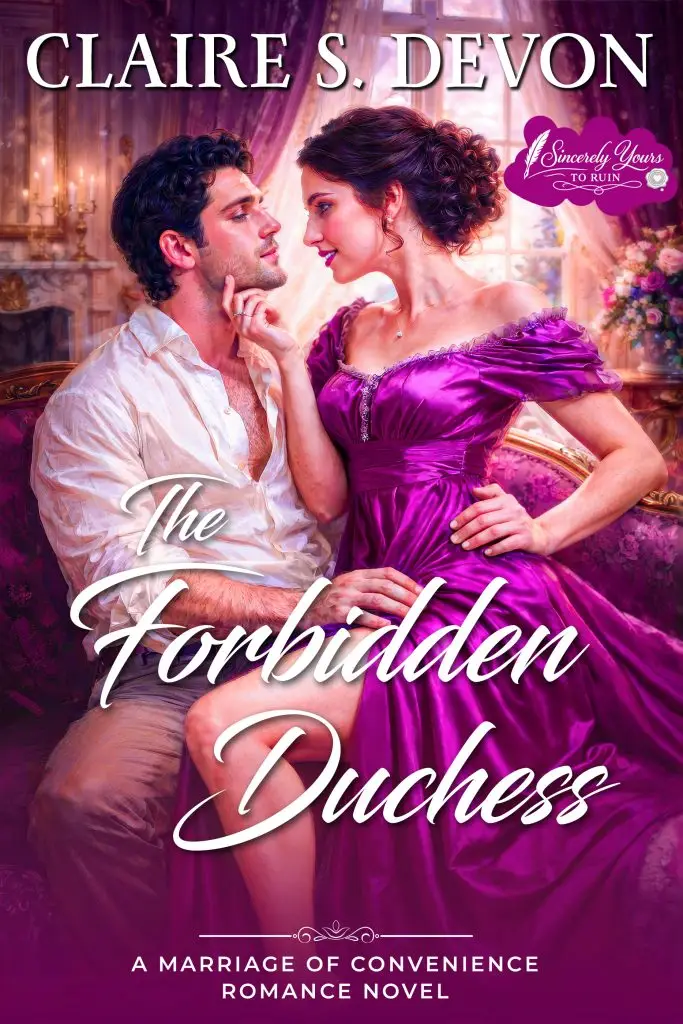
The Forbidden Duchess
“Don’t ask questions you don’t want the answers to, dear. We will not survive this charade of a marriage otherwise.”
Miss Amelia is sick and lonely. Plagued by an illness she cannot control, the only thing standing between her orphanage and ruin is a lie: that the Duke of Avon has promised his support. Desperate to make it real, she approaches a stranger and begs for his help…
Duke Nicholas of Avon wants nothing more than to disappear. Newly returned to Oxford and trailing scandal, the last thing he needs is an innocent woman pulling him into her scheme. Yet he makes a reckless promise: he will pretend to be the Duke of Avon…
Until one compromising moment traps them in marriage…
And as his past closes in and her illness threatens to steal her away, resisting what burns between them may be the one lie neither can keep…
Chapter One
1814
Oxfordshire
“You run a tight ship, Miss Tate. I see why the vicar dotes on you as he does. It’s not often one meets a young woman in possession of as much intellect as she has heart.”
Amelia forced a smile, wringing a rag between her hands as she watched the deliverer deposit his goods into the coal hole before them. The autumn months were quickly passing, and the orphanage would need sufficient fuel to ward off the oncoming winter chill.
At the thought of the coming cold, a brisk wind swept through the alley, rustling her hair in its combs.
“Mr. Hayes, you flatter me,” Amelia replied, observing the folded figure of the man before her. He grunted as he hauled another sack of coal down into the cellar. “But there is really no need for such kind praise. There are many who work here to ensure the well-being of these children. And many more who contribute in their small ways. Or shall we say nothing of your most generous rates? I know what you charge my uncle’s household. It is twice what you charge here.”
He paused, looking over his shoulder, his ears turning pink with more than the growing cold. “A generosity which remains between us?”
“Why, of course,” Amelia assured him. “I am nothing if not an excellent secret-keeper.”
To say nothing of the fact, she thought miserably, that I so often forget what is said to me the moment it reaches my ears.
Once Mr. Hayes had completed his task, Amelia walked him back to the coal wagon. He straightened his cap, smearing his forehead with soot. Amelia sighed through a smile, offering him her rag before he climbed back into the wagon.
“Now, now,” she chided playfully. “You must make yourself presentable for your wife. Which reminds me—pray, do thank Mrs. Hayes for the sweetmeats she dropped off last week. The children were besides themselves with joy for her gift. She must return as soon as she is able so they may extend their thanks to her in person. I have them preparing a play at present. Perhaps it would please her to partake in the rehearsals?”
Mr. Hayes nodded, returning Amelia’s rag with a sheepish smile. “Will we see you on Sunday morning?” he asked with a tired grunt, positioning himself onto the driver’s bench.
“Most certainly.” Amelia nodded. “I would not disappoint our dear vicar, who, according to you, thinks most highly of me.”
With another laugh, Amelia waved Mr. Hayes away, stepping back from the road before the orphanage, her boots clicking against the cobbles.
She watched the coal wagon drive out of sight, turning once it disappeared to admire the modest whitewashed building behind her. The painted sign above the door read St. George’s Home for Children in green letters, commissioned two years prior for the opening of the orphanage.
The sight of it warmed her with pride.
Indoors, Amelia hurried down into the kitchens, where Philippa was complaining loudly. She paused in the doorway to listen, not wanting to intrude while her friend aired her grievances.
“It’s not a silly idea at all,” Philippa was saying, viciously scrubbing a pewter bowl. Once it was clean, she thrust it toward the woman beside her to be dried, plunging her delicate hands back into the basin. “There are girls’ schools all over this county which operate in much the same manner.”
“I will not have this argument with you again, Miss Ashwood. We cannot feed the children out of a trough, no matter how much more convenient you believe it would be to clean,” said Mrs. Thatcher, shaking her head. “I would wager you have never set foot in a girls’ school besides, certainly no school for manners.”
Philippa stopped scrubbing, aghast. “I had a governess for that exact purpose actually, one of the finest in all the country, whom I shall not hear a bad word against. Not that I expect a woman of your caliber to behave accordingly, of course… Your husband is a pig farmer, is he not? His farm is on the Avon lands? A trough should be most easy to acquire, that being the case.”
A tense silence followed Philippa’s question, and Amelia stood on tenterhooks, ready to intervene. To her relief, both Philippa and Mrs. Thatcher burst out laughing, quickly resuming their work—and their bickering.
“If the children were to hear you…” Amelia said, making her presence known. The two women glanced at her and smiled as she entered and settled beside Mrs. Thatcher. “A foul impression you would leave on their impressionable young minds. For their sake and for your own, you should not be so mean to one another.”
“Spoilsport,” Philippa quipped with a grin, wiping an errant ringlet of blond hair out of her face with the back of her hand. “Trading jabs makes this job halfway tolerable.”
Mrs. Thatcher nodded, handing Amelia a bowl to put away. “How did you get on with Mr. Hayes?” she asked.
“Perfectly well,” Amelia replied. “I will send Mr. Marsh down to start the fires soon—assuming he can be woken from his post-prandial repose.”
Philippa paused her work and leaned over. “Trying to soften up old Robinson with a warm house? He is calling around today, is he not?”
A wave of fear passed through Amelia at the mention of the building’s landlord. She pressed her lips together, gingerly taking another bowl from Mrs. Thatcher.
“He is arriving sometime this afternoon,” Amelia admitted, diverting her eyes to the ground. “I tried to prepare a speech for him, hoping to convince him of the importance of the orphanage, that a month really is no time at all to wait for us to secure the funds for rent…”
“There is a heart of stone in that man’s breast, I swear it,” Mrs. Thatcher said, scowling in displeasure.
A stout woman with a ruddy face, she was a strange sight beside tall and fair Philippa, who looked down at her with amusement.
“Shall we cut him open and find out?” Philippa asked.
“No,” Amelia cut in, suppressing a smile so as not to encourage her friend. “No violence, and no japes, Philippa. Not where Mr. Robinson is concerned.”
“Your speech then…” Philippa waved a hand toward her, then sank it back beneath the soapy water to continue her task. “Let us see how convincing the daughter of Viscount Tate can be when it avails her to be charming.”
Amelia chewed on her lip, racking her mind for the words she had desperately tried to memorize that morning in the looking glass.
But the words would not manifest in her mind.
She felt a familiar panic rise within her, grasping at knowledge she knew existed somewhere within her but was just out of reach. Her eyes closed tight as she tried to summon the text she had rehearsed, her frustration mounting by the second.
“Miss Tate,” came the soft voice of Mrs. Thatcher, as she placed a hand over Amelia’s on the counter.
When Amelia looked down, her knuckles had turned white. She relaxed her hand immediately.
“Forgive me,” Amelia said, putting down the bowl and stepping back. “I should not over-rehearse, or my words will sound quite performative.”
She glanced at Philippa, hoping she had not noticed her lapse in memory. Her friend seemed chiefly concerned with finishing the washing up as quickly as possible.
“Excuse me. There is much to do before Mr. Robinson arrives,” Amelia said meekly, slipping her hand out from Mrs. Thatcher’s hold and quickly leaving the room.
I cannot allow my shortcomings to compromise the future of this orphanage, she thought as she mounted the stairs in search of Mr. Marsh, heart hammering in her chest. Mr. Robinson must be convinced to allow us to remain here a while more…
Mr. Robinson may have had a heart of stone, but at least he was punctual. Amelia had been watching the clock closely for his arrival. The moment it struck two o’clock, someone knocked on the front door. The children were reading with the other volunteers on the second floor—the house was mostly quiet.
As she raced into the entrance hall, she found Mr. Marsh climbing the stairs with a coal scuttle, a young girl, no older than four, shadowing him. Amelia waved them away with a pained look. There were only two sights Mr. Robinson would not brook: that of the working man and that of children.
“Miss Tate,” Mr. Robinson said upon entering. “I do not appreciate being left outside in the cold—especially not on the doorstep of a house I own.”
Amelia swallowed hard, closing the door behind him, and not daring to argue that he had knocked merely seconds before.
Mr. Robinson was a tall man with a protruding stomach, and he carried a steel-tipped cane wherever he went. It rapped against the floor as he marched into the entrance hall, turning in a circle to observe his surroundings.
“Certainly not, sir,” Amelia replied, folding her hands in front of her. “Allow me to apologize. May I offer you some tea?”
“I will not be remaining long enough for tea.”
“No.” Amelia winced. “Of course not.”
Without asking permission, Mr. Robinson promptly turned and proceeded into the nearest room. Amelia had barely reached him by the time he exited, continuing his immediate and silent tour of the house. He visited the downstairs playroom, the schoolroom, the dining hall, dodging Amelia’s weak attempts at trying to stop him.
“Are you looking for something, sir?” Amelia successfully asked at last, halting him as he reached the base of the stairs.
He sent her a cold look, and Amelia shrank into herself.
“The children are occupied upstairs,” she said timidly. “It pleasing you, I would not wish them… disturbed.”
Mr. Robinson extended his silence, broken eventually by a sigh. He stepped away from the stairs and folded his hands over the top of his cane.
“How many months have you rented number twelve from me?” he asked.
Amelia performed quick calculations in her mind, sensing this was a trick question. “Twenty-five, Mr. Robinson.”
“And in that time, have I not been a fair and tolerant proprietor? Have I not allowed you to run this enterprise as you saw fit, placing my trust in you, a child, a woman, despite my years of experience begging me to act otherwise?”
Amelia’s temper quickly rose. Upstairs, the floorboards groaned under the weight of small, happy footsteps. The muffled laugh of a child echoed down the stairs. She chewed on the insides of her mouth, focusing her attention on that gleeful sound, carefully constructing her reply.
“Yes,” she said. “You have been a fair and tolerant proprietor.”
Mr. Robinson tapped the ground with his cane. “A fair and tolerant proprietor, yes,” he continued. “Not a fool easily taken in. Miss Tate, I have waited two weeks for this quarter’s rent. I will not wait a day more. Do you have it? If you do not, I will proceed with my plan at once.”
“Which is?”
“To renovate this waifs’ hall immediately into apartments. The house seems to be in order. Building could begin at once. Oxford is an ever-expanding town, Miss Tate. I have a line of potential tenants waiting to move in once the renovations are complete. My Christian sense of charity alone stands between my penniless present with you and a profitable future.”
The words shot through Amelia like a bullet. Mr. Robinson wasted no time and left little room for negotiation, but Amelia had to try something to save the orphanage. These children, orphaned or awaiting the return of their parents from the workhouse or deployment, depended on the volunteers for their board and safety.
Her uncle Benjamin, though he was loyal and loving, did not have the means to help her again—and he did not believe Amelia should be managing an orphanage at all in what he liked to call her ‘delicate and weathervane state’.
She tried to recall the speech she had prepared in vain, cursing her affliction, then raised her eyes to meet the penetrating gaze of Mr. Robinson.
“Mr. Robinson,” she began with her most pleading, debasing look. “I understand very well your concerns. But I implore you to reconsider. As a businessman yourself, you must be aware of the recent increase in taxation—”
Amelia paused as a dark cloud passed over Mr. Robinson’s face.
“That is to say, we have not had sufficient time to seek out greater funding to accommodate the rising costs of running the orphanage. But our benefactors, though they may be small in number, are dependable and generous. If we could secure but one more charitable partner—”
“Ifs and buts.” Mr. Robinson shook his head. His cane knocked loudly against the floor like a death knell, dashing her hopes and dreams, and Amelia’s heart fell into her stomach in response. “I deal only in certitudes, Miss Tate. And what is certain, at present, is that you cannot afford number twelve.”
Amelia could not hide her indignation any longer. Her brow creased in anger as she recalled Philippa’s earlier suggestion of cutting open wide Mr. Robinson, imagining a rock-solid black heart falling out of his chest onto the carpet between them.
But there was something else she remembered along with that morbid image. The mention of the Avon lands on which Mrs. Thatcher and her husband lived.
What is it I have heard? she asked herself, rubbing her forehead. Come now, Amelia, think. Aunt Beatrice told me the news twice in the last week. News that is… That is…
Suddenly, her aunt’s words flooded into her mind, and Amelia beamed in relief. She took a decisive step forward.
“Sir, you did not allow me to finish. The Duke of Avon is recently returned to Oxfordshire,” she said, remembering how excited her aunt had been at the news. “St. George’s staff is to meet with him soon—later today, in fact.”
Amelia swallowed, not liking to lie but knowing it was necessary. For now, it seemed to have given Mr. Robinson pause, and she continued with her desperate, misguided plan.
“The Duke of Avon, in his letters, has expressed great interest in supporting the orphanage,” she lied, knowing there were no letters. The duke likely did not even know she existed. “It would not do to give you the exact number of what he has promised us… But rest assured, sir, that His Grace’s generosity would permit us to run the orphanage for many years to come.”
Mr. Robinson narrowed his eyes at her, but she could see the cogs turning in his mind. The man valued money above most things and had a long history of tyrannizing the gentry around Oxford…
But the aristocrats in the area refused to deal with him. If he could secure a connection with the Duke of Avon through St. George’s, it would be a risk worth its weight in gold.
Despite this, Mr. Robinson did not immediately agree. “The same Duke of Avon,” he inquired, “who has not visited his ducal seat in ten years? What interest does he have in you?”
Amelia recalled a few things about the duke, and from Mr. Robinson’s tone, his estimation seemed to align with her knowledge of the gentleman.
Nicholas Whitmore had inherited the duchy after his father’s demise the year prior. His father had been loved by all in Oxfordshire—had been a favorite of Queen Charlotte’s in London for his genteel manner. The same could not be said for his son, who, according to rumors, was a selfish and unpredictable rake whom many mothers hoped to reform.
Despite his shortcomings, there was no more eligible man in town, perhaps in all of England, owing to the power of his impressive, historic title.
“Yes,” Amelia said slowly, realizing how far-fetched her fabricated story now sounded. “I would not dare comment further on His Grace’s decision to meet with us, would not like to pry nor speculate on his motivations… But it seemed to me that he had a vested interest in leaving… a positive mark on the county.”
More lies. She was surprised by how easily they escaped her.
“If a man of the Duke of Avon’s station were to be a known associate of this modest orphanage…” She paused, giving Mr. Robinson enough time to imagine what this would mean for him. “Perhaps I should not have spoken out of turn. Forgive me, Mr. Robinson. You have been exceptionally generous in allowing me to speak. I shall say nothing more.”
For a moment that felt longer than it was, Mr. Robinson was silent. Amelia kept her eyes fixed on the floor, not daring to look up at him, partly out of shame.
Eventually, his cane clicked against the floor—softly this time.
“If the Duke of Avon seeks to support this house,” he replied, “then it would be a grave error in judgment to defy his wishes.”
Amelia almost cried out in relief, barely stopping herself from throwing her arms around the towering, sour-faced landlord in front of her.
“You say you are meeting with him today?” Mr. Robinson asked, already moving toward the door. Excitement glittered in his dark eyes. “Then I expect a call from you tomorrow with news of his decision.”
Amelia nodded emphatically, rushing to open the door for him.
“I will not tarry a moment longer than necessary,” she said, immune to the cold that swept indoors. Her nerves were on fire. She had succeeded in stalling another day! “Thank you, Mr. Robinson. I will ensure that this is not a decision you will come to regret.”
It was only once Mr. Robinson had departed—in a much better mood than he had arrived—that the reality of Amelia’s situation dawned on her.
The fire in her bones quickly extinguished itself. She sank against the now-closed door, staring absently into the empty hall before her.
She had never even met the Duke of Avon. Her brother, perhaps, would have been able to ask for a meeting with him. But Frederick was somewhere on the Continent, impossible to reach in time. How would Amelia alone secure an audience with the duke, let alone ask him for money?
Oh, Amelia, she thought, as Mr. Marsh appeared at the top of the stairs, the same little girl trailing behind him with her thumb in her mouth. What in heaven’s name have you done now?
Chapter Two
Oxfordshire
“Far be it from me to point out the obvious,” George drawled, rushing to keep up with Nicholas as they walked down Cornmarket Street. “But it would have been highly possible—and infinitely simpler—to remain in London and conduct operations from there.
“I have never known you to leave the big town for longer than a few weeks. Now you are telling me you wish to move here for six months? There is something queer afoot, old friend, only… I do not know what.”
Nicholas smiled, glancing down the street. Market stalls lined either side of the busy thoroughfare, merchants peddling all manner of goods and services. A bootblack called over to Nicholas and George as they passed, though he was quickly approached by another well-dressed man, perhaps a student.
Oxford was much smaller than London—too small to Nicholas’ taste, as he already missed the constant cultural amusements of home. But it was much more vibrant than he remembered from his childhood.
Perhaps it shall be no burden at all, Nicholas thought miserably, to settle myself here a while until the trouble has passed in London.
The specifics of that trouble, however, were not something Nicholas was ready to share with his friend. George had always been a good-natured fellow—too good-natured to understand the reason for Nicholas’ exile.
“Are you tiring of me already?” Nicholas deflected, slowing his pace as they retraced their steps to his carriage. “I thought you of all people would have been glad for my return. Or are you concerned that the mere presence of me here will sabotage your acquaintance with Miss Ashford? You spoke of little else over luncheon.”
“Her name is Miss Ashwood,” George corrected, his cheeks turning pink at the mention of the woman who had supposedly captured his heart. “And there is scarcely an acquaintance to sabotage for now. No, I fully intend to keep my business with you and my business with her quite separate…”
He paused a moment, adjusting his coat. “It was my mistake to mention her to you in the first place at the club. You have always been rotten when it comes to women. I say this, partly, with affection.”
“And partly with the utmost sincerity,” Nicholas surmised, not in the least bit offended. “That being the case, I shall not bother trying to change your view of things. The disappointment of learning that I have grown tired of that life may very well kill you.”
“Tired of that life?” George held Nicholas by the shoulder as they rounded the corner, arriving on a much quieter street. His long, serious face contorted in confusion. “Is that why you have come to Oxford? You cannot be seeking a wife!”
Nicholas laughed. “No, certainly not a wife.”
George looked confused, glancing over his shoulder before he leaned in conspiratorially. “Are you implying that you have changed your ways? Because what I have heard out of London recently—”
“Are rumors by which you should not abide,” Nicholas warned, scowling.
He looked toward his carriage, parked outside a row of white-washed houses, mind flashing with thoughts of his rakish past—and the unbridled flames of desire that burned in him still, despite his attempts to reform himself for his own sake.
“Suffice to say that I have grown weary of London and will welcome a reprieve from the society there,” Nicholas continued in a lie. “And let us not go over, again, the disarray in which I have found my father’s estate. Six months at least will be required to set things to order. The number of properties he left uninhabited boggles the mind…”
Nicholas was far from a shrewd businessman.
He enjoyed politics, attended sessions, and participated in debates, not only out of duty but because he was good at it and enjoyed putting lesser men in their places.
Business, however, had never appealed to him. His father had been traditional to a fault, looking down his nose at the new-money, industrious aristocrats who were quickly taking London by storm. And while Nicholas was very different from his father—not nearly as well-regarded among the ton—he agreed that there was nothing so crude as an obsession with coinage.
But his father had been perhaps too lax in the management of their large estate. The stewards had been ordered to leave the estate exactly as the late duke had found it, and there were Avon properties all over Oxfordshire lying abandoned, waiting to be renovated and sold.
The sooner I can sell off those unentailed properties, the sooner I can be rid of Oxford for good. Though it remains to be seen what will become of my life once I am free, and who will be waiting for me…
“You have gone quiet,” Nicholas heard George say beside him.
Nicholas looked up and blinked, laughing softly at the errant train of his thoughts.
“Forgive me,” he said, proceeding toward his carriage. “There is much to consider. For now, you must return home and begin devising a plan to ensnare your Miss Ashwood. And I must return to Riverside Court and meet with the land agents.”
Satisfied, George nodded and bid his friend farewell. Nicholas watched him disappear the way they had come, smiling to himself at their fortuitous reunion.
Upon entering the carriage, he waited a moment before setting off, collecting his thoughts. A copy of the deed to the Avon dower house in Kennington sat beside him on the bench. He had tasked his late father’s land agent with managing the finer points of the estate without his supervision.
But the dower house was another matter entirely—too important, too delicate, to be handled by the agent alone.
He thumbed the edge of the deed, the parchment sharp against his skin, his thoughts turning to the long-unoccupied house.
If my mother had not left, he thought sourly, would she have been living there now? Would Oxford have felt like a home to me rather than a place I refused to return for so long?
Suddenly, voices sounded from outside, so close that the people speaking must have been just outside his door.
Nicholas discreetly pushed the curtain aside, admitting a sliver of daylight into the carriage. Outside, he saw two bodies, their heads just outside his view. His driver, in his familiar, modest attire, was arguing with a well-dressed woman.
A crease formed in Nicholas’ brow as he tried to listen, their voices obscured. His curiosity got the better of him as their conversation escalated into an argument, and he cracked open his door, stepping outside.
“What the deuce is happening out here?” he asked, looking first at his nonplussed driver before addressing the woman before him.
His breath caught in his throat at the sight of her, before an amused smile played on his lips.
The circumstances being as they were, he had expected her to be some sort of old crone, arguing with Mr. Blaire about parking outside her house. But the woman before him was young, too fair for her own good, with hair the color of toffee and grey-blue eyes that flashed murder at poor Blaire.
A beauty spot decorated the soft skin beneath her right eye, and his gaze lingered there a moment as he recovered from his surprise.
He wondered what sound she’d make if he kissed it. If he bracketed that little waist with both hands and backed her against the nearest wall until she stopped spitting fury and started gasping his name instead.
It was the exact type of thought he had sworn not to entertain while in Oxford.
Despite this, he could not help but stare at her. Half with curiosity, half with desire.
She seemed more perturbed than he felt, looking up at him in shock. Her cheeks colored a familiar, satisfying shade of pink as Nicholas waited for an answer, and he felt a prickle of shame for having embarrassed such a delightful creature.
But only a prickle.
“Forgive me for the disturbance,” she began.
Her voice was pleasing, and the way she rounded her words made it clear she was well-bred. He gestured for her to continue, not giving any ground in this well-practiced dance between man and woman.
“I asked your driver to speak with the occupant of this vehicle, at which point he told me to…” She paused, frowning up at Mr. Blaire. “I shall not repeat what he told me to do now that I have your attention. I fear it would be adding insult to injury to hear a woman emulate such vulgar language.”
Nicholas suppressed a laugh, sending a damning look his driver’s way. Mr. Blaire looked apologetic but mostly annoyed. With a nod, Nicholas sent him back toward the front of the carriage, wanting to speak with the curious woman alone.
“I would like to apologize on behalf of my driver for exposing you to such uncouth behavior.” He saw the tension lift from her shoulders, and this pleased him. “But… I cannot excuse your behavior until I learn what caused you to accost my driver in the first place.”
The woman blinked up at him, unimpressed, perhaps, by his playful tone.
“I told you, sir. I had hoped to speak with you.” She looked past him at his carriage. “This is an impressive contraption.”
He smiled. “You are a vehicle-enthusiast, then? Most strange…”
“No, you misunderstand me,” she pressed. “The quality of the carriage led me to believe that the quality of its occupant must be… equally fine. By all appearances, you look a gentleman. I would like to introduce myself.” She gave a shallow curtsey. “My name is Miss Amelia Tate, and I volunteer at the establishment you see behind you.”
Nicholas nodded, though he was confused, staring up at the signage that read St. George’s Home for Children.
“Go on,” he murmured, crossing his arms.
“The orphanage survives on the generosity of this county’s charitable souls. Most among them are titled gentlemen who donate regularly to the—”
“So, it is a donation you are after.” He rolled his eyes, his impatience getting the better of him. And, he had to admit, he liked the way her face twitched angrily at the interruption.
“Not from you,” she protested, shaking her head. “There is a gentleman of the highest order in this area that I am hoping to ask for help. When I saw your carriage, it occurred to me that perhaps you knew him. Or that, if you did not know him, you may know someone who did and could secure an audience with him as soon as possible.” Miss Tate looked down at her shoes. “Perhaps it was a desperate, wicked thing to do. But I am a desperate woman.”
“Evidently,” he teased, cocking his head to the side. When Miss Tate did not smile back, Nicholas groaned. He was far from a philanthrope, but his family was sufficiently charitable and well-connected besides.
“And just who is this unfortunate man you seek?” he inquired.
Miss Tate sighed. “The Duke of Avon.”
At first, Nicholas thought he had misheard. An auditory fabrication of his narcissistic mind. He leaned forward slightly, his lips parted in surprise. “The Duke of Avon?” he repeated slowly.
“Yes, sir. Do you know him?”
“Oh… somewhat,” Nicholas said under his breath.
He observed Miss Tate a moment, noting the excited spark in her eyes, wondering whether they had met before in London. He recalled vaguely that there was, or had been, a Viscount Tate native to Oxfordshire.
Beyond that, he knew nothing else of the family. Certainly not about a pretty, young heiress. There was no telling that this woman was even who she claimed to be—she could have been, for all he knew, a charlatan lingering outside this orphanage soliciting donations that would go nowhere but her pocket.
No. Everything considered, he could not risk admitting that he was, in fact, the recently returned duke that she sought…
Even though a part of him—a reckless, foolish part of him—was inclined to give this beautiful woman anything she desired from him and more…
“It would be unwise,” he interrupted himself, thinking, “for me to introduce you to His Grace without preamble.”
Miss Tate’s face fell immediately, and a knot formed in Nicholas’ stomach.
“These are delicate matters?” he asked.
“Yes…” she agreed, crestfallen.
“And were you seeking a great donation from him?”
“In all honesty, his collaboration was far more important than any sort of financial donation.”
She glanced back toward the house behind her, and sadness swept over her features.
“I suppose there is no harm in telling you what may come to pass. The man who owns this building is a miserly demon who would see all the children expelled into the cold if we cannot immediately deliver this month’s increased rent. It is my hope—my belief—that the Duke of Avon’s support of this orphanage, that his acknowledgement of the landlord, would be enough to make Mr. Robinson—the landlord—reconsider his stance.”
A confusing tale… but not an implausible one.
“What you need, then,” Nicholas began, unsure why he felt compelled to entertain this woman, “is for this… man, the Duke of Avon, to meet with your landlord post-haste?”
Miss Tate turned to face him, nodding demurely.
An idea formed suddenly in Nicholas’ mind before he could stop it.
A wicked, desperate idea.
“But, as we have deduced, that would be an impossible task at such short notice…” he continued slowly, “so, a man to play the part of the Duke of Avon then. That would satisfy your Mr. Robinson for a time, would it not?”
It was difficult to judge a person’s character from a three-minute conversation, but Nicholas was almost certain the woman before him would object. Either because she was not really who she said she was, or because she had too good a heart to go along with such a ridiculous plan.
He was surprised, then, when her pretty face brightened with a smile.
“You cannot be serious, sir!” she whispered, glancing nervously at the driver, as though concerned he had overheard.
Nicholas smiled. “It was only a suggestion. But what do you think?”
“I think…” Here, she did indeed take a moment to think, biting her lower lip in a maddening way. “I think such a charade would forestall Mr. Robinson for a moment. But perhaps not long enough for me to meet the real Duke of Avon, who may very well turn me away. And what if Mr. Robinson were to meet with His Grace through his own means and discover my deception?”
“Do you sincerely think that is likely to pass?” Nicholas asked, cocking his head to the side. “You described the man as a miserly demon. What I know of the Duke of Avon suggests he would never grant Mr. Robinson the time of day—certainly not if I put my own word in.”
His plot was thickening by the second. Nicholas was no stranger to a prank, a lie. But if he agreed to play the part of the Duke of Avon, the woman would surely discover the truth one day.
Perhaps it did not matter, he reasoned, so long as they could trick her cruel landlord for a time, and he could have some of that sought-after country entertainment.
“Would you also put a word in about a donation?” Miss Tate asked, looking up at him prettily.
Nicholas laughed.
“Now you are asking too much,” he warned in good humor. Of course, he could afford a donation. But what reason did he have for supporting this woman’s orphanage? “Let us begin by getting this letter off your back, then we may discuss what else my friend… the duke, can provide for you.”
Miss Tate nodded, with less enthusiasm than he expected. “But will your friend not be quite cross with you for pretending to be him? What assurance do I have that you know His Grace at all? I do not even know your name.”
She was a picky charlatan, certainly. But Nicholas could see how much fun this might be and decided to reassure her.
“My name is… Mr. Moore,” he said, coming up with a story. “I am a gentleman recently returned to this area who has known Nicholas Whitmore since our days at the university of this town. Even if you do not believe me, you need only a man fitting the part of the elusive Nicholas Whitmore to charm your landlord. Do you not believe me to be as handsome and charming as they claim the Duke of Avon to be?”
Raising her brows, the young woman looked him up and down. He tingled a little under her scrutinizing gaze, extending his arms to provide her a good look at him and his attire.
“Perhaps not quite as handsome nor charming,” she said teasingly. “But I will work with what I’m given.”
Chapter Three
“When I saw your carriage yesterday, I wondered whether you had been sent to me by the Lord himself,” Amelia whispered, leading Mr. Moore up the steps to the orphanage the following morning.
“A touching, if blasphemous, hypothesis,” Mr. Moore replied behind her, casting his eyes to the autumnal, heavily overcast sky above them. “Unfortunately, I merely parked there as it was closest to the club where I took my luncheon. Has Cornmarket always been so busy?”
Amelia glanced over her shoulder at him, smiling. She found herself smiling often around the curious man. “As long as I have lived here, yes.”
“And how long has that been, exactly?”
“In Oxford proper? Three years, thereabout.”
Amelia paused at the top of the steps, and the gentleman came to an abrupt halt behind her. She looked down at him, observing him, impressed by her ability to have remembered all the finer details about him from yesterday.
Am I truly surprised? I cannot recall having ever met a gentleman so handsome in my life. Those warm brown eyes, the richness of his hair… He haunted my dreams, which were far from unpleasant—far from ladylike too…
She cleared her throat, a flush creeping to her cheeks. “Did you manage to speak with His Grace yestereve, as you intended?”
Mr. Moore—damningly dashing Mr. Moore, with his soft hair and aquiline nose—returned her look defiantly.
“I am a man of my word, Miss Tate. I wrote to the duke soon after. He was positively tickled by the idea that I should play the part of him today. He might have come himself, if he had not been otherwise engaged elsewhere in the country…”
Amelia did not know whether to believe him. This man could have been lying through his teeth for all she knew.
She had asked her aunt and uncle over dinner the night prior whether they had heard of a Mr. Moore recently returned to town. Her aunt Beatrice kept abreast of all the social news in the county but had heard nothing of the sort.
What does it matter who he is, or how he makes me feel just being near him? Amelia thought to herself, turning to open the door. All I need is for him to convince Mr. Robinson that he is the Duke of Avon. After that point, I may try to contact the real Duke personally, with or without Mr. Moore’s help.
Stepping aside to admit Mr. Moore indoors, Amelia watched his face darken slightly at the interior of the orphanage. So confident before, he took a few hesitant steps inside before stopping.
“Something the matter?” Amelia asked, closing the door behind her.
Mr. Moore looked around, pursing his lips. “How did you say this place was financed? When did you establish this house?” he asked.
“Two years ago,” Amelia explained. “My uncle previously sat on the board of the hospital here in Oxford, where he learned that they were struggling to house the sick children who came in for treatment.”
“That does not explain how you came to be here.”
“Well, he knew I desired a pastime of substance and suggested that together we could establish a home for them. He has since stepped back from the management of the orphanage—he is much too busy with other matters.” Amelia looked around the entrance hall proudly. “I have taken up much of the housekeeping in his stead, but I would be utterly lost without the help of the other volunteers.”
On cue, Mr. Marsh and Mrs. Thatcher entered with a great gaggle of children. Mrs. Thatcher leaned down to wipe the mouth of the child closest to her. Evidently, they had just had their breakfast and were moving across the house toward the schoolroom.
“Speaking of the other volunteers,” Amelia said, gesturing toward the quickly approaching group. “Allow me to introduce Mr. Marsh and Mrs. Thatcher. Perhaps you have met Mr. Marsh? He formerly performed administrative duties at Oxford.”
Mr. Marsh reached across the group of small children to shake Mr. Moore’s hand. Meantime, Mrs. Thatcher smiled politely before excusing herself and the children.
The same blonde-haired child who always followed Mr. Marsh hid behind his legs as Amelia presented Mr. Moore to them, the room considerably quieter now that Mrs. Thatcher and the others had taken their leave.
“This is…” She couldn’t countenance lying directly to Mr. Marsh, but accepted it as a necessary evil. “Well, this is Mr. Moore. He has come today to help us negotiate with Mr. Robinson.”
“A pleasure to make your acquaintance, good sir! “Mr. Marsh guffawed. “If you are here to help Miss Tate, then you have my sincerest thanks.”
Mr. Moore was unusually tense beside Amelia. When she looked over at him, it seemed to wake him from his daze. He nodded at Mr. Marsh, and with nothing more to say between them, Mr. Marsh left, scooping up the child.
Once they were alone again, Amelia turned to Mr. Moore.
“Really, is something the matter?” she asked. “You have seemed out of sorts since you set foot indoors.”
After a moment, Mr. Moore dared to meet her gaze again. “I do not fare well with… children.”
Amelia arched a brow.
“By that, I mean… I should like to avoid them for the duration of my visit.”
It was a strange request, given the location, but Amelia agreed. He was not the first gentleman she had met who disliked the company of children. Perhaps he worried they would ruin his nice clothes.
The thought reminded her to take the man’s coat, and she stepped around him to begin divesting him of it.
Mr. Moore, seemingly accustomed to such doting treatment, began shrugging out of the fine, dark garment with practiced ease. Despite herself, Amelia felt a chill run down her spine as her fingers grazed his shoulders accidentally, surprised by the warmth of his body now that they were within touching distance.
She had not been oblivious to his good looks and tall stature, but standing so close to him was another matter entirely. The air around him smelled pleasant, like soap and smoke, and she imagined pressing her body against his, nuzzling in close.
Taking his coat clumsily, she shook her head to rid it of her distracting thoughts. This man was here to help her, not be admired.
Once Mr. Moore’s coat had been stored somewhere safe, Amelia led him into the only withdrawing room that had escaped being repurposed for the children. She moved quickly to the fire to begin lighting the wall sconces, pausing a second when she heard Mr. Moore close the door behind them softly.
Locked away with him, Amelia’s heart fluttered. She extinguished the lighting taper with a gust of breath, throwing it behind the grate into the flames, conscious of Mr. Moore’s eyes on her.
“I would offer you tea,” Amelia murmured, stumbling over her words as she looked over at him and found him lingering by the door. He had quickly directed his eyes elsewhere, taking the measure of the modest room. “But I fear we should wait for Mr. Robinson, or else the pot will grow cold by the time he arrives.
He shrugged nonchalantly, moving toward the paintings on the far side of the room. The grey light from the windows fell lovingly on his form as he scrunched his face, examining the artist’s signature.
“They are not worth anything. I would have sold them otherwise to cover the rent,” Amelia said to fill the silence, moving a few steps closer. “Are you fond of art?”
“Tremendously,” he replied, quietly but sincerely. “And these pieces might not hold much pecuniary value, but that does not mean they are worth nothing.” He stepped away, held his hands behind his back, and smiled at her. “You said your surname was Tate? The artist was called Tate, also.”
“Felicia Tate, yes.” Amelia looked past him at the painting—a pastoral landscape, rolling fields of green and gold that matched the brown wallpaper of the room.
“A relative, then?”
“Yes, she was…” She scowled, suddenly failing to remember how the woman had been connected to her father. A great-aunt? A great-great-aunt? She swallowed, saying, “A decent painter indeed.”
Mr. Moore appeared satisfied with her answer—or at the very least, was not suspicious that something was amiss with Amelia’s mind.
“Do you know, Miss Tate… I had my suspicions about you yesterday. I wondered whether you were truly the daughter of Viscount Tate. But he is—forgive me, was—your progenitor, was he not? Your family owns Bright Corner in Abingdon-on-Thames.”
Amelia must have looked surprised, because Mr. Moore laughed, “Yes, I asked around about you. Does that offend you?”
To be on the receiving end of a handsome gentleman’s curiosity hardly constituted an offence, but Amelia knew better than to let him know that. She daydreamed only quickly about Mr. Moore asking his high-ranking friends about her.
Fear curled suddenly in her stomach as she wondered what else he had learned beyond the name of her family’s home. There were rumors abound about Amelia’s late mother and father…
If Mr. Moore had learned the truth about her family’s history, he gave no sign of it, turning instead back to the paintings.
“No. I would think you were strange if you did not ask questions about a woman you have never met. Myself… Yes, I have doubts about you, too,” she confessed. “I wondered this morning, for fact, whether it would not be wise to perform a test of your manners—to see if you act as gentlemanly as will be required to dupe Mr. Robinson into thinking you are truly the Duke of Avon.”
“You could try… he purred, coming closer to her, where his voice dropped low in a way it had not before, making her tingle. “But I would surely fail, owing in no part to my deception. I am a gentleman in my breeding, absolutely. But my manners have always been… questionable.”
A more level-headed woman, one who possessed an unfragmented mind, might have been concerned by his teasing tone. Amelia found herself smiling and blushing, confused but amused by his answer. His grin certainly seemed rakish, his warm brown eyes glowing with mischief. The door was closed. But she did not fear Mr. Moore’s banter, his daring manner.
Instead, she liked it more than she cared to admit.
“Who are you?” she asked, more curious than she should have been—and less concerned for propriety too. She was a single woman, and as far as she knew, so was Mr. Moore. “I know your name. But your profession, if you have one… Your origins… What are they?”
He was quiet for a moment, then he said, “I am a gentleman born in Oxford, but have lived in London for many years. I own properties here and there… I am an art collector, a frequent theatergoer, a literary, when it pleases me.”
“But only when it pleases you?”
“Quite. What else…?” He tapped his finger against his mouth, toying with her. “I have a soot-colored terrier named Bosun, a brother, have never married, and I’m born in March. Is that sufficient, Miss Tate, or shall I bore you with a lengthier list of anecdotal information about me? Believe me, I would do so gladly. There is nothing I love so much as speaking about myself.”
“No wife?” she asked, not knowing what had prompted her to ask such a daring question. Her cheeks colored. “I only meant… You had not mentioned whether you are married in that long list…”
He took a step closer, then turned his hand to show her a bare ring finger. “No wife,” he repeated. “Does that make you wary, Miss Tate?”
Amelia was unconvinced on that point.
He liked to play the part of a self-absorbed rake—that much was evident in the way he swayed on his feet, teasing her, making her tingle—but a man who truly valued himself highest of all would never have agreed to help her.
“So long as you can charm Mr. Robinson…” she rasped once she found her voice. “I have no reason to be wary.”
He arched a brow. “Do you doubt it? Do you doubt I will charm him?”
“No… To my eyes, you seem charming to a fault.”
He threw his head back with a laugh, and Amelia understood at once that he thought she was joking.
“Not a good-mannered fellow, nor a convincing actor, it would seem. How it wounds me, Miss Tate, that you are one of the scarce few women immune to my charms. A pitiable state of affairs,” he said, clicking his tongue against his palate, landing in one of the empty chairs by the hearth. “You should have recruited another man.”
“I think you will do just fine for my purposes, Mr. Moore.”
He grinned, and there was something dark in it he was trying to conceal. Something dark responded within her as he murmured, “And I think you will do just fine for mine.”
Amelia froze at his words, narrowing her eyes at him.
“By that, of course I mean,” he began, drawling every word, before leaning over to pat the armchair beside him, “entertaining me by telling me a little about yourself! before your miserly demon arrives, and like two ships in the night, we sail past one another toward different horizons…”